
Polymer Review, Pricing & Alternatives (2026)
AI-driven dashboards and embedded analytics for teams and products
Last updated: October 26, 2026
What is Polymer?
Polymer is an AI-driven dashboard and embedded analytics product for marketing, sales, ecommerce, and product teams. It connects spreadsheets, databases, and marketing sources, then builds visualizations and supports embedded reporting. The visible pricing page starts at $20 per individual license monthly, while the homepage advertises API access from $500 per month.
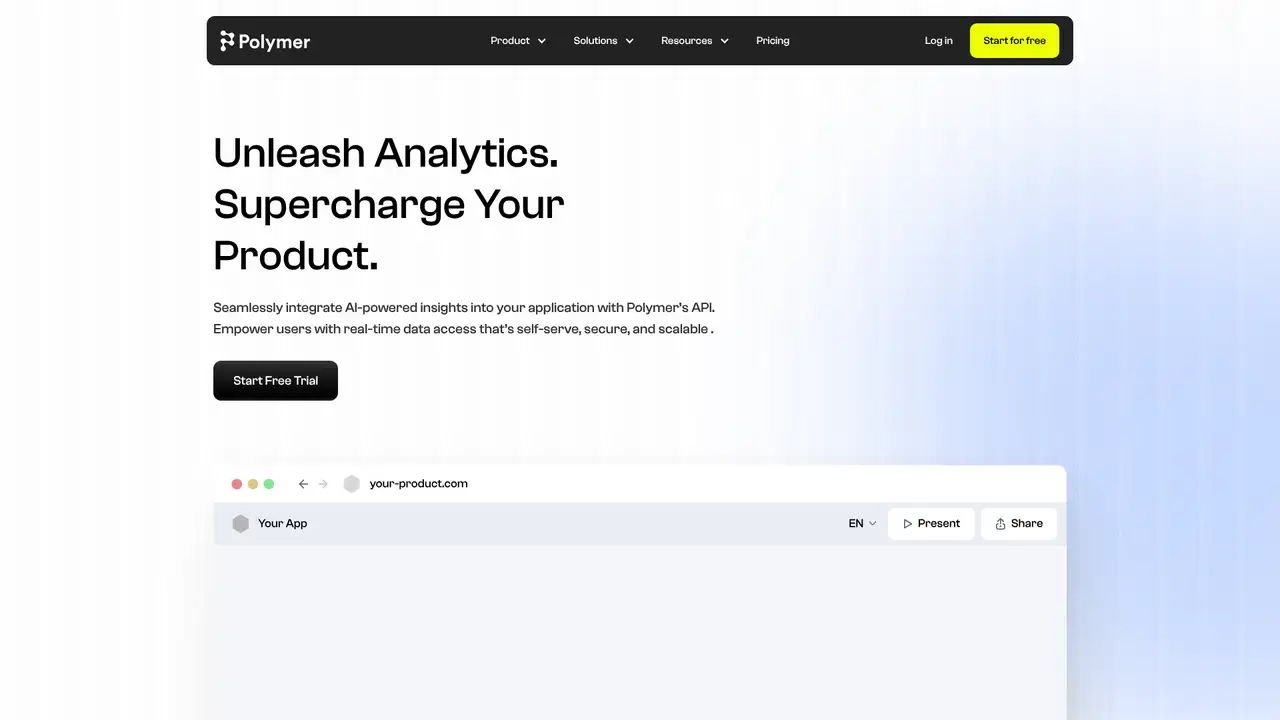
Polymer is an AI-driven embedded analytics and dashboard product made by Polymer Search Inc. Its stated audiences include marketing, sales, ecommerce, and other teams that need dashboards without building a complete business intelligence system. The About page names Ash Gupta and Yasser Ansari as co-founders, and identifies Gupta as a former machine learning leader for Google AdWords. CB Insights reports that Polymer was founded in 2019 and raised an estimated $6.4 million over five rounds, including a February 2024 seed VC-II round. The funding figure comes from CB Insights rather than a company disclosure. Polymer also presents its product as suitable for developers embedding analytics inside applications, alongside direct dashboard use.
Polymer’s workflow begins with connecting spreadsheets, databases, marketing sources, or other supported data systems. The company says its AI dashboard workflow can import data in under 30 seconds, then generate dashboards and visualizations. Users can review insight explanations and interact with PolyAI chat, while teams can build reports from templates. The product supports interactive embedded dashboards for customer-facing applications, with branding controls described for fonts, colors, and logos. Its homepage also describes automated user permissions through the API and a self-serve analytics playground. The AI dashboard page says accounts are unlimited and scheduled updates can run hourly. These capabilities position Polymer between a dashboard builder for internal teams and an embedded reporting layer for software products.
Polymer’s documented API uses API keys supplied through the X-API-KEY header or a query parameter, with an optional workspace-id parameter. The API documentation describes authenticated endpoints and synchronization operations, and sets a limit of 100 requests per hour per key. Requests beyond that limit return HTTP 429. Polymer says uploaded data is confidential and encrypted in transit and at rest with AES-256. Its data-handling page says data generally remains inside the service environment except in limited support circumstances. No official 2025 or 2026 product-release post is identified here. The newest official release material listed is a June 18, 2024 presentation-mode announcement, alongside June and July 2023 announcements concerning PolyAI and embedding.
The visible pricing section lists Starter at $20 per individual license monthly, with manual syncing, one workspace, unlimited connectors, visualizations, and templates. A $40 monthly individual-license tier adds hourly syncing, custom branding, custom metrics and calculations, and unlimited embeds. Custom pricing adds real-time syncing, multiple workspaces, customizable embeds, API access, and dedicated support. The page displays $10 and $20 individual-license prices when billed yearly and labels them as 50 percent savings. Its billing help page retains older Free, Data Plus, Data Pro, and Premier terminology, including row limits of under 5,000, up to 50,000, and up to 500,000 rows. The homepage separately advertises API access from $500 monthly, so API pricing is best treated as custom.
Polymer’s practical strengths are fast dashboard creation without SQL, embedded analytics, and connectors for marketing, ecommerce, and web analytics data. Its pricing page is difficult to interpret because duplicated blocks show older $50, $100, $125, and $250 combinations, while the billing page uses a different plan vocabulary and row limits. The documented API limit is also relevant to teams expecting high request volume. Looker and Sigma are stronger choices for governed enterprise semantic modeling and warehouse-native workflows. Tableau and Power BI offer broader, more mature BI platforms and visualization administration. Metabase and Explo are additional direct alternatives. Choose Polymer for fast, branded dashboards and embedded reporting when its current plan details fit your requirements.
Who is Polymer best for?
- Marketing and ecommerce teams building dashboards without SQL.
- Software companies embedding branded analytics into products.
- Teams needing connectors, templates, and scheduled data updates.
- Organizations testing AI-assisted dashboard creation.
Polymer Pricing (2026)
Pricing model: Paid. All prices in USD.
| Plan | Price | What you get |
|---|---|---|
| Starter | $20/month or $10/month billed yearly | One workspace, manual syncing, unlimited connectors, visualizations, and templates. |
| Pro | $40/month or $20/month billed yearly | One workspace, hourly syncing, custom branding, custom metrics and calculations, and unlimited embeds. |
| Custom | Custom | Real-time syncing, multiple workspaces, customizable embeds, API access, and dedicated support. |
Pros and Cons
Pros
- Polymer can generate dashboards from connected data sources.
- The product supports branded, interactive embedded analytics.
- The API documents authentication and synchronization operations.
- The visible Starter plan includes unlimited connectors and visualizations.
Cons
- Polymer’s pricing page contains conflicting duplicated plan blocks.
- The billing page retains older plan names and row limits.
- Each API key is limited to 100 requests per hour.
Who should look elsewhere?
- Organizations requiring a clearly documented current free plan.
- Enterprise teams centered on governed semantic warehouse models.
- High-volume API workloads constrained by per-key rate limits.
Technical Details
Frequently Asked Questions
How much does Polymer cost?
Polymer’s visible pricing page lists Starter at $20 per individual license each month, or $10 per month when billed yearly. A $40 monthly tier, or $20 billed yearly, adds hourly syncing, branding, custom metrics, and unlimited embeds. Custom pricing covers real-time syncing, multiple workspaces, customizable embeds, API access, and dedicated support.
Does Polymer have a free plan?
Polymer’s billing help page uses a Free label for accounts under 5,000 rows and says that tier has no charts. The visible pricing section instead presents Starter as the lowest priced plan at $20 monthly. Because those pages use different plan systems, customers should confirm current free-plan availability and inclusions directly through Polymer’s pricing flow.
What is Polymer’s closest competitor?
Sigma is a close alternative for teams seeking interactive analytics connected to warehouse data, while Looker is stronger for governed enterprise semantic modeling. Polymer differs through its emphasis on rapid dashboard creation, marketing and ecommerce connectors, AI-assisted visualizations, and embedded branded reporting. The better choice depends on whether fast setup or centralized analytical governance matters more.
Does Polymer train AI models on customer data?
Polymer says uploaded data is confidential and encrypted in transit and at rest with AES-256. Its data-handling page says data generally remains inside the service environment except for limited support circumstances. The listed privacy policy is dated April 19, 2023, and the cited materials do not state that customer data is used to train general-purpose AI models.
Can companies use Polymer commercially?
Polymer is designed for commercial team dashboards and for embedding analytics inside customer-facing applications. The company describes branded embeds, API access, user permissions, and product integrations. The visible pricing page includes commercial-oriented Custom features such as customizable embeds and dedicated support. Licensing terms beyond the listed plans are not detailed here, so commercial customers should review the applicable agreement.
Best Polymer Alternatives in 2026
These tools do the same job as Polymer, with different pricing, limits and trade-offs.

Cloud BI with spreadsheet analysis, warehouse writeback, and data apps

Governed business intelligence built around a shared semantic model

AI assistance for governed dashboards, metrics, and data preparation

Natural language assistance for governed Power BI analysis