
Picovoice Review, Pricing & Alternatives (2026)
Private voice interfaces for phones, browsers, and embedded devices
Last updated: October 26, 2026
What is Picovoice?
Picovoice provides on-device voice SDKs for wake words, speech recognition, speaker functions, noise suppression, intent detection, and text-to-speech. It targets developers building mobile, browser, hardware, and embedded products. Personal non-commercial use is free, while eligible startups can buy Foundation for $6,000 annually. Local processing supports offline operation, but licensing, quotas, and AccessKey validation still apply.
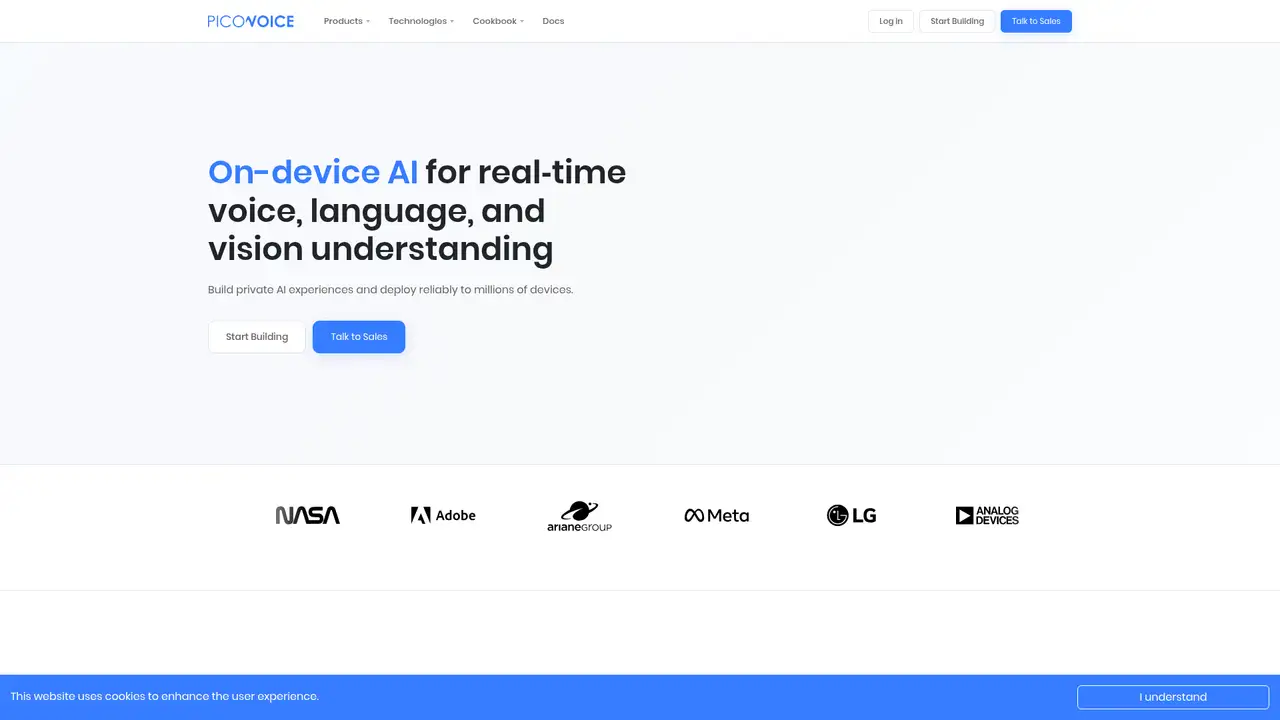
Picovoice is a Vancouver voice AI company founded in 2018 by Alireza Kenarsari-Anhari. GeekWire reported a $500,000 investment from Founders’ Co-op in 2020 and said developers at Whirlpool, LG, and Telenav used its technology. The company offers software development kits, models, and a Console for voice features in mobile, browser, consumer electronics, industrial, and embedded products. Its engines process audio on the device rather than requiring a cloud speech-recognition round trip. Picovoice also describes offline processing and predictable device-side costs. Commercial access uses annual plans, while a separate free plan covers personal, non-commercial work. This makes the platform relevant when an application needs local voice handling and its development team can work within annual licensing terms.
Picovoice’s product family covers separate stages of a voice workflow. Porcupine detects custom wake words, Cobra detects voice activity, Cheetah performs streaming speech-to-text, Leopard transcribes speech, Rhino maps speech to intents, Falcon performs speaker diarization, Eagle recognizes speakers, Koala suppresses noise, and Orca provides streaming text-to-speech. Developers can use the Picovoice Console to design, train, and test on-device models. Listed SDK support includes Android, iOS, web, Linux, macOS, Windows, Raspberry Pi, and microcontrollers. A typical application can detect a wake word, handle audio, transcribe speech, map it to an intent, and produce spoken output locally. Teams can therefore assemble a voice pipeline from focused engines rather than treating speech recognition as the entire product.
Picovoice’s engines are proprietary on-device models, while its public GitHub repositories contain SDKs, wrappers, demos, and related tooling rather than a fully open model stack. The privacy policy dated March 18, 2026 says processing happens locally and that Picovoice cannot access end-user data for model training. In 2025, Cheetah added French, German, Italian, Portuguese, and Spanish. Picovoice also reported seven new Orca languages and Cobra VAD v2.1, which improved accuracy in noisy environments, and expanded.NET support for Cobra and Orca. Its 2025 review reports 2.5 times developer-user growth and five times revenue growth. Picovoice said every engine would move to a new architecture during the first half of 2026, potentially affecting future integration planning.
Picovoice’s Free plan costs $0 per year and is strictly non-commercial, with usage limits listed on the pricing page. The commercial Foundation plan costs $6,000 per year for eligible startups incorporated within five years, with no more than 20 employees and less than $50 million in funding. Published Foundation allowances include 25,000 monthly minutes for Cheetah, Leopard, and Falcon; 10,000 minutes for Eagle and Koala; and 100 minutes for Porcupine, Rhino, and Cobra. The pricing page lists Enterprise at $30,000 per year, while the Foundation checkout lists 25,000 Cheetah minutes and 10,000 Eagle minutes. AccessKey requires internet connectivity to validate plan limits, although runtime processing remains local. These conditions require quota and connectivity planning.
Picovoice’s commercial plans are annual, and its proprietary licensing restricts modifying, sublicensing, and using the software to train other machine-learning models without written consent. Its terms also restrict certain safety-critical uses unless Picovoice authorizes them. Sensory is another embedded voice technology vendor. Mycroft’s 2025 material appears among Picovoice’s local text-to-speech alternatives, while OpenAI’s Whisper is a separate open-source speech-recognition model rather than a complete wake-word, intent, diarization, and synthesis suite. Picovoice is a poor fit for teams seeking an open model stack or a conventional hosted pay-per-minute transcription API. Pick Picovoice for commercial products needing branded, offline voice features and annual licensing.
Who is Picovoice best for?
- Teams shipping offline voice features in hardware.
- Mobile developers needing local speech processing.
- Products requiring custom wake words.
- Organizations limiting runtime audio transmission.
Picovoice Pricing (2026)
Pricing model: Freemium. All prices in USD.
| Plan | Price | What you get |
|---|---|---|
| Free | $0/year | Strictly non-commercial. Usage limits apply by engine. |
| Foundation | $6,000/year | For eligible startups. Includes 25,000 monthly minutes for Cheetah, Leopard, and Falcon, plus other engine quotas. |
| Enterprise | Starting at $30,000/year | Commercial plan with custom terms. Picovoice says Enterprise can adjust Foundation terms for support or development needs. |
Pros and Cons
Pros
- Runtime processing happens locally on the device.
- Supports wake words, intents, speech, and TTS.
- Runs across mobile, desktop, web, and embedded targets.
- Supports offline processing after licensing validation.
Cons
- Commercial licensing starts at $6,000 annually.
- Core engines and models are proprietary.
- AccessKey validation requires internet connectivity.
Who should look elsewhere?
- Developers wanting a hosted pay-per-minute API.
- Hobbyists needing commercial rights at no cost.
- Teams requiring open model weights.
Technical Details
Frequently Asked Questions
How much does Picovoice cost?
Picovoice’s Free plan costs $0 per year and is strictly non-commercial. Foundation costs $6,000 per year for eligible startups. Enterprise starts at $30,000 per year. These are annual prices, not monthly subscriptions or per-minute cloud rates. Usage quotas vary by engine, and Enterprise can use customized terms.
Is Picovoice free for commercial use?
No. The Free plan is for personal, non-commercial projects, including learning, hobby development, and some non-commercial open-source work. Commercial evaluations, development, testing, and production require a commercial plan. Foundation is available to eligible new startups, while Enterprise is intended for customers needing adjusted terms or additional support.
How does Picovoice compare with OpenAI Whisper?
Picovoice provides commercial SDKs and proprietary on-device engines for wake words, intents, diarization, speaker recognition, noise suppression, speech recognition, and synthesis. Whisper is an open-source speech-recognition model that developers can run or modify. Picovoice fits packaged offline voice interfaces, while Whisper fits teams prioritizing control of a speech-recognition model.
Does Picovoice send voice data to the cloud or train on it?
Picovoice says AI processing happens locally and that it cannot access, collect, or use end-user data to train or improve its models. Custom development is an exception when a customer explicitly provides data under a separate written agreement. Console accounts and AccessKey validation can involve service data, and customers remain responsible for end-user privacy obligations.
Can I use Picovoice commercially?
Yes, commercial use is available through Foundation or Enterprise under Picovoice’s terms. The Free plan does not include commercial rights. The terms grant a limited license and restrict sublicensing, modification, model training, and certain safety-critical applications. Commercial customers should review distribution, usage limits, data responsibilities, and any additional agreement before deployment.
Best Picovoice Alternatives in 2026
These tools do the same job as Picovoice, with different pricing, limits and trade-offs.