OpenAI Whisper Review, Pricing & Alternatives (2026)
Open source speech recognition for local machines and API workflows
Last updated: October 26, 2026
What is OpenAI Whisper?
OpenAI Whisper is an open source speech recognition model for developers, researchers, and teams needing local transcription, translation, or language identification. Its code and weights are MIT licensed. Local use has no software fee, while the deprecated hosted whisper-1 API costs $0.006 per minute. Users provide computing resources and manage deployment, storage, and support.
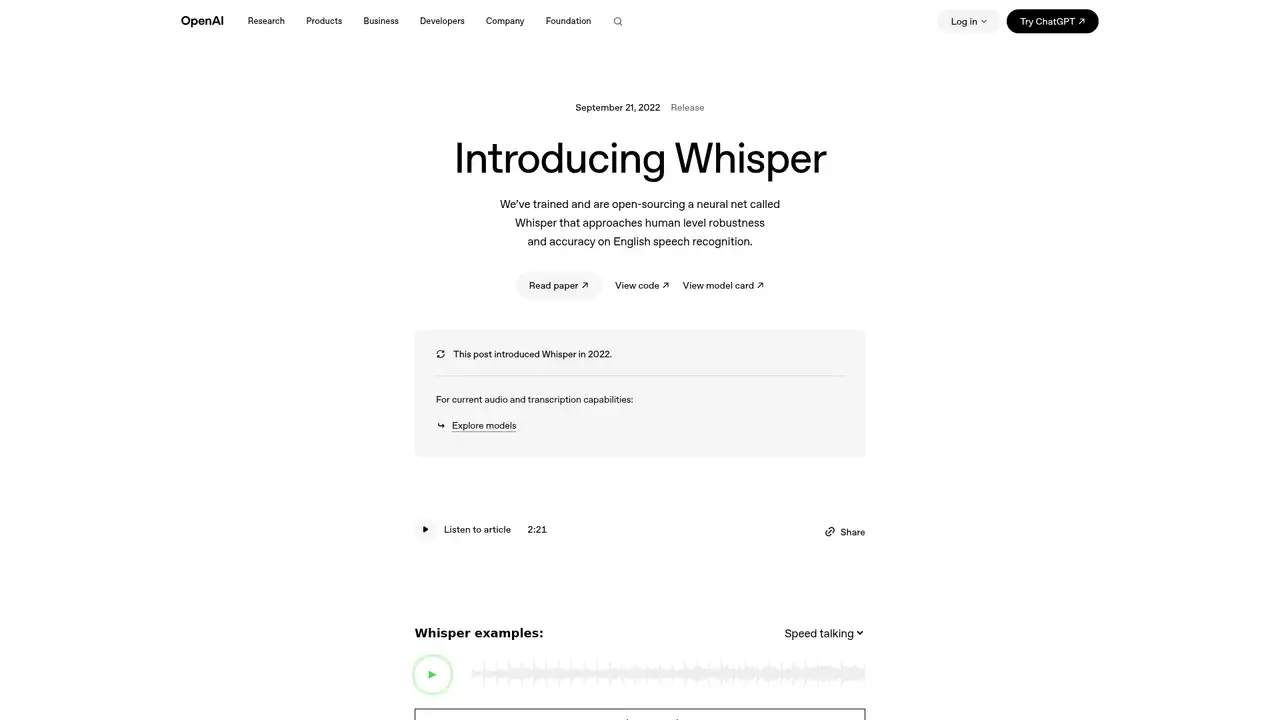
Whisper is an open source speech recognition model from OpenAI, released in 2022. Its Transformer sequence-to-sequence system handles multilingual speech recognition, speech translation, spoken language identification, and voice activity detection. The code and model weights are released under the MIT License, which permits use, modification, distribution, sublicensing, and sale subject to the license conditions. Whisper is software rather than a hosted consumer application, so local users supply the compute, storage, deployment, and support. OpenAI describes it as a general purpose model trained on a large dataset of diverse audio. OpenAI trained the original system on 680,000 hours of multilingual and multitask audio collected from the web. This makes budgeting primarily an infrastructure and engineering exercise rather than a subscription purchase decision for teams.
A local workflow installs the Python package, obtains a model checkpoint, and sends an audio file through the transcription command or Python interface. Whisper can transcribe speech in its original language, translate speech to English, identify the spoken language, and produce timestamped output. The repository supports several model sizes, letting operators trade speed and resource requirements against recognition quality. Its multitask format uses special tokens to tell the decoder which task to perform. The setup may also require Rust when a prebuilt tiktoken wheel is unavailable. That dependency is a minor installation hurdle, while hardware selection and audio preprocessing remain the larger operational decisions for a self-hosted deployment. Teams should also plan how outputs are stored, reviewed, and passed into downstream systems.
Whisper uses a Transformer encoder-decoder architecture trained across several speech tasks. OpenAI's current transcription guide lists whisper-1 as deprecated and directs new file-based integrations to the recommended transcription workflow, while live audio should use the recommended realtime workflow. The guide says whisper-1 and several other legacy transcription models, including gpt-4o-transcribe and gpt-4o-mini-transcribe, will shut down on February 26, 2027. OpenAI describes whisper-1 as a general purpose model for multilingual recognition, speech translation, and language identification. A 2024 report summarized research finding hallucinated content in Whisper transcripts, including findings ranging from eight in ten tested transcriptions to more than half in another study. These findings make human checking important for sensitive uses.
Local Whisper has no subscription or per-minute software charge under its MIT license, but compute and operations are not free. OpenAI's model page lists hosted whisper-1 at $0.006 per minute. It also shows rate limits by usage tier, including 2,500 for Build, 7,500 for Launch, and 10,000 for Grow, though the page does not identify the unit in the displayed table. OpenAI's data controls page lists /v1/audio/transcriptions as having no abuse-monitoring retention, no application-state retention, and no training use. Because whisper-1 is deprecated, its price is a migration concern rather than a sensible basis for a new integration. Buyers comparing local and hosted use should include infrastructure, maintenance, migration, and review costs, not only the stated API rate.
Whisper's MIT license and local execution suit teams that need control over deployment and audio handling, but recognition quality and operations depend on the chosen checkpoint, hardware, and application. The 2024 research reported hallucination risks that matter in medical and other high-stakes settings. Rev is a better fit for managed human transcription, captions, and editing. Deepgram and AssemblyAI are better fits when a buyer wants a managed speech API rather than model deployment. These options address different operating preferences, so the choice depends on who owns infrastructure and review. Pick Whisper if you can run the software yourself and need multilingual recognition with permissive licensing; pick a managed service if operational support or review is more important.
Who is OpenAI Whisper best for?
- Developers building local transcription pipelines.
- Researchers needing inspectable speech recognition weights.
- Teams requiring MIT licensed commercial deployment.
- Subtitle workflows needing timestamped output.
OpenAI Whisper Pricing (2026)
Pricing model: Usage-based. All prices in USD.
| Plan | Price | What you get |
|---|---|---|
| Local open source | Free | Code and weights are MIT licensed. Compute, storage, deployment, and support remain operator costs. |
| whisper-1 API | $0.006/minute | Hosted transcription and translation. Deprecated, with shutdown scheduled for February 26, 2027; local open source Whisper remains available. |
Pros and Cons
Pros
- MIT licensing covers the code and weights.
- Local inference can keep audio under operator control.
- Multilingual recognition and English translation are supported.
- Several model sizes support different hardware budgets.
Cons
- Local deployment requires engineering work.
- Whisper has documented hallucination concerns.
- Hosted whisper-1 is deprecated.
Who should look elsewhere?
- Buyers wanting managed human editing.
- Teams without compute or operations capacity.
- New API projects requiring a nondeprecated model.
Technical Details
Frequently Asked Questions
How much does Whisper cost?
The downloadable code and weights use the MIT License, so Whisper has no per-minute software charge for local use. Running it still requires compute, storage, and engineering work. OpenAI lists hosted whisper-1 at $0.006 per minute, but the model is deprecated and scheduled to shut down on February 26, 2027.
Does Whisper have a free plan?
Local Whisper is free to download and use under the MIT License, including commercial use subject to its conditions. It is not a hosted free plan. OpenAI lists usage tiers for the API, but new integrations should not depend on whisper-1 because OpenAI marks it deprecated and has announced its shutdown date.
Whisper or Rev?
Whisper is designed for local model deployment and gives developers MIT licensed code and weights. Rev provides a managed transcription service with human transcription, captions, legal formatting, and an editor. Choose Whisper for control over software and infrastructure, or Rev for a managed workflow and review services.
Does Whisper send audio to OpenAI?
Local Whisper runs on infrastructure chosen by the operator, so Whisper itself does not send audio to OpenAI. Hosted whisper-1 requires uploaded audio. OpenAI says API data is not used to train or improve its models unless a customer opts in, and its data controls page lists no abuse-monitoring or application-state retention for /v1/audio/transcriptions.
Can I use Whisper commercially?
Yes. The repository's MIT License permits users to use, copy, modify, distribute, sublicense, and sell the software and associated materials, subject to its conditions. Commercial operators remain responsible for privacy, consent, copyright, recording, biometric, and sector-specific legal requirements that apply to their audio and transcripts.
Best OpenAI Whisper Alternatives in 2026
These tools do the same job as OpenAI Whisper, with different pricing, limits and trade-offs.

Speech-to-text, text-to-speech and voice agent APIs priced by the minute

Developer APIs for transcription, speech understanding, guardrails, and voice agents.

AI and human transcription for media, business, and legal teams
Microsoft's cloud speech API for transcription, neural voices, translation and avatars