
Magic Patterns Review, Pricing & Alternatives (2026)
Prompt-driven interfaces that connect design work with production code
Last updated: October 26, 2026
What is Magic Patterns?
Magic Patterns is a hosted AI design and prototyping platform for product teams, founders, designers, and engineers. It turns prompts into editable interfaces and code, with Figma, GitHub, MCP, integrations, and a v3 API. A free tier is available, while paid plans start at $20 per seat monthly or $17 annually.
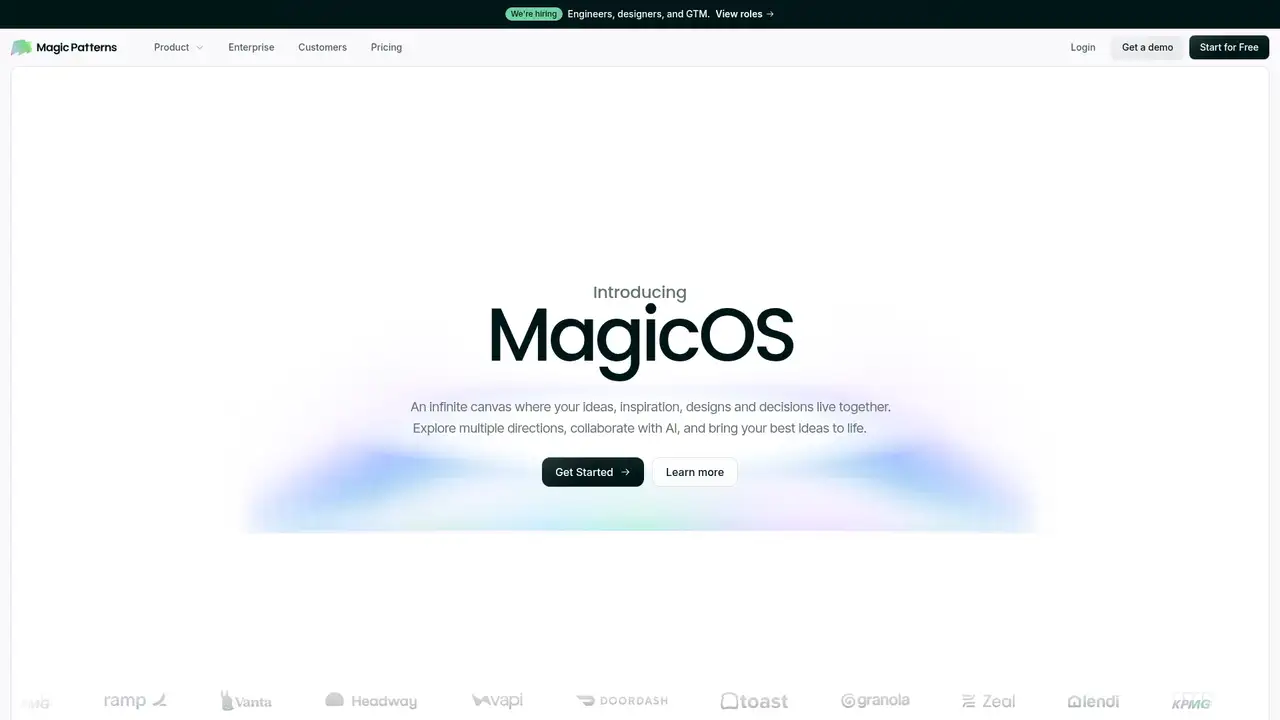
Magic Patterns is a cloud-based web platform from North Park Labs, Inc. that turns natural-language product ideas into interfaces, designs, frontend code, and prototypes. Users can generate a design asynchronously, refine it through follow-up prompts, visual edits, manual changes, or “Fix with AI,” then move work between Figma, GitHub, and connected development tools. Its MCP support links designs with Cursor, Claude Code, Codex, and Claude.ai, while integrations include Notion, Linear, PostHog, Shopify, Google Analytics, and feedback tools. The v3 API supports programmatic generation, status checks, artifact-file edits, and publishing, but generation commonly takes two to ten minutes, requires polling, and allows up to 1,000 generations per ten hours per key. Teams should also note that Free-plan content may train services or appear publicly.
A typical project begins with a natural-language description of a feature, screen, or user flow. Users can refine the result with visual edits, manual changes, additional generations, or the Fix with AI workflow. The /Clear command resets the current conversation without forking the design, which can reduce context-related credit use. Figma import and export support movement between design tools, while two-way GitHub synchronization connects artifacts with repositories. MCP can move designs between Magic Patterns and Cursor, Claude Code, Codex, or Claude.ai, including importing layouts from a codebase and adapting designs into an existing codebase. Integrations also cover Notion, Linear, PostHog, Shopify, Google Analytics, Meta Pixel, Google Sheets, OpenAI, Anthropic Claude, and custom MCP servers. Visual edits, exports, sharing, retries, and Fix with AI do not consume credits.
Magic Patterns uses an asynchronous generation system with a documented v3 REST API. The API can create and iterate designs, initiate generations, poll status, read and write artifact files, and publish changes. Generations commonly take two to 10 minutes, and v3 has no webhooks, leaving polling as the completion method. Clients should wait at least 60 seconds between status checks, while each API key permits 1,000 generations per 10 hours unless Magic Patterns raises the limit. The March 20, 2026 release introduced usage-based credits, on-demand usage, and restructured plans. Paid MCP connections support round-trip workflows with Cursor, Claude Code, Codex, and Claude.ai, allowing teams to move between hosted designs, local interfaces, and codebases.
Magic Patterns uses a freemium, per-seat pricing model. Free includes monthly credits, although the current pricing material does not give a numeric allowance, and free content may receive attribution or be used to train and improve the service. Starter costs $20 per seat monthly or $17 per seat monthly with annual billing, includes 1,000 monthly credits plus Free credits, and supports up to 10 paid seats. Business costs $100 monthly or $85 annually per seat and includes 5,000 monthly credits plus Free credits, shared workspaces for 11 or more paid seats, SSO, permissions, and usage reporting. Enterprise uses custom annual pricing. Paid plans can buy additional credits at $0.02 each, and unused monthly credits expire after one month.
Credit costs vary with request complexity, making spend less predictable than a flat prompt fee. A simple generation may use about 70 credits, a small prototype can use 110 to 200, and a substantial project may approach 950. Generation also takes minutes rather than returning instantly, while API automation requires polling. MCP is restricted to paid plans, and Magic Patterns does not document open-source licensing or self-hosted deployment. Compared with Cursor, Magic Patterns is more focused on visual product concepts and design artifacts; Claude Code is stronger as a code-first agent; Codex emphasizes repository-oriented development. Teams that need shared product prototyping tied to Figma, GitHub, and frontend workflows should pick Magic Patterns.
Who is Magic Patterns best for?
- Product teams prototyping frontend interfaces from prompts.
- Designers moving work between Magic Patterns and Figma.
- Engineers connecting generated artifacts with GitHub repositories.
- Teams using MCP for design-to-code collaboration.
Magic Patterns Pricing (2026)
Pricing model: Freemium. All prices in USD.
| Plan | Price | What you get |
|---|---|---|
| Free | $0/seat/month | Includes free monthly credits, but the numeric allowance is not published. Free content may carry attribution and may be used to train or improve the service. |
| Starter | $20/seat/month or $17/seat/month annually | Includes 1,000 monthly credits plus Free credits, supports up to 10 paid seats, and offers on-demand usage at $0.02 per extra credit. Unused monthly credits expire after one month. |
| Business | $100/seat/month or $85/seat/month annually | Includes 5,000 monthly credits plus Free credits, supports 11 or more paid seats, and adds SSO, permissions, shared workspaces, and usage reporting. Unused monthly credits expire after one month. |
| Enterprise | Custom | Annual custom pricing includes custom credit allocation, shared credit pooling, priority support, SCIM, audit logs, custom contracts, and flexible invoicing. |
Pros and Cons
Pros
- Generated interfaces remain editable as designs and code.
- Figma export, import, and GitHub synchronization support existing workflows.
- The v3 API supports generation, artifact changes, and publishing.
- Paid plans assign generated content and code to the user.
Cons
- Credit usage varies with request complexity.
- Business pricing reaches $100 per seat monthly.
- API completion requires polling because v3 has no webhooks.
Who should look elsewhere?
- Teams requiring offline or self-hosted deployment.
- Users needing predictable cost per generation.
- Organizations needing enterprise controls on a small budget.
Technical Details
Frequently Asked Questions
How much does Magic Patterns cost?
Magic Patterns has a free tier with monthly credits. Starter costs $20 per seat monthly or $17 per seat monthly with annual billing. Business costs $100 monthly or $85 annually per seat. Enterprise uses custom annual pricing. Paid plans can enable on-demand usage at $0.02 per additional credit after monthly credits run out.
Does Magic Patterns have a free plan?
Yes. The Free plan includes monthly credits, but Magic Patterns does not publish the numeric allowance in its current plan details. Free content may include Built with Magic Patterns attribution, may be publicly displayed or promoted, and may be used to train and improve the service. Paid plans remove those content-training terms.
How does Magic Patterns compare with Cursor?
Magic Patterns centers on visual product design, interface generation, editable prototypes, Figma exchange, and design-to-code workflows. Cursor is primarily an AI code editor for working inside repositories. Magic Patterns connects to Cursor through MCP, so the products can complement each other, but teams wanting repository-first coding may prefer Cursor while product teams starting with screens may prefer Magic Patterns.
Does Magic Patterns train on user content?
Magic Patterns says it will not use, retain, or access user-provided or generated content to train, fine-tune, or improve models on paid plans. Free-plan users agree that inputs and content may be used to train and improve the service. Its privacy policy says personal information is not rented, sold, or traded, while service providers and subprocessors may receive information.
Can I use Magic Patterns output commercially?
The terms say generated designs, code, and interfaces are the user's sole and exclusive property as between the user and Magic Patterns, subject to the terms. Users may use that output commercially, but they remain responsible for their inputs, third-party materials, and legal compliance. Free public work may carry attribution and may be displayed in promotional materials.
Best Magic Patterns Alternatives in 2026
These tools do the same job as Magic Patterns, with different pricing, limits and trade-offs.
AI coding workspace with repository context and software agents
An agentic coding assistant for terminal, IDE, desktop, and web

Turn prompts, screenshots, and sketches into editable interface prototypes
A cloud and terminal agent for writing, testing, and reviewing code

AI features for design, prototyping, content, and code