OpenAI Codex Review, Pricing & Alternatives (2026)
A cloud and terminal agent for writing, testing, and reviewing code
Last updated: October 26, 2026
What is OpenAI Codex?
OpenAI Codex is a software engineering agent from OpenAI for developers who want delegated coding work in a terminal, IDE, web workspace, GitHub, or mobile app. Access starts with a limited free offering and ChatGPT plans, with Plus at $20/month. Business and API routes add administration or token billing.
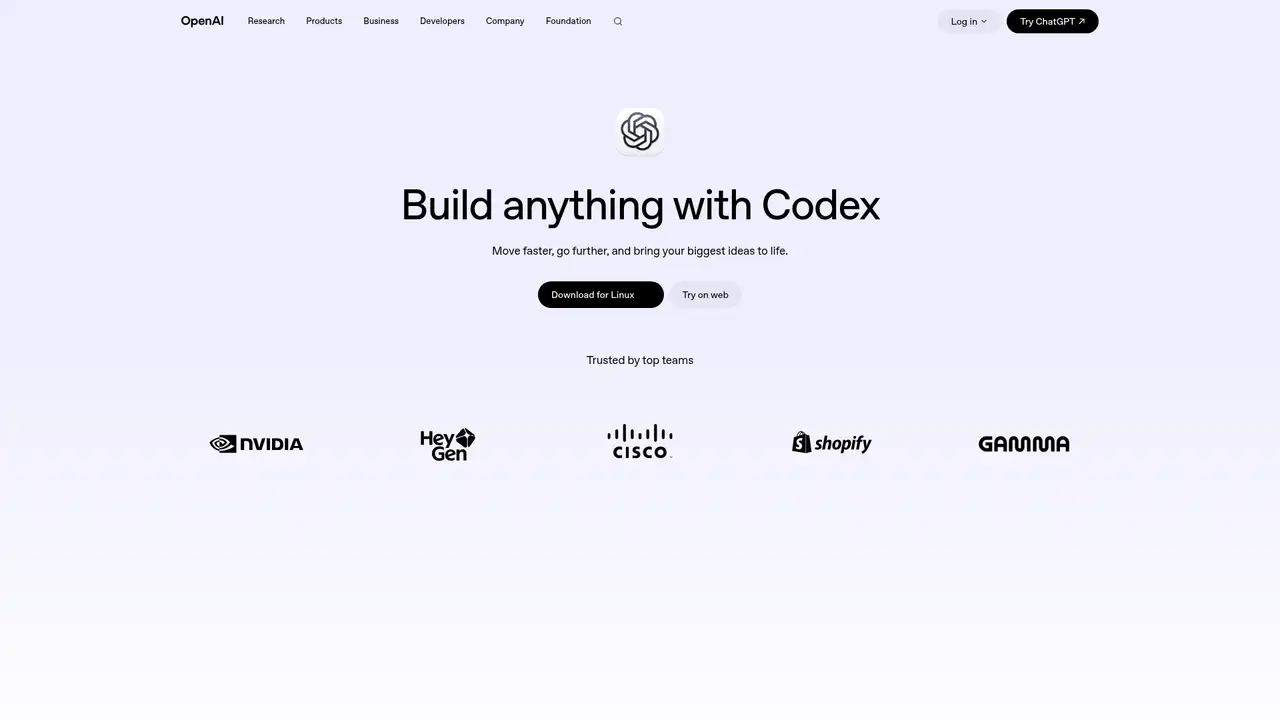
OpenAI Codex is an AI software engineering agent made by OpenAI. It launched in 2025, beginning as a cloud based research preview in May before reaching general availability in October. Codex writes, reviews, tests, and modifies code through web, terminal, IDE, GitHub, Slack, and mobile interfaces, with local and cloud workflows connected through ChatGPT. OpenAI says daily usage grew more than tenfold since early August 2025, while GPT-5-Codex processed more than 40 trillion tokens during its first three weeks, figures reported by the company rather than independent auditors. Codex remains active and has not been acquired or closed. Its current plans include Free, Plus, Pro, Business, Edu, Enterprise, and usage based API access, with limits varying by task and model.
OpenAI Codex is a software engineering agent that writes, reviews, tests, and ships code through its web client, CLI, IDE extension, GitHub, Slack, and iOS app. A typical workflow starts with a repository and a scoped request, such as adding an API endpoint. Codex reads the relevant files, edits the project, runs commands, tests, linters, and type checkers, then presents a diff with terminal logs and test results. You review the changes, request revisions, merge them, or open a pull request. Cloud tasks run in separate environments, while the CLI and IDE extension support local work with configurable permissions. Codex is included with ChatGPT plans, including Plus at $20 monthly, and API key usage is billed by tokens. Limits vary with task size and execution location.
OpenAI Codex is a software engineering agent that combines language models with repository tools, isolated execution, and developer interfaces. Its May 2025 launch used codex-1, an o3-based model trained with reinforcement learning on coding tasks. Codex could inspect and edit files, run commands, tests, linters, and type checkers, then provide diffs, logs, and test evidence. GPT-5-Codex arrived in September 2025 for interactive coding, long tasks, refactoring, and code review. October brought general availability, a Slack integration, the TypeScript Codex SDK, GitHub Actions, and administration tools. Current plans list GPT-5.4, GPT-5.3-Codex, GPT-5.4-mini, and a Pro-only GPT-5.3-Codex-Spark preview. The open-source CLI supports local work, while cloud features add GitHub reviews and delegated tasks.
Codex pricing combines subscriptions with usage-based extensions. Free and Go access is available for a limited time, while Plus costs $20 per month, Pro $200 per month, and Business $30 per user per month; Enterprise and Edu terms depend on the workspace arrangement. API-key use is metered by tokens under API pricing rather than included ChatGPT allowances, and cloud features are unavailable through that route. Subscription limits use shared five-hour windows for local messages and cloud tasks, with additional weekly limits possible; allowances vary by model, task size, complexity, context, and execution location. Pro provides six times Plus local and cloud limits and ten times cloud code reviews. When included usage runs out, Plus and Pro users can buy credits, while flexible Business, Edu, and Enterprise workspaces can purchase workspace credits. Speed settings consume credits faster.
OpenAI Codex is a coding agent for delegated repository work across the terminal, IDE, web, GitHub, Slack, and iOS. It can edit files, run commands, execute tests, and propose pull requests, but its output still requires human review. Task allowances vary with codebase size, model, and execution location, while cloud work and API-key use have different capabilities. Sandboxed execution can also constrain workflows needing network access, and remote tasks may take longer than interactive editing. Claude Code is more terminal-centered, Google Jules emphasizes asynchronous repository tasks, and GitHub Copilot focuses more on editor assistance. Codex fits teams already using ChatGPT, GitHub workflows, or OpenAI workspaces, especially when business administration and cross-surface access matter. Choose Codex if you want one OpenAI agent spanning local development, cloud delegation, and team workflows.
Who is OpenAI Codex best for?
- Developers delegating repository tasks to an agent.
- Teams needing GitHub, Slack, and workspace administration.
- Terminal users who want local permissions and repeatable commands.
- OpenAI customers already paying for ChatGPT.
OpenAI Codex Pricing (2026)
Pricing model: Freemium. All prices in USD.
| Plan | Price | What you get |
|---|---|---|
| Free | $0/month | Limited Codex access for a limited time; allowance varies by task complexity. |
| Plus | $20/month | Web, CLI, IDE, iOS, cloud integrations, latest models, and higher usage limits. |
| Pro | $200/month | Everything in Plus, priority processing, six times local and cloud limits, and ten times cloud code reviews. |
| Business | $30/user/month | Dedicated workspace, larger virtual machines, admin controls, SAML SSO, MFA, and no training on business data by default. |
| Enterprise | Custom | Enterprise security, SCIM, EKM, analytics, audit logs, retention, and residency controls. |
| API key | Usage based | CLI, SDK, and IDE access billed by token; cloud integrations are unavailable. |
Pros and Cons
Pros
- Runs tests and development commands inside its task environment.
- Works across web, terminal, IDE, GitHub, Slack, and iOS.
- GPT-5-Codex targets long software engineering tasks.
- Business plans exclude business data from training by default.
Cons
- Usage allowances vary with task size and execution location.
- API access and cloud features have different availability.
- Generated changes still require human review.
Who should look elsewhere?
- Teams requiring fully autonomous production changes.
- Users unwilling to review generated diffs and test results.
- Workflows dependent on unrestricted network access in sandboxes.
Technical Details
Frequently Asked Questions
How much does OpenAI Codex cost?
Codex is included in ChatGPT plans. Plus costs $20/month, Pro costs $200/month, and Business costs $30 per user monthly. Free and Go access is currently described as limited time. API-key use is metered by tokens, and ChatGPT credits can extend included usage.
Is OpenAI Codex free?
Yes, OpenAI lists Codex in Free and Go plans for a limited period, with lower allowances than paid plans. The amount consumed depends on task size, codebase context, and whether work runs locally or in the cloud. OpenAI can change availability and limits, so free access should not be treated as a permanent unlimited tier.
How does Codex compare with Claude Code?
Codex spans a ChatGPT-connected web client, cloud tasks, terminal, IDE extension, GitHub, Slack, and iOS. Claude Code is principally a terminal coding agent. Codex is a better fit for teams already using OpenAI workspaces and GitHub workflows, while Claude Code may suit developers who want a terminal-first Anthropic workflow.
Does OpenAI train on Codex conversations?
For Plus and Pro, Codex content may be used to improve models unless the account owner turns training off in ChatGPT data controls. OpenAI says Business, Enterprise, Edu, and API inputs and outputs are not used for training by default, subject to applicable settings and agreements.
Can Codex be used commercially?
Codex supports professional and commercial development, including repository work, code review, SDK integration, and business workspaces. Commercial users remain responsible for reviewing output, complying with applicable OpenAI terms, and ensuring generated code meets licensing, security, and policy requirements.
Best OpenAI Codex Alternatives in 2026
These tools do the same job as OpenAI Codex, with different pricing, limits and trade-offs.
An agentic coding assistant for terminal, IDE, desktop, and web
AI coding assistance across editors, terminals, and GitHub
AI coding workspace with repository context and software agents
An agent-native code editor unified with Cognition's Devin platform

An asynchronous coding agent that turns GitHub tasks into pull requests