
LibreChat Review, Pricing & Alternatives (2026)
Self-hosted chat for multiple AI providers
Last updated: October 22, 2026
What is LibreChat?
LibreChat is a free, MIT-licensed, self-hosted chat platform for developers, teams, and organizations that want one interface for many remote and local AI providers. The software costs $0, while hosting, storage, and model usage remain separate. It suits operators who want provider choice, agents, tools, and administrative controls instead of a bundled model subscription.
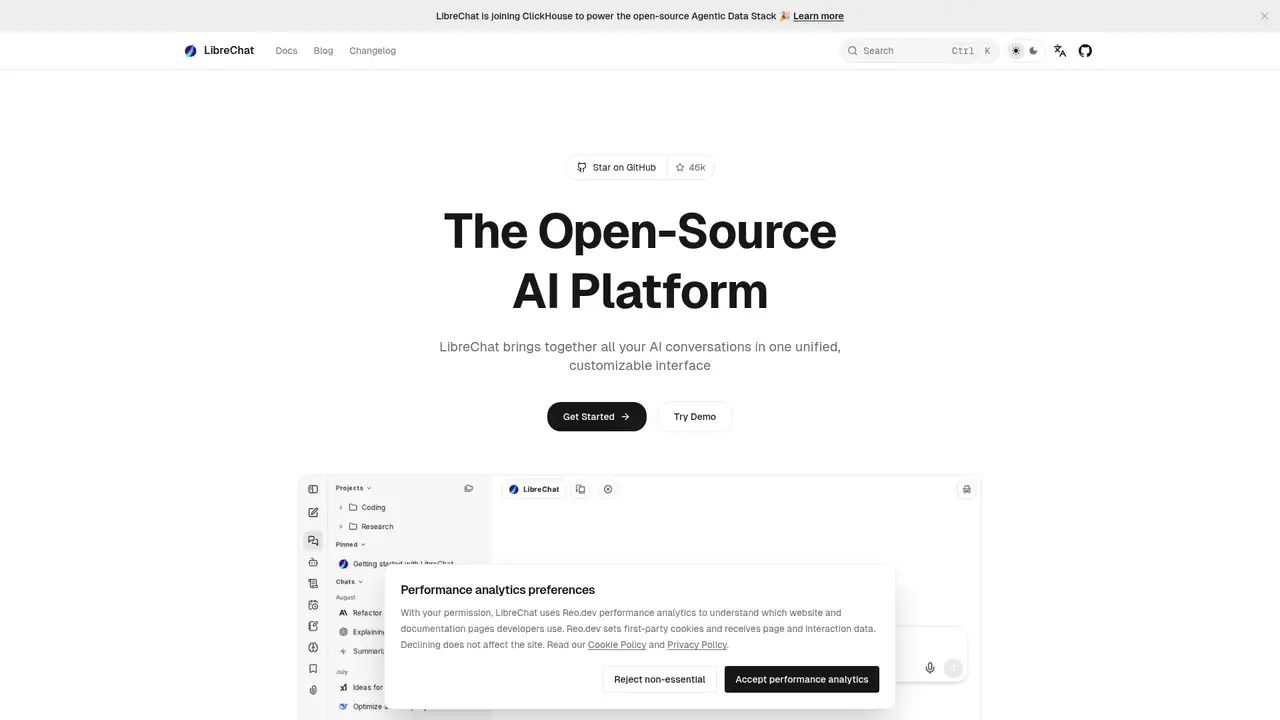
LibreChat is a free, open-source chat platform maintained by the LibreChat community and distributed under the MIT license. Its GitHub repository was created on February 12, 2023. The project page reports 46.1 thousand GitHub stars and 58.5 million Docker pulls in October 2026, while the repository lists 9,457 forks and the MIT license. LibreChat targets developers, teams, and enterprises that want to run an AI interface on their own infrastructure. The license permits use, modification, distribution, sublicensing, and sale, provided the notice is retained, and the software is provided without warranty. LibreChat does not include model inference, hosting, or provider credits. Connected services can still process prompts, files, and tool requests under their own terms, so users seeking self-hosting and provider flexibility should pick LibreChat.
A typical deployment runs LibreChat with Docker, configures provider credentials or OpenAI-compatible endpoints, and gives users a browser workspace. Users can switch models, upload files, search conversations, create agents, call MCP tools, run code in a sandbox, and use RAG for indexed documents. Authentication supports email and OAuth, with LDAP, SAML, two-factor controls, roles, groups, moderation, and spend controls described for multi-user installations. The interface can connect to OpenAI, Anthropic, Google, Azure, AWS Bedrock, OpenRouter, Ollama, Groq, Mistral, Cohere, and other local or remote services. These connections route requests through configured endpoints, but they do not provide a LibreChat model API subscription or included model allowance. Pick LibreChat if you need a self-hosted shared workspace with multiple providers, agents, tools, files, and user permissions.
LibreChat is a self-hosted web application and routing layer, not a model family. It sends requests to configured remote APIs or local engines such as Ollama, so privacy depends on the endpoint, storage settings, logging, and deployment design. LibreChat does not make every installation offline. Release activity continued through 2026: version 0.8.7 arrived on June 23, followed by the v0.8.8 GitHub release marked as a pre-release on October 1. Version 0.8.8 added a beta Agents API, public OpenAPI and Swagger documentation, agent and skill management, scheduled chats, experimental attached workspaces, background tool controls, trace features, and additional model integrations. The release notes identify several workspace and scheduling features as experimental or beta. LibreChat is best suited to teams that need self-hosting, multiple providers, agents, tools, files, and user permissions in one application.
LibreChat has no required subscription, seat fee, or bundled model allowance. Under the MIT license, self-hosted software costs $0, but operators pay for servers, storage, databases, search and tool services, and model requests based on their configuration. Users also pay connected providers’ token or subscription charges unless they run local inference, which still requires hardware and administration. The public commercial page lists Starter at $1K and Professional at $1M, and Enterprise as contact sales, without identifying a billing period or unit for the numeric figures, so they are not useful subscription prices. The Code Interpreter API page says subscriptions are currently unavailable. The practical entry point for most users is therefore the free software, with variable infrastructure and provider costs. LibreChat is best for operators who want self-hosted multi-provider chat and accept this administration.
LibreChat’s flexibility brings deployment work, credential management, upgrades, provider-specific limits, and security responsibility. It is less turnkey than ChatGPT, which provides managed hosting, and less focused on local inference than Open WebUI, particularly in Ollama-centered setups. LibreChat is also less developer-oriented as a model-serving engine than Ollama-style workflows or direct provider SDKs. Chatbot UI provides a simpler interface, while LibreChat offers broader provider, agent, tool, file, and multi-user administration controls. Pick LibreChat when control, provider choice, self-hosting, agents, MCP tools, files, and user permissions matter more than a managed subscription. Pick ChatGPT for a polished hosted experience, Open WebUI for a local-first model interface, or direct provider APIs when application integration matters more than a shared chat workspace. LibreChat is best for teams needing these combined capabilities.
Who is LibreChat best for?
- Teams standardizing access to several model providers.
- Developers building agent and MCP workflows.
- Organizations requiring self-hosted authentication and permissions.
- Operators comfortable with Docker and provider credentials.
LibreChat Pricing (2026)
Pricing model: Free. All prices in USD.
| Plan | Price | What you get |
|---|---|---|
| Self-hosted | $0 | The MIT software has no seat or message allowance. Hosting, storage, and connected provider usage are separate. |
| Enterprise | Custom | The public pricing page lists 24/7 support, enterprise-grade security, custom roles, and custom permissions. |
Pros and Cons
Pros
- MIT licensing permits modification and redistribution.
- Connects remote, local, and OpenAI-compatible providers.
- Includes agents, MCP, RAG, files, and code execution.
- Offers roles, SSO options, and token-spend controls.
Cons
- Provider fees and infrastructure costs remain separate.
- Privacy depends on endpoint and storage configuration.
- Deployment and upgrades require technical administration.
Who should look elsewhere?
- People seeking a zero-setup hosted chatbot.
- Users expecting included model credits.
- Teams unable to maintain servers and integrations.
Technical Details
Frequently Asked Questions
How much does LibreChat cost?
The core software costs $0 under the MIT license. You still pay for server hosting, storage, search or tool services, and model providers configured in your deployment. LibreChat's public commercial page lists Starter at $1K, Professional at $1M, and Enterprise as contact sales, but it does not explain a billing period or unit for the two numeric figures.
Does LibreChat have a free plan?
Yes. Self-hosting LibreChat costs $0 for the software, with no required subscription or bundled message allowance. OpenAI, Anthropic, Google, Bedrock, and other providers charge under their own terms. Local models can avoid per-request provider charges, but they still require suitable hardware, storage, maintenance, and configuration.
How does LibreChat compare with Open WebUI?
LibreChat and Open WebUI are self-hosted interfaces for AI models. LibreChat emphasizes connections across many remote and local providers, agents, MCP tools, RAG, and multi-user administration. Open WebUI is a closer fit for a local-first setup centered on services such as Ollama. The stronger choice depends on provider breadth, administration needs, and preferred deployment.
Does LibreChat train on user data?
LibreChat is application software and does not itself supply a model-training policy for every connected service. Self-hosting can keep the application and database under an operator's control, but remote providers can receive submitted prompts and files. Local endpoints reduce external transfer. Operators must review each provider's retention and training terms and configure logging accordingly.
Can companies use LibreChat commercially?
Yes. The repository's MIT license permits commercial use, modification, distribution, sublicensing, and sale, provided the license notice remains with copies or substantial portions. Companies remain responsible for provider contracts, model output rights, user data, security, and third-party dependencies. Agent tools, code execution, and uploaded files require deployment-specific permissions and isolation.
Best LibreChat Alternatives in 2026
These tools do the same job as LibreChat, with different pricing, limits and trade-offs.