
Kahoot! Review, Pricing & Alternatives (2026)
Live quizzes and AI study tools for classrooms, teams, and families
Last updated: October 26, 2026
What is Kahoot!?
Kahoot! is a learning and engagement platform for teachers, students, families, and workplace teams. It combines live quizzes, self-study, reports, presentations, and AI-assisted content creation. The school free plan supports up to 40 participants, while paid school plans start at $3/month with annual billing, or $9/month with monthly billing.
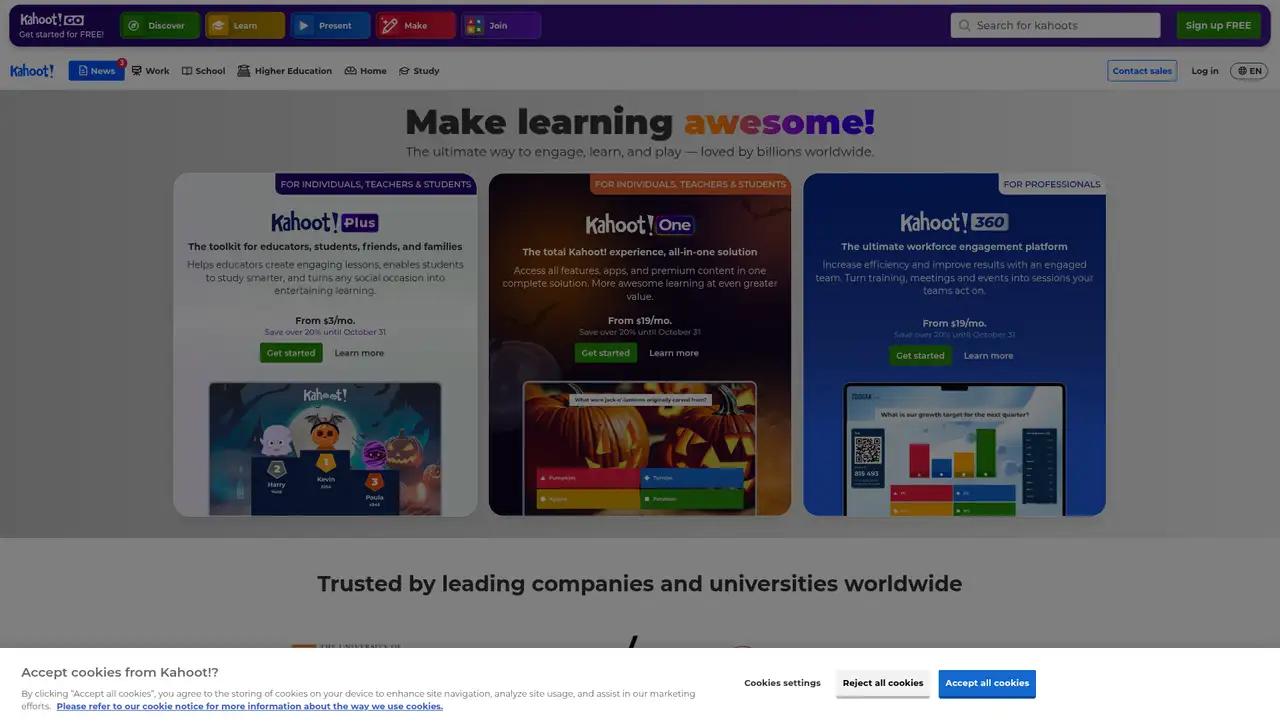
Kahoot! is a learning and engagement platform developed by the Kahoot! Group, headquartered in Oslo, Norway. The company was founded in 2012 by Morten Versvik, Johan Brand, Jamie Brooker, Alf Inge Wang, and Åsmund Furuseth, then launched publicly in 2013. Kahoot! says its platform has hosted more than 14 billion cumulative participants since launch, while more than 10 million educators hosted a kahoot during the past 12 months. It serves school, workplace, family, and community use cases. The company was publicly traded on Oslo Børs from 2021 until its acquisition led by Goldman Sachs Asset Management, General Atlantic, KIRKBI, and other investors. The acquisition concluded with delisting in January 2024.
A typical session begins with a teacher, trainer, or host selecting an existing kahoot or creating one in the editor. The host can run it live, assign it for self-study, or use courses and presentations to structure a longer learning activity. Participants join from a device, often with a nickname rather than a personal account, then answer quizzes, true-or-false questions, puzzles, polls, slides, or flashcards. Kahoot! provides reports after sessions, including participant and question results. Its library contains ready-made games, while paid plans add broader question types, presentation features, participant capacity, and content creation options. The workflow is quick for short checks of understanding, although the game format can make deeper written assessment less central.
Kahoot!'s technology combines its own platform with third-party AI models rather than a company-built large language model. Its Trust Center lists Microsoft Azure OpenAI models, Google Gemini, Apple Foundation Models, and Perplexity among models used for different AI features. The AI creator can generate questions from a topic, URL, Wikipedia page, PDF, or notes, while mobile features can scan written material. In 2025, Kahoot! added AI study formats, question extraction, practice tests, vocabulary reviews, micro-lessons, a step-by-step solver, offline study, and Apple on-device Quiz Starter for compatible devices. In 2026, the product update hub added items including animated full-body characters, improved member management, creator help, content-creation controls, and the ability for individual users to disable AI features.
Kahoot! has a free school plan with a listed limit of 40 participants per live game. The school pricing page lists Kahoot!+ Bronze at $3 per month, or $36 billed annually, with up to 50 participants; Silver at $7 per month, or $84 annually, with up to 100; Gold at $12 per month, or $144 annually, with up to 200; and Kahoot! One at $19 per month, or $228 annually, with up to 800. The page says educational plans are billed upfront annually, despite monthly price displays. Kahoot! One personal plans differ from school plans: One Max lists $35 per month billed annually and up to 2,000 participants, while One Ultra lists $39 per month billed annually and up to 4,000. School and district pricing is custom.
Kahoot!’s strongest case is fast, energetic participation, but participant caps and plan gates matter for larger classes, richer question types, and presentation-heavy teaching. Its AI output also needs review because Kahoot! warns that generated material can be inaccurate, while prompts or uploaded text are sent to Microsoft for processing in relevant features. Wayground offers broader assessment formats and student-paced work, Gimkit centers more heavily on game mechanics, and Nearpod emphasizes interactive lessons and presentations. Kahoot! is a weaker fit for teachers seeking extensive written assessment or self-hosting, and the company does not publish a public general API. Its school plans range from free access for 40 participants to custom pricing. Choose Kahoot! if live participation, quick checks, and familiar game-based sessions are your priority.
Who is Kahoot! best for?
- Teachers running fast formative checks with a whole class.
- Trainers adding participation to live presentations.
- Students who prefer gamified self-study and practice tests.
- Families and communities hosting interactive quizzes.
Kahoot! Pricing (2026)
Pricing model: Freemium. All prices in USD.
| Plan | Price | What you get |
|---|---|---|
| Kahoot! Go | $0 | Supports up to 40 participants per live game. Includes the classic live experience. |
| Kahoot!+ Bronze | $3/month | Annual billing costs $36/year, or monthly billing costs $9/month. Supports up to 50 participants and includes AI creation, basic question types, reports, and 55+ languages. |
| Kahoot!+ Silver | $7/month | Annual billing costs $84/year, or monthly billing costs $15/month. Supports up to 100 participants and adds feedback question types, file creation, and presentation features. |
| Kahoot!+ Gold | $12/month | Annual billing costs $144/year, or monthly billing costs $26/month. Supports up to 200 participants and adds broader question, presentation, and study features. |
| Kahoot! One | $19/month | Annual billing costs $228/year, or monthly billing costs $35/month. Supports up to 800 participants and includes premium features, apps, content, and AI-assisted creation. |
| Kahoot! One Max | $35/month | Annual billing costs $420/year, or monthly billing costs $44.99/month. Supports up to 2,000 participants and adds presentations, NPS, branding, and image generation. |
| Kahoot! One Ultra | $39/month | Annual billing costs $468/year. Supports up to 4,000 participants and adds large-document AI, audience Q&A, reactions, and advanced branding. |
| School and district | Custom | Designed for multi-license and broader administrative requirements. Kahoot! directs schools and districts to custom pricing. |
Pros and Cons
Pros
- Live games are easy to join with a nickname.
- The free school plan supports up to 40 participants.
- AI creates content from topics, URLs, PDFs, and notes.
- Reports show participant and question-level results.
Cons
- Participant limits vary sharply across paid plans.
- AI-generated content requires human accuracy review.
- Advanced question and presentation features require paid plans.
Who should look elsewhere?
- Teams needing a self-hosted assessment platform.
- Teachers focused mainly on extended written responses.
- Classes exceeding the participant limit of their plan.
Technical Details
Frequently Asked Questions
How much does Kahoot! cost?
Kahoot! has a free school plan supporting up to 40 participants per live game. School plans list Bronze at $3/month annually or $9/month monthly, Silver at $7 or $15, and Gold at $12 or $26. Kahoot! One starts at $19/month annually or $35/month monthly. School and district plans use custom pricing.
Does Kahoot! have a free plan?
Yes. Kahoot! Go is free and supports up to 40 participants in a live game. Users can create or select kahoots and host the classic experience. Paid plans add larger audiences, more question types, presentation tools, and additional AI capabilities. Participants can join sessions from a device with a nickname.
How does Kahoot! compare with Wayground?
Kahoot! centers on live and self-study quizzes, game modes, presentations, and quick participation. Wayground covers a wider assessment and lesson workflow, including passages, flashcards, interactive videos, reports, accommodations, and student-paced sessions. Kahoot! fits teachers prioritizing familiar live competition, while Wayground fits teachers needing more varied assignment formats.
Does Kahoot! train AI models on user data?
Kahoot!'s Trust Center says platform data is not used to train or refine AI models. Text entered into relevant AI features and uploaded material are sent to Microsoft for processing. Kahoot! advises users not to include personal data in prompts or files. Some compatible Apple features process material locally on the device.
Can Kahoot! be used commercially?
Kahoot! offers workplace products for training, presentations, events, and communication, alongside education and personal plans. Commercial use depends on selecting an appropriate product and following the applicable terms. The workplace pages describe organizational use, while licensing details should be checked in the agreement attached to a specific subscription.
Best Kahoot! Alternatives in 2026
These tools do the same job as Kahoot!, with different pricing, limits and trade-offs.

Flashcards, adaptive practice, and AI study tools for students

AI-assisted lessons, assessments, and differentiation for classroom teaching
Interactive K-12 lessons with live quizzes, games and AI-generated lesson drafts
Live classroom quiz games with strategy modes, AI question generation and no ads
Classroom review games with collectible Blooks, homework mode and Khanmigo AI sets
Real-time assessment platform with Luna AI for building lessons, grading and feedback