
Intercom Fin Review, Pricing & Alternatives (2026)
Outcome-priced customer-service automation for helpdesks and support channels
Last updated: October 26, 2026
What is Intercom Fin?
Intercom Fin is an AI customer-service agent for support teams that want automated answers, configured workflows, and human handoffs across chat, email, phone, SMS, and WhatsApp. Standalone Fin costs $0.99 per outcome with a 50-outcome monthly minimum. Intercom plans add paid helpdesk seats, while a 14-day trial includes unlimited outcomes without requiring a credit card.
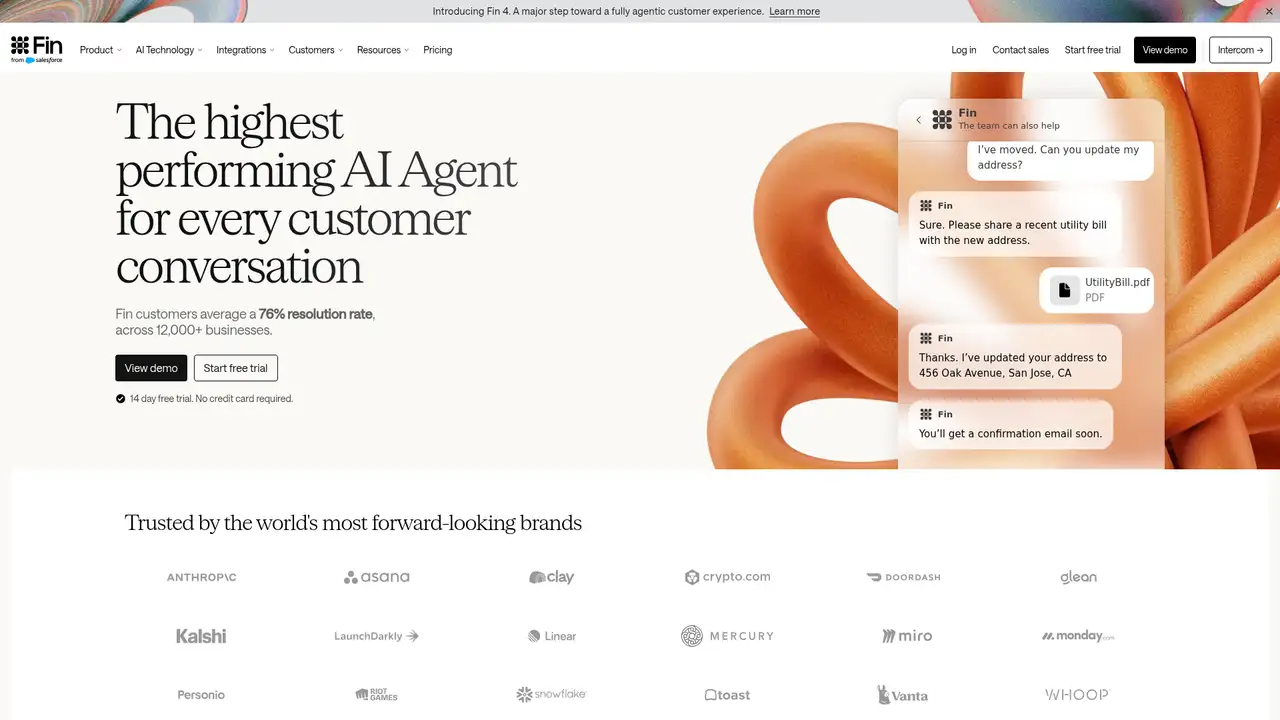
Fin is Intercom’s AI customer service agent, launched in 2023 for teams seeking automated support without replacing their helpdesk. It works within Intercom and with platforms such as Salesforce, HubSpot, Freshworks, Dixa, Front, Zoho, Sprinklr, and Gorgias. Its scope includes knowledge retrieval, Procedures, external system actions, escalation, reporting, and human inbox workflows. Intercom reported more than 7,000 teams using Fin in March 2026, while a later announcement put the broader Fin Agent Platform at about 8,000 companies. Intercom also says Fin resolves more than 2 million customer issues weekly. These figures are vendor claims rather than independent measurements. Fin is therefore aimed at support organizations that want automation alongside controls for review, escalation, and operational oversight.
Fin begins with approved knowledge sources, policies, and Procedures, then deploys across live chat, email, WhatsApp, SMS, phone, Slack, and social messaging. Procedures describe workflows for refunds, identity verification, appointment changes, approvals, and controlled handoffs. Fin Vision can interpret customer images, while Fin Guidance sets behavior and escalation instructions in plain language. A typical rollout connects the knowledge base and business systems, defines procedures, tests edge cases through simulations, deploys to selected channels, and monitors results. Conversations can move to Intercom’s Inbox or another helpdesk. Fin over API supports custom product experiences, while Copilot assists human agents with answers, translation, troubleshooting, and follow-up work. This setup gives teams a staged path from knowledge answers to more involved service actions.
Intercom’s 2025 releases added Fin Vision, Fin Guidance, Fin Tasks, AI Inbox Translation, Fin Voice, Zendesk and Salesforce integrations, and Fin over API. Fin Tasks was in closed beta in the March 2025 announcement, and Fin Voice was being tested with selected customers. In March 2026, Intercom changed its billing language from resolutions to outcomes, including successful Procedure handoffs as billable results. In April 2026, it announced the Fin API platform and Apex, a specialized customer service language model, with contracts starting at $250,000 per year. Intercom describes a family of models using knowledge grounding, retrieval, reranking, validation, and confidence based escalation. Performance comparisons and model claims come from Intercom, so buyers should treat them as vendor claims.
Pricing depends on how Fin is deployed. With an existing helpdesk, the listed price is $0.99 per outcome, with a 50 outcome monthly minimum, no seat charges, and no setup, integration, or platform fees. Intercom’s helpdesk plans add seats at $19 monthly for Essential, $85 for Advanced, and $132 for Expert on the displayed annual billing view. A current Fin help center page also describes a $49 monthly base plan with 50 resolutions and extra outcomes at $0.99, so buyers should confirm the applicable package. One billable outcome applies per conversation. Successful resolutions and configured Procedure handoffs count, while failed attempts and ordinary escalations do not. Qualifications cost $9.99 where available. Copilot, Pro, and Voice add separate costs or custom pricing.
Fin’s clearest limitation is cost forecasting. Outcome billing is tied to conversation results, while Intercom packaging and terminology changed during 2026. The system also depends on maintained knowledge, connected systems, and carefully tested procedures, particularly for actions affecting accounts or payments. Its security material describes simulations, monitoring, confidence thresholds, and human escalation, but those controls still require customer configuration and review. Zendesk AI suits teams already committed to Zendesk, Salesforce Agentforce fits Salesforce centered operations, and Decagon targets custom support workflows with enterprise contracts. Fin offers more published deployment choices than a helpdesk only bot, yet its $250,000 API entry point narrows access to model services. Choose Fin if you want outcome based support automation with an existing helpdesk or Intercom’s shared agent workspace.
Who is Intercom Fin best for?
- Support teams wanting outcome-based automation without changing helpdesks.
- Intercom customers needing shared AI and human support workflows.
- Teams handling text, voice, image, and multilingual requests.
- Operations groups able to maintain procedures and monitor results.
Intercom Fin Pricing (2026)
Pricing model: Usage-based. All prices in USD.
| Plan | Price | What you get |
|---|---|---|
| Fin with existing helpdesk | $0.99/outcome | 50-outcome monthly minimum. No seat, setup, integration, or platform fees are listed. |
| Fin base plan | $49/month | Includes 50 resolutions. Additional outcomes cost $0.99 each, and unused included resolutions do not carry over. |
| Intercom Essential | $19/seat/month | Includes Fin, with outcomes billed at $0.99 each. The displayed price reflects annual billing. |
| Intercom Advanced | $85/seat/month | Includes Fin and advanced automation features. Fin outcomes and some communication channels remain usage-based. |
| Intercom Expert | $132/seat/month | Includes Fin, security features, SLAs, multibrand support, and 50 free Lite seats. Fin outcomes remain usage-based. |
| Pro add-on | $100/month | Includes Operator, performance analysis, monitoring, and monthly credits. Extra Operator credits cost $0.01 each. |
| Copilot | $29/user/month | Annual billing price. Monthly billing is $35 per agent, with unlimited usage under the paid add-on. |
| Fin API platform | $250,000/year | API contracts start at this annual amount. Usage rates depend on the contract. |
Pros and Cons
Pros
- Existing-helpdesk deployment starts at $0.99 per outcome.
- Fin supports multiple helpdesks without requiring migration.
- Procedures can perform actions before controlled human handoffs.
- Simulations, hard limits, and reporting support operational oversight.
Cons
- Outcome billing can be less predictable than seat-based pricing.
- Pricing terminology and packaging changed during 2026.
- Fin API contracts start at $250,000 annually.
Who should look elsewhere?
- Companies requiring an open-source or self-hosted customer-service agent.
- Teams unable to forecast conversation-based usage charges.
- Buyers seeking deep automation without helpdesk or platform dependencies.
Technical Details
Frequently Asked Questions
How much does Intercom Fin cost?
Standalone Fin costs $0.99 per outcome with a 50-outcome monthly minimum. Intercom plans add helpdesk seats, displayed from $19 per seat monthly for Essential on annual billing. Copilot costs $29 per agent monthly with annual billing or $35 monthly. Pro starts at $100 monthly, and Fin API contracts start at $250,000 annually.
Does Fin have a free plan or trial?
Fin does not publish a permanent unlimited free plan. Its trial lasts 14 days, includes unlimited outcomes, and does not require a credit card. After the trial, standalone customers pay outcome charges and the applicable minimum, while Intercom customers also pay selected helpdesk seat charges. Eligible startups may qualify for a separate Early Stage offer.
How does Fin compare with Decagon?
Fin publishes outcome pricing starting at $0.99 and can run with several existing helpdesks, which suits teams seeking a defined deployment path. Decagon is positioned for custom enterprise support operations with bespoke integrations and contracts. Fin fits faster helpdesk adoption and Intercom workflows, while Decagon fits buyers prepared for more customized implementation and commercial terms.
Does Fin train on customer data?
Intercom says Fin trains on approved knowledge and Procedures, not unapproved data. Its security materials say anonymized customer data can be used for fine-tuning, with opt-out available and deletion within 30 days. Third-party AI providers are contractually barred from training on customer data and use zero retention after generating a response.
Can Fin be used commercially and perform automated actions?
Fin is sold for commercial customer support and can perform configured actions through Procedures. Intercom lists refunds, identity verification, and appointment changes as examples. A Procedure can gather context, act on connected systems, and hand a case to a human or workflow. Customers remain responsible for permissions, testing, escalation rules, and regulatory review.
Best Intercom Fin Alternatives in 2026
These tools do the same job as Intercom Fin, with different pricing, limits and trade-offs.

Enterprise agents connected to Salesforce data, workflows, and channels

Enterprise agents for complex customer-support operations

Enterprise agents for customer service and revenue outcomes
Enterprise AI agents for multilingual customer service across channels
AI agents and copilots built into the Zendesk help desk, billed per verified resolution