Ada Review, Pricing & Alternatives (2026)
Enterprise AI agents for multilingual customer service across channels
Last updated: October 26, 2026
What is Ada?
Ada is an enterprise customer service agent platform for support teams handling complex, high volume workflows across chat, email, messaging, and voice. It targets organizations that need SOP execution, API actions, quality controls, and contractual governance. Ada does not publish an entry price or free tier, so customers must request a quote for enterprise service.
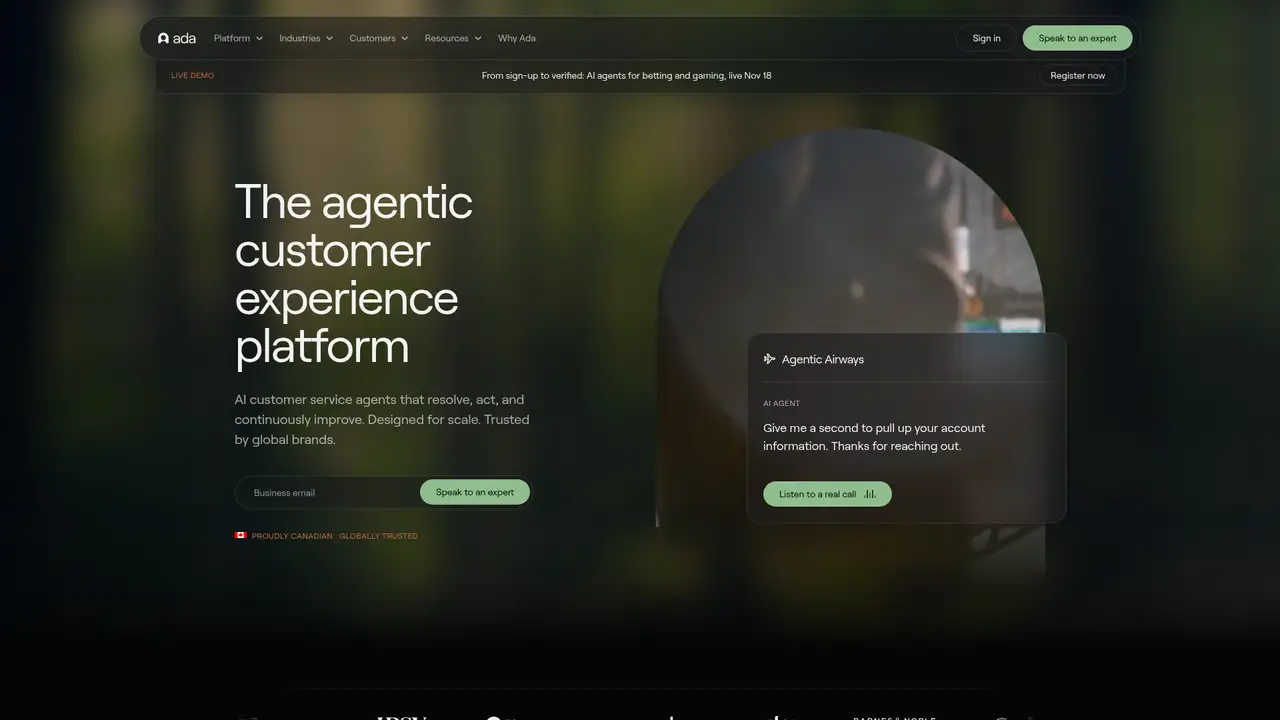
Ada is an enterprise customer service agent platform made by Ada Support, a company founded in 2016. OpenAI describes Ada as valued at $1.2 billion with $200 million in funding, and names Verizon, YETI, Canva, and Square among its customers. Ada’s site reports more than 4.1 billion engaged customer conversations across more than 350 global businesses and deployments in over 85 countries. The company sells software for multilingual customer experiences across digital channels and voice, with a focus on automated resolution rather than basic FAQ deflection. The product is aimed at large support organizations that can manage implementation, knowledge governance, human escalation, and enterprise contracting. It is not a self serve chatbot product with public monthly plans.
Ada deployments begin with a knowledge base, policies, business rules, and connected systems. An AI agent interprets a customer request, retrieves relevant content, invokes an approved API or code tool, follows a Playbook, and escalates when policy or confidence requires human involvement. Playbooks describe multi step procedures in natural language and can be generated from prompts, uploaded SOPs, flowcharts, or an editor. Recommendations can turn escalated resolutions into draft help content. Coaching lets managers annotate conversations to adjust tone, context, or answers, while Scorecards evaluate interactions against custom quality criteria. Ada presents this cycle as an operating model: configure the agent, test workflows, review performance, refine instructions, and deploy improvements across channels. Voice requires a customer Twilio subscription unless an order form says otherwise.
Ada uses a curated set of third party models from OpenAI, Anthropic, and Cohere, selected through testing for accuracy, safety, latency, and cost. OpenAI described Ada’s multi agent design as a central planning agent with supporting subagents, and reported that Ada used GPT 4 and GPT 4o during that collaboration. Ada’s April 2025 GARAGe article describes generative augmented retrieval, which creates representative questions and indexes their answers to improve semantic matching. The May 2025 launch introduced second generation generative voice, Recommendations, Scorecards, Coaching, and Playbooks. July 2025 materials added detail on Playbook creation, API calls, guardrails, adherence supervision, and testing. Release notes dated September 22, 2026 document response time reporting for API tools, while code and MCP tools do not record that metric.
Ada does not publish a dollar price, free tier, seat price, or standard usage allowance. Its pricing page describes conversation based billing as the usual model and resolution based billing for enterprises with specific needs. A July 2025 pricing article gives $0.35 per conversation and $1.50 per resolution as comparison figures, not universal contract rates. Customer terms state that the order form controls fees, purchased conversation overages use Ada’s then current rates, and invoices are issued according to the agreed billing schedule. Automated resolutions are conversations that are not escalated and meet Ada’s relevance, accuracy, and safety definitions. Voice has a default fair use limit of seven minutes per conversation and 100 concurrent conversations per bot when the order form sets no different limit.
Ada’s main drawback is procurement and price opacity: teams cannot build a dependable production budget from a public plan table. Generative outputs can be inaccurate, non unique, or unsuitable for professional advice, so customers retain review and compliance duties. Zendesk AI suits organizations already centered on Zendesk, Intercom Fin fits teams using Intercom, and Salesforce Agentforce is stronger for CRM native actions. Ada offers a more focused combination of cross channel service automation, Playbooks, voice, Coaching, and Scorecards, but it demands enterprise implementation discipline. Its terms also place responsibility for customer data, consent, lawful use, and generated content on the customer. Pick Ada when complex support procedures, voice, and controlled enterprise automation outweigh self serve pricing.
Who is Ada best for?
- Enterprise support teams automating chat, email, messaging, and voice.
- Organizations with complex SOPs and API driven workflows.
- Teams needing Coaching, Scorecards, and controlled escalations.
- Companies budgeting service automation by conversation volume.
Ada Pricing (2026)
Pricing model: Usage-based. All prices in USD.
| Plan | Price | What you get |
|---|---|---|
| Conversation-based | Custom | Ada normally charges by conversation volume. Contracted volume, included channels, overages, and billing schedule are defined in the order form. |
| Resolution-based | Custom | Available for enterprises with specific needs. An automated resolution is a non-escalated conversation meeting Ada’s relevance, accuracy, and safety definitions. |
Pros and Cons
Pros
- Playbooks convert SOPs and flowcharts into editable procedures.
- Voice and digital channels share one agent platform.
- Coaching and Scorecards support quality management.
- Ada says customer data is excluded from provider model training.
Cons
- Ada publishes no standard production dollar price.
- Enterprise contracting complicates casual experimentation.
- Generative output still requires customer validation.
Who should look elsewhere?
- Developers seeking a public free API tier.
- Small teams needing transparent monthly pricing.
- Deployments without human review and governance.
Technical Details
Frequently Asked Questions
How much does Ada cost?
Ada does not publish a standard public price. Its usual model charges by conversation, while resolution based billing is available for some enterprise requirements. A July 2025 pricing article uses $0.35 per conversation and $1.50 per resolution as comparison examples, not universal rates. The order form sets actual fees, volume, overages, and billing schedule.
Does Ada have a free plan?
Ada’s current product and pricing pages describe a sales led enterprise service, not a public free plan or developer tier. Prospective customers request a quote and should confirm included volume, supported channels, integrations, overage rules, retention, service levels, and support terms before signing an order form.
How does Ada compare with Zendesk AI?
Zendesk AI is a natural fit for teams already operating Zendesk and wanting automation within that service suite. Ada is positioned around a dedicated agent platform with Playbooks, voice, Coaching, and Scorecards across channels. Ada’s pricing is less transparent. Existing help desk investment and workflow complexity should decide the choice.
Does Ada train models on customer data?
Ada says customer data is not used to train models and that its large language model providers operate under zero data retention policies. Customer terms allow Ada to create aggregated and de identified information for service improvement and model improvement. Contracts also govern retention, deletion, residency, and processing responsibilities, so customers should review those provisions.
Can Ada be used commercially?
Yes. Ada is sold for commercial enterprise customer service deployments under a customer agreement and order form. Customers remain responsible for permissions, disclosures, lawful use, and generated content. Ada’s service terms warn that generative outputs may be inaccurate, non unique, or non infringing only with no guarantee, and should not provide professional advice.
Best Ada Alternatives in 2026
These tools do the same job as Ada, with different pricing, limits and trade-offs.

Enterprise agents connected to Salesforce data, workflows, and channels

Outcome-priced customer-service automation for helpdesks and support channels

Governed AI agents and workflows for complex enterprise operations
Enterprise AI agents for multilingual contact center conversations
AI agents and copilots built into the Zendesk help desk, billed per verified resolution