
Sierra Review, Pricing & Alternatives (2026)
Enterprise agents for customer service and revenue outcomes
Last updated: October 26, 2026
What is Sierra?
Sierra is an enterprise AI agent platform for customer service, sales, and revenue workflows across chat, voice, email, SMS, WhatsApp, and ChatGPT. Entry pricing is Custom, with contracts based mainly on resolved outcomes or blended consumption rather than public seat or token rates. Agent Studio and the SDK support deployment, testing, integrations, and guardrails.
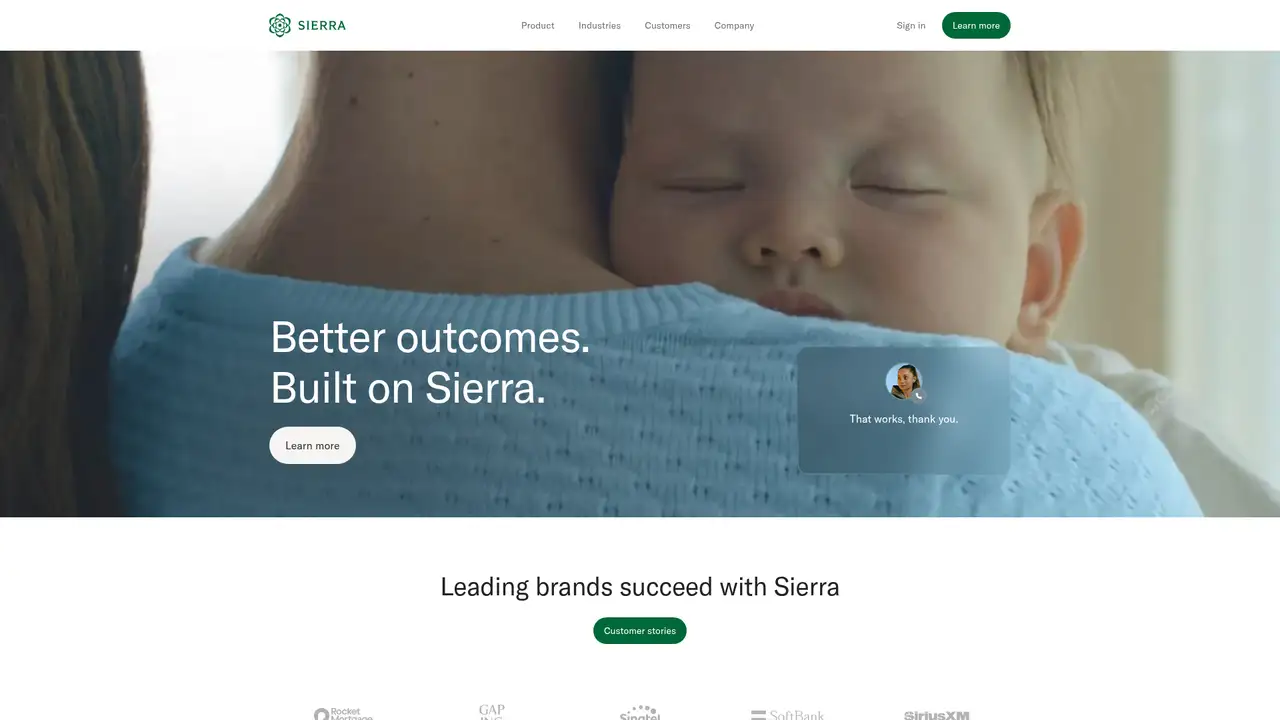
Sierra was founded in early 2024 by Bret Taylor, former Salesforce co-CEO, and Clay Bavor, former Google executive. Fortune reported $110 million raised before its public launch, with Benchmark and Sequoia involved. Reuters later reported a $175 million round at a $4.5 billion valuation in October 2024, while TechCrunch reported $350 million at a $10 billion valuation in September 2025. Sierra’s positioning has broadened from conversational customer service to customer experience, sales, engagement, and revenue agents. The company remains active and has no reported acquisition or shutdown. The company had about 30 employees around its public launch, then expanded its financing to $635 million by September 2025 as its product scope widened toward broader enterprise customer experience and revenue operations.
Sierra lets teams build agents with or without engineering support and deploy one agent across chat, SMS, WhatsApp, email, voice, and ChatGPT. The product page describes support for 59 languages, continuous availability, natural-language context handling, systems-of-record connections, and end-to-end tasks such as insurance claims, returns, and mortgage actions. Agent Studio adds no-code Journeys, operating-procedure generation, instructions, guardrails, traces, knowledge management, gap detection, expert-answer drafting, and more than 40 integrations. The Agent SDK supports goals, composable skills, simulations, debugging, API-call traces, secure actions, handoff summaries, and omnichannel deployment. Sierra also supports custom integrations through MCP, REST, GraphQL, or other interfaces. These capabilities target customer-facing operations rather than a general-purpose consumer chatbot.
Sierra describes a constellation of frontier, open-weight, and proprietary language models with automatic provider switching. Open-weight models are components of the managed service, so their presence does not make Sierra open source. The Agent OS, Agent Studio, and SDK are proprietary. Sierra’s September 2025 announcement described an Agent OS for customer-experience teams and developers, expansion beyond customer service into sales and engagement, and continued investment in agent development. Its trust materials describe controlled systems-of-record actions, supervisor models, monitoring, and enterprise safeguards. Sierra’s model selection is therefore an implementation detail within a managed platform, rather than a customer-controlled model distribution. Sierra’s Agent SDK supports tuning agent behavior from flexible to deterministic, allowing developers to combine broad language-model reasoning with more controlled skills. These features position the platform as managed infrastructure for connected enterprise actions.
Sierra does not publish numeric dollar tiers, seat rates, token rates, or usage allotments. Its primary commercial approach is custom outcome-based pricing, with payment tied to agreed results such as resolved conversations, saved cancellations, upsells, or completed tasks. Sierra says unresolved cases and escalations generally do not incur charges under that model. Where outcome attribution is unsuitable, contracts may use blended consumption, including conversation-based billing for routing or greeter interactions. The entry price is Custom, and limits depend on negotiation and the selected billing method. Sierra lists SOC 2, HIPAA, GDPR, PCI, FedRAMP High, CCPA, CSA STAR, ISO 27001, and ISO 42001 among its security and compliance credentials. Sierra’s outcome criteria are agreed before deployment, so a contract can define what counts as a resolved conversation, saved cancellation, upsell, or completed task. Sierra does not publish minimum commitments or numerical allowances.
Sierra is aimed at large organizations that need autonomous customer interactions, systems-of-record actions, compliance controls, multilingual support, and measurable service outcomes. Intercom and Zendesk are closer to helpdesk products, while Flowise, Langflow, AutoGen, and LlamaIndex are build frameworks offering greater deployment and source control. Sierra provides managed operations, expert deployment, testing, monitoring, guardrails, and enterprise support, although its proprietary design, custom contracts, and lack of a public self-hosted edition reduce price comparability and infrastructure control. Public terms reserve Sierra’s service intellectual property to Sierra and restrict commercial use except as allowed by an applicable service arrangement. Choose Sierra when managed enterprise resolution matters more than public rates or source ownership.
Who is Sierra best for?
- Enterprise customer service automation
- Systems-of-record customer workflows
- Omnichannel support and revenue agents
- Teams needing managed compliance and deployment
Sierra Pricing (2026)
Pricing model: Usage-based. All prices in USD.
| Plan | Price | What you get |
|---|---|---|
| Enterprise outcome-based | Custom | Agreed outcomes such as resolved conversations or completed tasks; numeric limits are not published. |
| Blended consumption | Custom | May use conversation or other consumption billing when outcome attribution is unsuitable; numeric limits are not published. |
Pros and Cons
Pros
- Sierra supports chat, voice, email, SMS, WhatsApp, and ChatGPT deployment.
- Agent Studio provides no-code journeys, guardrails, testing, and monitoring.
- Agent SDK supports simulations, traces, secure actions, and composable skills.
- Sierra lists broad enterprise security and compliance coverage.
Cons
- Sierra does not publish numeric prices or standard usage allowances.
- The platform is proprietary and has no public self-hosted edition.
- Custom outcome attribution can complicate budgeting and vendor comparison.
Who should look elsewhere?
- Small teams seeking self-serve pricing
- Developers requiring open-source or self-hosted control
- Buyers needing fixed per-seat budgeting
Technical Details
Frequently Asked Questions
How much does Sierra cost?
Sierra uses Custom pricing rather than a published numeric rate card. Its main model charges for agreed outcomes such as resolved conversations, saved cancellations, upsells, or completed tasks. Unresolved cases and escalations generally have no charge under that model. Sierra may use blended or conversation-based billing when outcome attribution is unsuitable, so commercial terms require direct negotiation.
Does Sierra have a free plan?
Sierra does not publish a free plan, public self-serve tier, or numeric trial allowance. Its public commercial model describes enterprise arrangements negotiated around outcomes or blended consumption. Prospective customers should request pricing, implementation details, usage assumptions, data terms, and security provisions directly from Sierra. Sierra does not publish details of any trial or evaluation arrangement.
What is the closest competitor to Sierra?
Intercom and Zendesk are close customer-service competitors because they provide support workflows and automated resolutions. Sierra differs through autonomous customer-facing agents, systems-of-record actions, omnichannel deployment, managed implementation, and outcome-based contracts. Flowise, Langflow, AutoGen, and LlamaIndex are alternatives for teams building agent systems themselves, although they are frameworks rather than the same managed enterprise service.
Does Sierra train models on customer data?
Sierra’s public privacy policy does not provide a blanket statement that customer data is never used for training. Its trust material says data is used as instructed, is not shared with other customers, and includes encrypted and masked personally identifiable information. Enterprise buyers should request contractual data-use, retention, and model-training restrictions through the applicable privacy, security, and service terms.
Can Sierra be used commercially, and what license does it use?
Sierra is a commercial managed platform, not an open-source Agent OS. Its public terms reserve Sierra and service intellectual property to Sierra and restrict commercial use of public services except as permitted by an applicable service arrangement. Customers receive access under negotiated service terms rather than a source license for the platform. The exact rights for a customer therefore depend on its contract.