
Greptile Review, Pricing & Alternatives (2026)
Repository-aware AI review for pull requests and coding agents
Last updated: October 26, 2026
What is Greptile?
Greptile is an AI code review agent for software teams that want pull request checks using full codebase context. It supports configurable review depth, team guidance, coding-agent connections, and multiple repositories. Starter is free for one active developer with 50 monthly credits. Pro costs $1 per prepaid credit, while Enterprise pricing is custom.
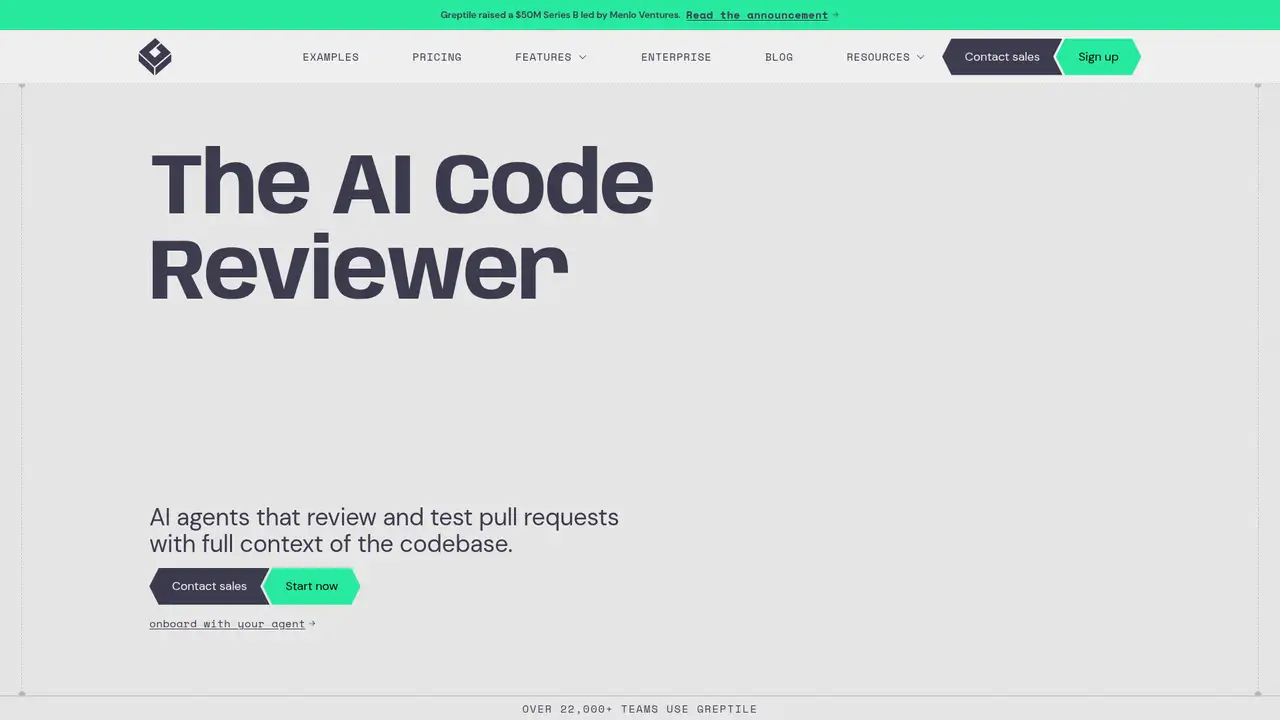
Greptile is an AI code review agent made by Tabnam, Inc., founded by Daksh Gupta after his 2023 Georgia Tech graduation. TechCrunch reported that the company joined Y Combinator’s Winter 2024 cohort and raised a $4 million seed round led by Initialized Capital. Greptile announced a $25 million Series A led by Benchmark Capital on September 23, 2025. The company says its service reviewed more than 500 million lines of code in one month and helped prevent more than 180,000 bugs. Greptile’s public plans are Starter, Pro, and Enterprise. The company is active and publishes current pricing, billing, security, privacy, and integration information.
Greptile reviews pull requests with full codebase context and lets teams control review depth by organization, repository, directory, branch, label, file path, or change size. Teams connect repositories, define coding guidance, and choose Base, Plus, Apex, or Auto. Auto selects a tier using pull request size, risk, and complexity. Greptile can learn standards from human review comments and detect files such as CLAUDE.md and.cursor/rules. Its comments can include prompts for coding agents. Integrations include Jira, Linear, Notion, GitHub, GitLab, Bitbucket, Gitea, Cursor Origin, and Perforce, with availability varying by deployment and plan.
Greptile v3, announced on September 23, 2025, rewrote the core agent architecture. The company says v3 catches three times more critical bugs than v2, a vendor claim that depends on its testing. The release added learning from human review comments, the Greptile MCP server, Jira and Notion integrations, automatic detection of common guidance files, and copyable repair prompts. MCP tools expose repository, review, comment, knowledge-base, and analytics functions to coding agents. Greptile’s documentation describes repository identification, review retrieval, custom instructions, knowledge-base search, and analytics. Greptile also warns that knowledge-base text synthesized from repository content is untrusted and should not be treated as instructions.
Starter is free for one active developer and includes 50 credits each month plus unlimited repositories. Pro has unlimited developers and agents, no seat fees, unlimited repositories, and shared prepaid credits priced at $1 each. Base reviews use one credit, Plus uses three, Apex uses ten, and Auto charges for the tier selected. A TREX run costs three additional credits when a flow reaches pass or fail. New reviews pause when credits run out. Annual and multi-year contracts can receive custom pricing. Enterprise pricing is custom and adds deployment, identity, access, residency, support, and invoicing options. Qualified non-commercial open-source projects can apply for free access, and eligible pre-Series A startups can receive 500 monthly credits for six months.
Greptile’s credit model makes intensive review budgets less predictable than seat-based plans. A large or high-risk pull request can cost ten credits before any TREX charge, and new reviews stop at zero balance. CodeRabbit is the closest comparison for automated pull request review, with a more conventional plan structure. Graphite is stronger for teams centered on stacked changes and pull request workflow. Qodo combines review with broader coding assistance and test-oriented tooling. Greptile stands out through shared organizational credits, repository-wide context, configurable review depth, and MCP access. Self-hosting, SSO, RBAC, and data residency require Enterprise. Choose Greptile if your team needs shared repository context and agent-connected reviews.
Who is Greptile best for?
- Teams reviewing pull requests across multiple repositories.
- Organizations using coding agents alongside human reviewers.
- Developers who want MCP access to reviews and team rules.
- Eligible early-stage startups and qualified open-source projects.
Greptile Pricing (2026)
Pricing model: Usage-based. All prices in USD.
| Plan | Price | What you get |
|---|---|---|
| Starter | $0 | One active developer, 50 credits per month, and unlimited repositories. |
| Pro | $1/credit | Unlimited developers and agents share prepaid credits. Base costs 1 credit, Plus 3, Apex 10, and TREX 3 additional credits. |
| Enterprise | Custom | Adds self-hosting, SSO and SAML, RBAC, data residency, on-premises integrations, security reviews, dedicated support, and custom terms. |
| Open source | $0 | Qualified non-commercial projects with an OSI-approved license can apply for free access. |
Pros and Cons
Pros
- Shared credits avoid per-developer billing.
- Review depth can vary by repository or directory.
- MCP connects review findings with coding agents.
- Enterprise supports self-hosting in customer infrastructure.
Cons
- Deeper reviews increase credit consumption.
- Starter is limited to one active developer.
- Enterprise security features require custom pricing.
Who should look elsewhere?
- Teams requiring predictable per-seat billing.
- Projects needing only local static analysis.
- Organizations needing self-hosting without Enterprise terms.
Technical Details
Frequently Asked Questions
How much does Greptile cost?
Starter is free for one active developer and includes 50 credits per month. Pro charges $1 per prepaid credit, with credits shared across the organization and no seat fees. Base reviews cost one credit, Plus costs three, Apex costs ten, and TREX costs three additional credits. Enterprise pricing is custom.
Does Greptile have a free plan?
Yes. Starter includes one active developer, 50 monthly credits, and unlimited repositories. Qualified non-commercial projects with an OSI-approved license can apply for free access. Pre-Series A startups with under $2 million in revenue during the past 12 months can receive 500 credits monthly for six months.
How does Greptile compare with CodeRabbit?
Greptile uses shared prepaid credits and configurable Base, Plus, Apex, or Auto review tiers. CodeRabbit uses per-developer plans. Greptile emphasizes full codebase context, learned team standards, cross-repository information, and MCP connections. CodeRabbit offers its own plan structure and review workflow, so seat-based billing may suit teams seeking simpler cost forecasts.
Does Greptile train on customer code?
Greptile says it may aggregate and anonymize customer data for analytics, service improvement, and AI training. Organization administrators can turn off Help us improve Greptile in Data & Privacy settings. Self-hosted customers do not have customer data collected or processed for machine learning unless they configure it. Greptile also publishes zero data retention agreements with LLM providers.
Can businesses use Greptile commercially?
Yes. Pro is a team plan for commercial organizations, with unlimited developers and agents using shared prepaid credits. Enterprise adds self-hosting, SSO and SAML, RBAC, data residency, on-premises code-host integrations, security reviews, and custom terms. Free open-source access is limited to qualified non-commercial projects with an OSI-approved license.
Best Greptile Alternatives in 2026
These tools do the same job as Greptile, with different pricing, limits and trade-offs.
AI coding assistance across editors, terminals, and GitHub

Context-aware AI review for pull requests and coding workflows

Stacked pull requests and AI review for engineering teams

AI code review and governance for teams shipping agent-generated software
Developer-first SAST with real-time findings and guided fixes