Snyk Code Review, Pricing & Alternatives (2026)
Developer-first SAST with real-time findings and guided fixes
Last updated: October 26, 2026
What is Snyk Code?
Snyk Code is Snyk’s developer-focused static application security testing product for software teams. Free access costs $0 monthly and includes 100 Code tests, while Team costs $25 monthly at the Snyk platform level. Enterprise uses credit-based pricing through sales, with broader platform capabilities and most API access reserved for that tier.
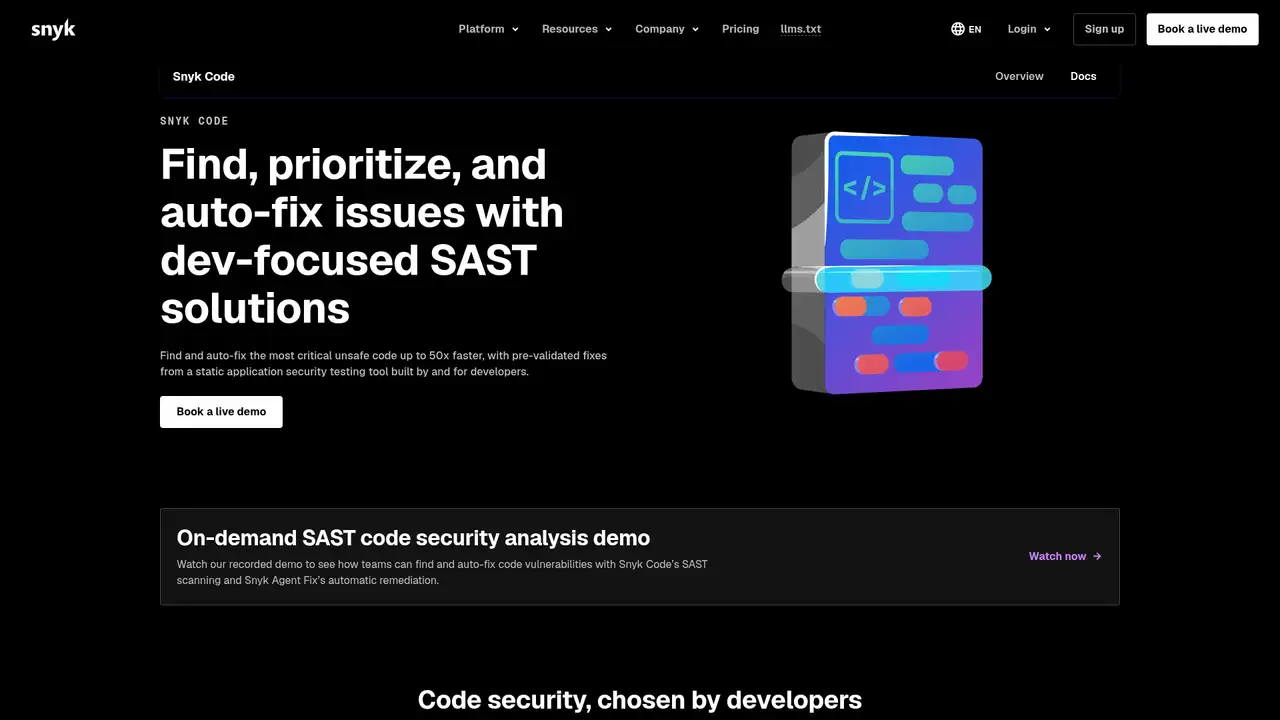
Snyk Code is Snyk’s developer-first static application security testing product, launched on October 21, 2020, after Snyk acquired DeepCode. DeepCode’s machine-learning and semantic code-analysis technology powers its engine. The product remains active within Snyk’s broader application and AI security platform and has not been shut down, separately acquired, or rebranded away. Snyk’s 2021 company announcement reported more than $350 million raised, a $2.6 billion valuation, 200% revenue growth during 2020, and more than 4.5 million vulnerabilities found or fixed. These figures describe Snyk’s historical company position rather than its current scale. Snyk Code is commercial proprietary software, with pricing and deployment connected to the wider Snyk platform. Public or open-source components of the Snyk CLI do not make the hosted Snyk Code engine open source.
Snyk Code operates through the web interface, pull-request checks, IDE plugins for Visual Studio Code, Visual Studio, and JetBrains, source-control repository monitoring, CLI commands, CI/CD integrations, Jira, and REST APIs. It provides real-time inline findings, severity and priority filters, data-flow views, explanations, remediation guidance, and automated fixes. Its semantic engine evaluates API usage, control flow, data flow, type inference, value ranges, templates, and selected hardcoded secrets. The default deployment is SaaS, and Snyk Broker connects the service with self-hosted Git servers. The Local Engine historically supported no-upload scanning but is deprecated, unavailable for new deployments, and scheduled for removal. Snyk describes scans as build-free and claims speeds up to 50 times faster with fixes that are 80% accurate. Those figures are vendor claims, not independent measurements.
Snyk Code uses DeepCode’s semantic, AI-based analysis engine rather than relying only on pattern matching. It models control and data flows, insecure sources and sinks, API behavior, types, and possible variable values. The October 12, 2026 update, available October 26, expanded analysis across Java, Kotlin, Go, TypeScript, JavaScript, Python, C#, PHP, and Ruby. It added configuration-aware import resolution through go.mod, tsconfig.json, and jsconfig.json, along with additional or improved findings for PHP XSS, path traversal, and SQL injection; Java Spring mass assignment; Python XXE; JavaScript deserialization, XXE, and zip slip; C# path traversal; Go SQL injection; and Ruby path traversal and SSRF. Template and serverless analysis also became deeper. A September 2026 update retired the fix-example priority factor, lowering affected scores by up to 200 points without adding, removing, or re-rating findings.
Snyk’s Free plan costs $0 per month and includes 100 Code tests, 200 Open Source tests, 300 IaC tests, and 100 Container tests, with real-time code scanning plus IDE, CLI, and source-control integrations. Team costs $25 per month and is described for development teams of up to 10 developers. It adds higher product test limits, Jira integration, and next-business-day support, but the public pricing page does not identify a separate Snyk Code dollar allocation. Therefore, the Team fee should not be described as an unlimited standalone Snyk Code price. Enterprise is a credit-based platform subscription sold through Snyk’s sales organization, and credits can be applied across capabilities. Most API access is Enterprise-only. Evo features, including AI Pentesting and Coding Agent security, also require Enterprise and are unavailable in Free or Team.
Snyk Code fits teams seeking developer-workflow SAST alongside software composition, container, and infrastructure security. Its SaaS service temporarily clones imported repositories for analysis, while Snyk Broker connects the service with self-hosted Git servers. The Local Engine historically offered a no-upload option, but current documentation marks it deprecated, excludes new deployments, and schedules removal in a future release; existing customers receive support during their contracts. Snyk Code is therefore neither generally self-hostable nor open source, although the CLI supports local and CI/CD scanning. GitHub Advanced Security with CodeQL, GitLab SAST, and Semgrep provide competing workflow integrations, while Checkmarx and Veracode target larger security programs. Snyk Code remains part of Snyk’s broader platform rather than a separately priced product, and its Free and Team allowances are platform-level. Choose Snyk Code when integrated remediation and adjacent security controls matter more than broad self-hosting.
Who is Snyk Code best for?
- Development teams adding SAST to pull requests and IDEs.
- Organizations combining code, dependency, container, and IaC scanning.
- Teams wanting guided remediation inside developer workflows.
- Companies using SaaS with private source-control connections.
Snyk Code Pricing (2026)
Pricing model: Freemium. All prices in USD.
| Plan | Price | What you get |
|---|---|---|
| Free | $0/month | 200 Open Source tests, 100 Code tests, 300 IaC tests, and 100 Container tests; includes real-time scanning and IDE, CLI, and source-control integrations. |
| Team | $25/month | Designed for development teams of up to 10 developers; includes increased product test limits, Jira integration, and next-business-day support. |
| Enterprise | Contact sales | Credit-based platform subscription with credits usable across Snyk capabilities; most API access and Evo capabilities require Enterprise. |
Pros and Cons
Pros
- Strong IDE, repository, CLI, and CI/CD coverage.
- Semantic analysis follows data and control flows.
- Free access includes a defined Code test allowance.
- Enterprise credits span multiple Snyk capabilities.
Cons
- Enterprise API access and pricing require sales contact.
- Local Engine is deprecated and unavailable for new deployments.
- Free and Team plans impose separate product test limits.
Who should look elsewhere?
- Teams requiring a new fully local deployment.
- Buyers seeking a standalone Code-only public price.
- Small projects needing unrestricted test volume.
Technical Details
Frequently Asked Questions
How much does Snyk Code cost?
Snyk Code has a Free plan with $0 monthly pricing and 100 Code tests. Team costs $25 monthly at the Snyk platform level and adds higher limits, Jira, and next-business-day support. Enterprise uses credit-based pricing through sales, so the Team price should not be described as an unlimited standalone Snyk Code subscription.
Does Snyk Code have free access?
Yes. The Free plan includes 100 Snyk Code tests, plus separate allowances for Open Source, IaC, and Container testing. It also includes real-time code scanning and integrations with IDEs, the CLI, and source-control managers. Snyk counts tests separately for each product, so unused allowances in another product do not increase the Code allocation.
What is the closest Snyk Code competitor?
GitHub Advanced Security with CodeQL is a close competitor for teams centered on GitHub pull requests and repository security. GitLab SAST is a natural alternative for GitLab users, while Semgrep offers another developer-focused static analysis workflow. Snyk Code stands out when teams want SAST alongside dependency, container, and infrastructure scanning in one Snyk platform.
Does Snyk Code train on customer code?
Snyk Code temporarily clones imported repositories for SaaS analysis, while private source-control systems can connect through Snyk Broker. Snyk’s published product and documentation pages do not state a complete training policy for customer code. Organizations should review Snyk’s current privacy, retention, residency, and subprocessors terms before adopting the service for sensitive repositories.
Can companies use Snyk Code commercially?
Snyk Code is commercial proprietary software offered through Snyk’s paid and free platform plans. Commercial use depends on the applicable Snyk agreement and plan terms. A commercial subscription does not transfer ownership of Snyk’s analysis engine, rules, service, or generated security intelligence. Open-source components in the Snyk CLI do not make hosted Snyk Code open source.