Qodo Review, Pricing & Alternatives (2026)
AI code review and governance for teams shipping agent-generated software
Last updated: October 26, 2026
What is Qodo?
Qodo is an AI code review and governance platform for engineering teams. It combines pull-request review, repository context, rules, IDE assistance and CLI agents for teams managing AI-written code. Pro Team starts at $30/month for 2,500 pooled credits, while Enterprise pricing is custom.
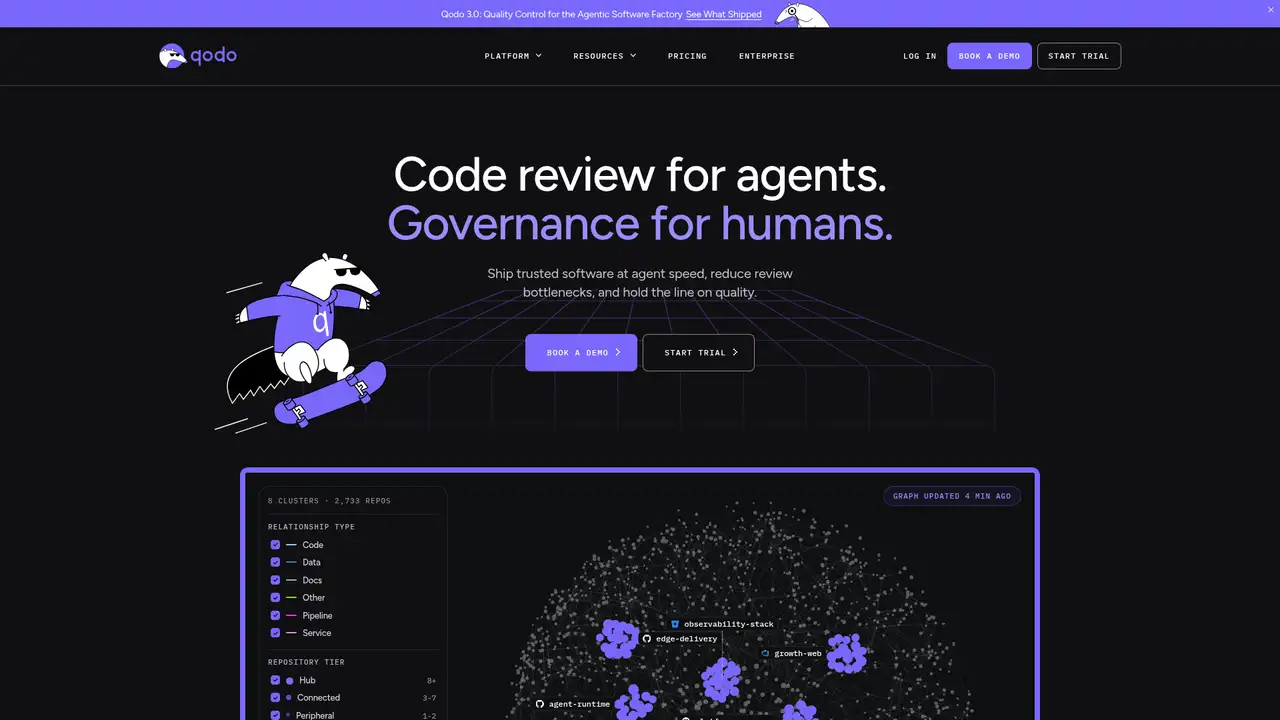
Qodo is an AI code review and governance platform from the company formerly called CodiumAI, which adopted the Qodo name in September 2024. It began with test generation and shifted toward reviewing and governing code written by developers and coding agents. Qodo announced $40 million in Series A funding in 2024 and $70 million in Series B funding in March 2026, bringing reported total funding to $120 million. The company names Nvidia, Walmart, Red Hat, Intuit and Texas Instruments among its customers. Qodo targets engineering organizations rather than casual autocomplete users. Its strongest fit is teams that need repository context, repeatable standards and an audit-friendly review process across multiple repositories, especially when AI-generated changes are entering production workflows.
Qodo’s typical workflow begins in Git, where it analyzes pull requests and returns prioritized findings, explanations and suggested fixes. Teams encode coding standards through rules, while its context engine considers repository structure, pull-request history and business logic alongside the immediate diff. Review can begin earlier through IDE and pre-PR skills. The current product names map to distinct surfaces: Qodo Merge is the Git experience, Qodo Gen is the IDE experience, Qodo Command is the CLI experience, and Qodo Aware is the underlying Context Engine. Published integrations include GitHub, GitLab, Bitbucket and Azure. Dashboards and analytics give managers visibility into review activity and team-wide standards, while rules help apply the same expectations across repositories.
Qodo’s 2026 positioning centers on a multi-agent review system rather than one chat prompt. The company describes a Multi-Agent Fabric, Context Engine and Rules Lifecycle Management as core architectural parts. Specialized agents can inspect bugs, requirements and standards in parallel before combining findings. Qodo launched Command in alpha in June 2025 as a command-line interface for configurable agents, with runs from a terminal or browser and triggers from CI/CD, webhooks or MCPs. In March 2026, Qodo said releases 2.0 and 2.2 added multi-agent review and learning from pull-request history. TechCrunch reported a 64.3 percent Martian Code Review Bench score, a third-party benchmark that does not guarantee identical results for every repository.
Qodo uses pooled credits inside paid team plans. The company offers a 14-day trial without a credit card, then requires a paid plan because there is no permanent general free tier. Pro Team starts at $30 per month for 2,500 credits, estimated at about 18 reviews, and supports up to 30 users. Larger packs cost $60 for 5,000 credits, estimated at 36 reviews, or $240 for 20,000 credits, estimated at 144 reviews. Each credit costs $0.012. Larger or more complex pull requests consume more credits, and overage is charged at the same rate against a customer-set cap. Enterprise pricing is custom and adds SSO/SAML, audit logs, BYOK, governance analytics and single-tenant SaaS or on-premises deployment.
Qodo’s credit meter makes monthly forecasting less direct than a per-seat tool, and the hosted platform has no permanent general free tier. Product renaming also makes older Qodo Merge, Qodo Gen and Qodo Command documentation harder to map. PR-Agent is a separate community-owned project transferred by Qodo in April 2026, with an open-source, self-hostable path under the MIT license. CodeRabbit is the closest hosted comparison, while GitHub Copilot Code Review and Amazon CodeGuru Reviewer cover adjacent review workflows. Snyk Code focuses more on security analysis than a full review equivalent. Choose Qodo if your engineering team needs governed, context-aware review across AI-generated changes and can budget according to review activity.
Who is Qodo best for?
- Engineering teams reviewing AI-generated pull requests across many repositories.
- Organizations that need rules, history and repository context in code review.
- Teams wanting Git, IDE and CLI agents under one quality program.
- Enterprises requiring SSO, audit logs, BYOK or controlled deployment.
Qodo Pricing (2026)
Pricing model: Usage-based. All prices in USD.
| Plan | Price | What you get |
|---|---|---|
| Trial | $0 for 14 days | No credit card; full platform trial. Reviews pause when the trial ends unless a paid plan is selected. |
| Pro Team, 2,500 credits | $30/month | Pooled across a team of up to 30 users; Qodo estimates about 18 reviews per month. |
| Pro Team, 5,000 credits | $60/month | Pooled credits; Qodo estimates about 36 reviews per month, with actual use varying by pull-request complexity. |
| Pro Team, 20,000 credits | $240/month | Pooled credits; Qodo estimates about 144 reviews per month, with overage at $0.012 per credit. |
| Enterprise | Custom | For larger organizations and advanced requirements, including SSO/SAML, audit logs, BYOK, governance analytics and single-tenant or on-premises deployment. |
| Qodo for Open Source | Free for qualified projects | Application-based access for eligible open-source projects; this is separate from the community-owned PR-Agent project. |
Pros and Cons
Pros
- Multi-agent reviews can examine cross-file context and historical decisions.
- Rules and analytics support repeatable team-wide review standards.
- Enterprise plans include BYOK and single-tenant or on-premises options.
- A separate community project preserves a self-hostable PR-Agent path.
Cons
- The hosted platform has no permanent general free tier.
- Credit consumption varies with pull-request size and complexity.
- Product renaming makes older Qodo Merge, Gen and Command documentation harder to map.
Who should look elsewhere?
- Solo developers seeking a permanent free hosted reviewer.
- Teams that prefer predictable per-developer pricing over credit consumption.
- Buyers wanting a fully open-source version of the commercial Qodo platform.
Technical Details
Frequently Asked Questions
How much does Qodo cost?
Qodo Pro Team starts at $30 per month for 2,500 pooled credits, priced at $0.012 per credit. Qodo estimates that pack at about 18 reviews. Published larger packs include $60 for 5,000 credits and $240 for 20,000 credits. Enterprise pricing is custom, and overage uses the same per-credit rate up to a customer-set cap.
Does Qodo have a free plan?
Qodo offers a 14-day trial without a credit card, but its pricing page says there is no permanent general free tier after the trial. Qualified open-source projects can apply for free access. The separate PR-Agent project is community-owned and open source, rather than the free edition of the hosted Qodo platform.
How does Qodo compare with CodeRabbit?
Both products review pull requests with AI and return comments inside development workflows. Qodo differentiates itself with a multi-agent architecture, repository and pull-request history, an organization-wide rules system, pre-PR skills and enterprise deployment controls. CodeRabbit is a direct alternative and may be easier to budget when per-seat pricing is preferable to Qodo’s pooled credit model.
Does Qodo train models on customer code?
Qodo’s documentation says Team and Enterprise users are opted out of model training by default, while free users can request an opt-out. Its security materials say repository code, findings and scan data are not used to train models for the bug-scanner service. Buyers should review the applicable plan terms, privacy policy and data-processing agreement for their deployment.
Can companies use Qodo commercially or host it themselves?
The commercial Qodo platform is intended for business use under paid terms, with Enterprise offering single-tenant SaaS or on-premises deployment. Qodo itself is not an open-source product. The community-owned PR-Agent project is a separate, self-hostable open-source reviewer, and its current repository describes an MIT license. Licensing obligations therefore depend on which product is deployed.
Best Qodo Alternatives in 2026
These tools do the same job as Qodo, with different pricing, limits and trade-offs.