
CodeRabbit Review, Pricing & Alternatives (2026)
Context-aware AI review for pull requests and coding workflows
Last updated: October 26, 2026
What is CodeRabbit?
CodeRabbit is an AI code review service for engineering teams using GitHub, GitLab, pull requests, IDEs, and coding agents. A Free plan costs $0, while paid access starts at $24 per developer per month billed annually, or $30 month to month. It suits teams that need automated feedback without making code generation the main workflow.
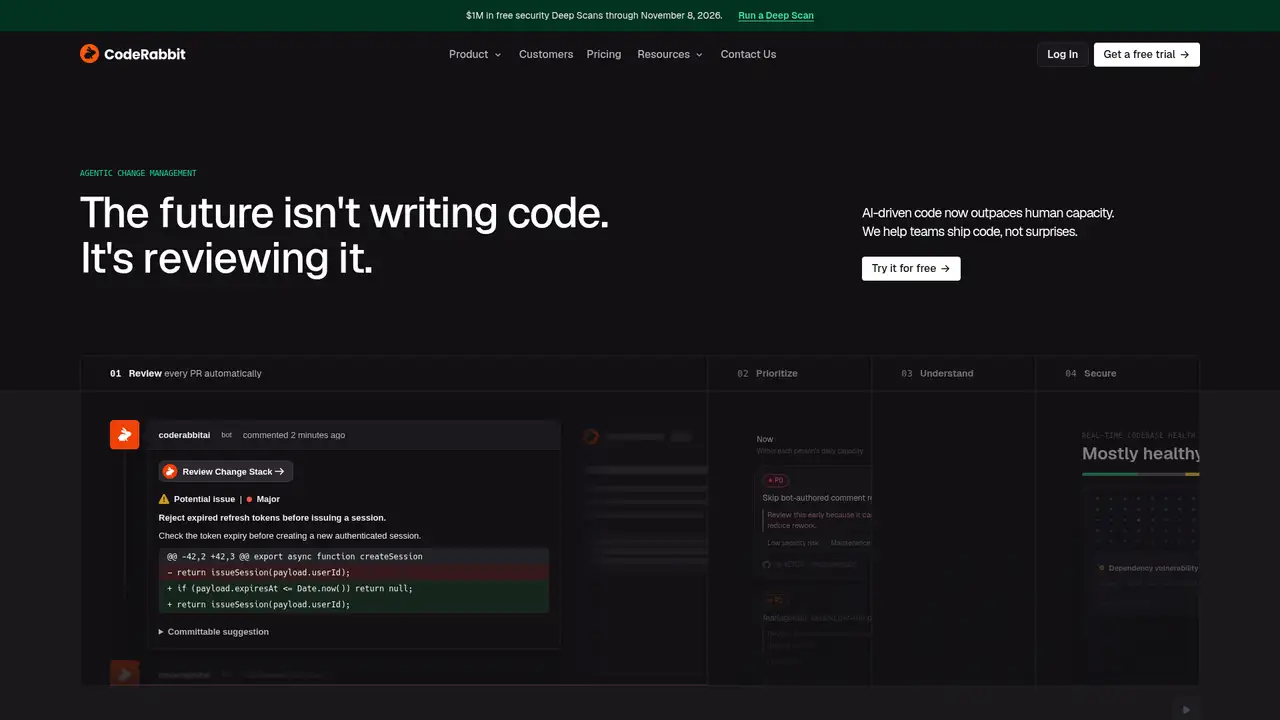
CodeRabbit is an AI-powered code review company founded by Harjot Gill in early 2023. The service reviews pull requests and supports repository, IDE, CLI, and coding-agent workflows. In September 2025, the company said it had been installed on 2 million repositories, reviewed 13 million pull requests, and served more than 100,000 open-source projects. TechCrunch reported more than 8,000 business customers and over $15 million in annual recurring revenue. CodeRabbit raised a $60 million Series B in September 2025, bringing total funding to $88 million and valuing the company at $550 million. The round was led by Scale Venture Partners, with participation from NVentures and returning investors. CodeRabbit also acquired FlexNinja in 2023.
CodeRabbit reviews pull requests with repository context, producing summaries, line-level findings, and suggestions covering correctness, security, performance, and coding practices. Developers can discuss comments inside the pull request, ask CodeRabbit Chat questions, apply one-click fixes, or review from an IDE or CLI. A normal workflow begins when a developer opens a pull request or pushes changes to a working branch. CodeRabbit analyzes the diff with history, linters, issue context, code graphs, conversations, and configured learnings, then posts feedback. The developer addresses findings, pushes another revision, and receives an incremental review. Team adds triage, issue planning, unit test generation, and merge conflict resolution. Advanced adds continuous pull request security review. Deep Scan and Agent are separate paid products.
CodeRabbit uses a multi-step review system that combines repository context with several language models. OpenAI describes o3 and o4-mini handling multi-line bugs, refactors, and architecture issues, while GPT-4.1 supports summaries, docstrings, and routine checks with a 1 million token context window. The company says customer code is not used for model training, although code is shared with OpenAI or Anthropic for review. In 2025, CodeRabbit expanded Visual Studio Code reviews and announced CodeRabbit CLI for terminal workflows and coding agents. Its plan matrix also lists MCP context, custom pre-merge checks, unit test generation, and continuous pull request security review. The published product announcements identify no 2026 release.
The Free plan costs $0 and allows unlimited public and private repositories, but it provides pull request summarization only. Free users can access code reviews through the Visual Studio Code extension and CLI, with one PR review and three IDE or CLI reviews per developer per rolling hour. Essentials costs $30 per developer monthly, or $24 with annual billing, and includes five PR, IDE, and CLI reviews per hour. Team costs $60 monthly, or $48 annually, with eight reviews. Advanced costs $90 monthly, or $72 annually, with ten reviews. Enterprise is custom and includes twelve reviews per hour. Eligible paid accounts can continue some over-limit reviews at $0.25 per reviewed file. Agent costs $0.40 per minute, while Security Scan pricing varies.
CodeRabbit’s AI findings remain review assistance, not a replacement for tests or maintainers, and the company does not guarantee complete accuracy. Full pull request reviews begin with Essentials, while Deep Scan, Security Scan, Agent, and over-limit reviews can add charges. Greptile uses prepaid credits and review-depth pricing, whereas CodeRabbit uses per-developer plans with broader workflow features. Graphite focuses more heavily on pull request workflow and stacked changes. GitHub Copilot covers code generation and broader developer assistance rather than concentrating on dedicated review. CodeRabbit also processes customer code through external model providers, despite its stated training restrictions. Pick CodeRabbit if your team wants repository-aware review across pull requests, IDEs, CLI, and coding agents.
Who is CodeRabbit best for?
- Engineering teams reviewing AI-generated pull requests.
- Organizations needing pull request, IDE, CLI, and agent access.
- Open-source projects eligible for Team features.
- Teams wanting automated pre-merge checks and fixes.
CodeRabbit Pricing (2026)
Pricing model: Freemium. All prices in USD.
| Plan | Price | What you get |
|---|---|---|
| Free | $0 | Unlimited public and private repositories with pull request summarization. Includes 1 PR review and 3 IDE or CLI reviews per developer per rolling hour. |
| Essentials | $24/user/month annually, $30/month | Adds PR reviews, fixes, integrations, Knowledge Base, analytics, docstrings, and pre-merge checks. Includes 5 PR, IDE, and CLI reviews per developer per rolling hour. |
| Team | $48/user/month annually, $60/month | Adds triage, CodeRabbit Plan, issue planning, unit test generation, merge conflict resolution, and related actions. Includes 8 reviews per developer per rolling hour. |
| Advanced | $72/user/month annually, $90/month | Adds continuous pull request security review through CodeRabbit Security. Includes 10 PR, IDE, and CLI reviews per developer per rolling hour; Deep Scan costs extra. |
| Enterprise | Custom | Adds self-hosting options, multi-organization support, SSO, SLA support, API access, custom RBAC, audit logging, and 12 reviews per developer per rolling hour. |
Pros and Cons
Pros
- It covers pull request, VS Code, CLI, chat, and agent workflows.
- Paid tiers add fixes, checks, triage, testing, and planning.
- Qualified open-source projects receive Team features without payment.
- Enterprise includes self-hosting options and audit controls.
Cons
- The Free plan provides summarization and limited full review access.
- Per-developer pricing increases with team size.
- Deep Scan and over-limit reviews can add usage charges.
Who should look elsewhere?
- Teams requiring fully local review on a small budget.
- Developers seeking code generation as the primary product.
- Organizations unwilling to share code with external review providers.
Technical Details
Frequently Asked Questions
How much does CodeRabbit cost?
CodeRabbit has a Free plan. Essentials costs $24 per developer per month billed annually or $30 month to month. Team costs $48 annually or $60 month to month, and Advanced costs $72 annually or $90 month to month. Enterprise pricing is custom. Over-limit reviews, Deep Scan, Security Scan, and Agent can create separate charges.
Is CodeRabbit free?
Yes. The Free plan supports unlimited public and private repositories without a credit card. It provides pull request summarization, while code reviews are available through the Visual Studio Code extension and CLI. New organizations receive a 14-day Advanced trial. Eligible open-source projects receive Team features without a paid subscription.
How does CodeRabbit compare with Greptile?
CodeRabbit uses per-developer plans from Free through Enterprise and adds review fixes, pre-merge checks, triage, testing, and planning at higher tiers. Greptile uses shared prepaid credits and focuses on cross-repository context and MCP access. CodeRabbit covers more review workflow stages, while Greptile centers more tightly on repository-aware analysis.
Does CodeRabbit train on customer code?
CodeRabbit says it never uses customer code to train models. It says proprietary code is shared with OpenAI or Anthropic for review, and neither provider uses that code for model training. Data retention controls stored code-related context, while optional model output logging can place outputs and reasoning from private reviews in support troubleshooting logs.
Can businesses use CodeRabbit commercially?
Yes. CodeRabbit sells Essentials, Team, Advanced, and Enterprise plans for organizations. Enterprise includes self-hosting options, SSO, SLA support, API access, custom RBAC, and audit logging. Businesses should review deployment, retention, model-provider, usage billing, and support terms before adoption, especially when enabling over-limit reviews or separately priced products.
Best CodeRabbit Alternatives in 2026
These tools do the same job as CodeRabbit, with different pricing, limits and trade-offs.
AI coding assistance across editors, terminals, and GitHub

Repository-aware AI review for pull requests and coding agents

Stacked pull requests and AI review for engineering teams

AI code review and governance for teams shipping agent-generated software

Developer-first SAST with real-time findings and guided fixes