
folk Review, Pricing & Alternatives (2026)
Collaborative relationship CRM for contacts, pipelines and outreach
Last updated: October 26, 2026
What is folk?
folk is a collaborative relationship CRM for startups, agencies and sales teams managing contacts, companies, pipelines and communications. It combines shared records with email campaigns, enrichment, sequences and AI-assisted fields. Standard costs $30 per member monthly, or $24 per member monthly with annual billing, with usage limits for messages, enrichment and magic fields.
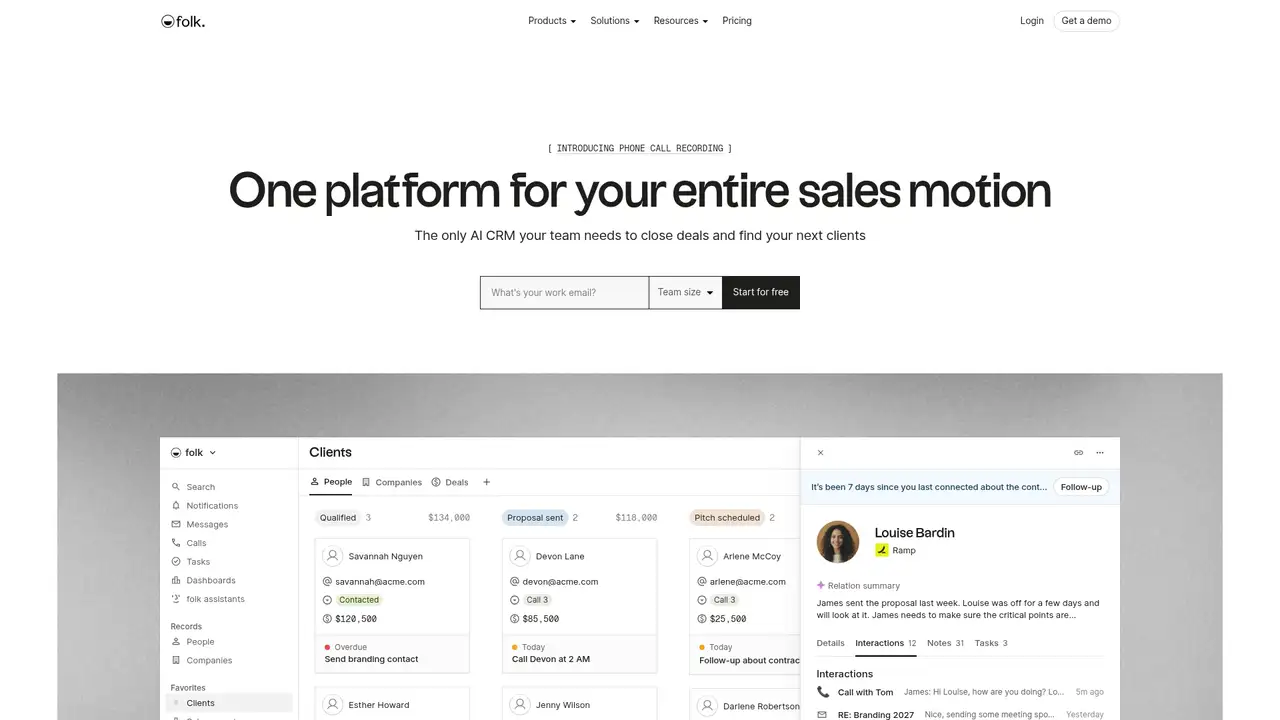
folk is a cloud relationship CRM for teams managing contacts, companies, groups, pipelines and communications in shared workspaces. The company says it formed within eFounders, now Hexa, around 2020, and publicly launched in 2022. TechCrunch reported a $3.3 million seed round led by Accel and 35 angels in September 2021, while folk has described total 2021 funding of about $9 million. The product uses the term xRM to describe records that include communication context, enrichment and flexible relationship workflows. It targets startups, agencies and sales teams that need adaptable records without adopting a larger enterprise CRM suite. The hosted product is available through browser workspaces, and no public self-hosted or open-source edition is identified.
folk combines contact management with groups, pipelines, custom objects and communication synchronization. A typical workflow starts with importing or collecting people and companies, then organizing them in groups or deal pipelines. Teams can connect email, calendars and WhatsApp, add contacts through the LinkedIn extension, enrich records and create custom fields for a workspace. Email campaigns support broadcast outreach, while Premium adds sequences for structured follow-up. Dashboards and deals provide reporting and pipeline views on higher plans. The API covers people, companies, groups, custom fields, custom objects, deals, enrichments, credits and webhooks. Developer documentation also describes batch create, update and delete operations for up to 100 records per batch, alongside REST and JSON requests over HTTPS.
folk does not name an underlying AI model. Its privacy documentation says managed providers, including OpenAI, process task-relevant content for features such as enrichment and formatting. The company says customer data and personal data are not used to train AI models, and that AI features can be disabled. Product materials published for the current period emphasize AI assistants and magic fields rather than a separately branded model release. The developer platform uses Bearer API keys, webhooks, versioning and rate limits, although exact rate-limit numbers are not published in the reviewed documentation. API access is included with Premium and available through Enterprise. Recent product positioning therefore centers on AI-assisted CRM fields and workflow automation rather than a proprietary foundation model.
folk charges per member, with Standard priced at $30 per member monthly or $24 per member monthly with annual billing. Standard includes unlimited contacts, 2,000 messages per member monthly, 500 contact enrichments per workspace monthly and 2,000 magic fields per workspace monthly. Premium costs $60 monthly or $48 annually, raising those allowances to 5,000 messages, 1,000 enrichments and 5,000 magic fields, while adding sequences, dashboards, deals, API access and advanced permissions. Enterprise starts at $100 per member monthly or $80 annually, with custom limits and security controls. A two-week Premium trial requires no credit card. After expiry, the account is blocked unless upgraded, although trial guidance says data is not immediately deleted. Seat billing and prorating apply.
folk's main limitation is scope. It combines relationship management with outreach features, while Reply.io focuses on multichannel outbound execution across email, LinkedIn, calls and SMS. HubSpot CRM covers a broader CRM and marketing suite, whereas folk concentrates on flexible relationship records and shared context. Pipedrive is more centered on sales pipelines, while folk adds groups, enrichment, messaging synchronization and custom relationship structures. Per-member pricing and metered allowances can become expensive for larger teams, and API access starts with Premium. folk also lacks a public self-hosted or open-source edition. Choose folk if your team needs a flexible relationship CRM with collaborative contact workflows, synchronized communication context and lightweight AI.
Who is folk best for?
- Teams sharing relationship context across contacts, companies and groups.
- Agencies managing several client pipelines in one workspace.
- Startups wanting flexible CRM records without enterprise administration.
- Sales teams needing email, calendar and WhatsApp synchronization.
folk Pricing (2026)
Pricing model: Paid. All prices in USD.
| Plan | Price | What you get |
|---|---|---|
| Standard | $30/member/month, or $24/member/month billed annually | Unlimited contacts, 2,000 messages per member monthly, 500 contact enrichments per workspace monthly and 2,000 magic fields per workspace monthly. |
| Premium | $60/member/month, or $48/member/month billed annually | Unlimited contacts, 5,000 messages per member monthly, 1,000 contact enrichments per workspace monthly and 5,000 magic fields per workspace monthly. Adds sequences, dashboards, deals and API access. |
| Enterprise | From $100/member/month, or from $80/member/month billed annually | Custom limits for enrichments, messages, account synchronization and AI fields. Adds security controls, group permissions and onboarding support. |
| Premium trial | Free for two weeks | Includes Premium features without a credit card. The account is blocked after expiry unless upgraded, while data is not immediately deleted. |
Pros and Cons
Pros
- Flexible groups, pipelines, custom objects and fields support varied sales processes.
- Email, calendar, WhatsApp and LinkedIn connections keep communication context with records.
- Premium includes sequences, dashboards, deals, permissions and API access.
- The company says customer data is not used to train its AI models.
Cons
- Per-member pricing combines with metered messages, enrichments and magic fields.
- API access is unavailable on Standard.
- folk has no public self-hosted or open-source edition.
Who should look elsewhere?
- Organizations needing a specialist high-volume outbound sequencer.
- Teams requiring self-hosting or an open-source CRM.
- Large companies seeking unlimited activity without seat or usage limits.
Technical Details
Frequently Asked Questions
How much does folk cost?
folk Standard costs $30 per member monthly, or $24 per member monthly with annual billing. Premium costs $60 monthly or $48 annually. Enterprise starts at $100 monthly or $80 annually per member. Plans also impose usage allowances for messages, contact enrichments and magic fields.
Does folk have a free plan?
folk does not publish a permanent free plan. It offers a two-week Premium trial without requiring a credit card. When the trial ends, the account is blocked unless the workspace upgrades. Trial guidance says data is not immediately deleted after the account becomes blocked.
How does folk compare with Reply.io?
folk is a relationship CRM for shared contacts, companies, groups, pipelines and communications. Reply.io is primarily a sales engagement platform for multichannel sequences, mailboxes, LinkedIn, calls, SMS and warmup. They overlap on contacts and email, but folk fits relationship management better, while Reply.io focuses on outbound execution.
Does folk train AI models on customer data?
folk says it does not use customer data or personal data to train AI models. Its AI features can involve managed providers such as OpenAI, with task-relevant content sent for processing. folk says data is encrypted in transit and at rest, and that customers can disable AI features.
Can businesses use folk commercially?
folk is designed for ordinary commercial CRM use, including contact management, pipelines, communications and relationship workflows. The company does not describe a general prohibition on commercial use in the reviewed materials. Customers remain responsible for checking current terms, privacy documentation and messaging laws before running campaigns or republishing generated content.
Best folk Alternatives in 2026
These tools do the same job as folk, with different pricing, limits and trade-offs.

Visual sales CRM for pipelines, activities, automation and growth

Flexible CRM for configurable go-to-market operations.

Multichannel sales engagement with sequences, deliverability tools, and AI SDR
CRM-grounded AI assistants, agents, and workflows for go-to-market teams