
Attio Review, Pricing & Alternatives (2026)
Flexible CRM for configurable go-to-market operations.
Last updated: October 22, 2026
What is Attio?
Attio is a cloud CRM for teams needing flexible records, custom objects, relationship context, synced email and calendars, workflows, reporting, and AI features. It supports web, desktop, mobile, REST API, integrations, and developer tools, with pricing starting at $0 per user monthly on the Free tier. Plus, Pro, and Enterprise add capacity and advanced controls, with Enterprise priced by quote.
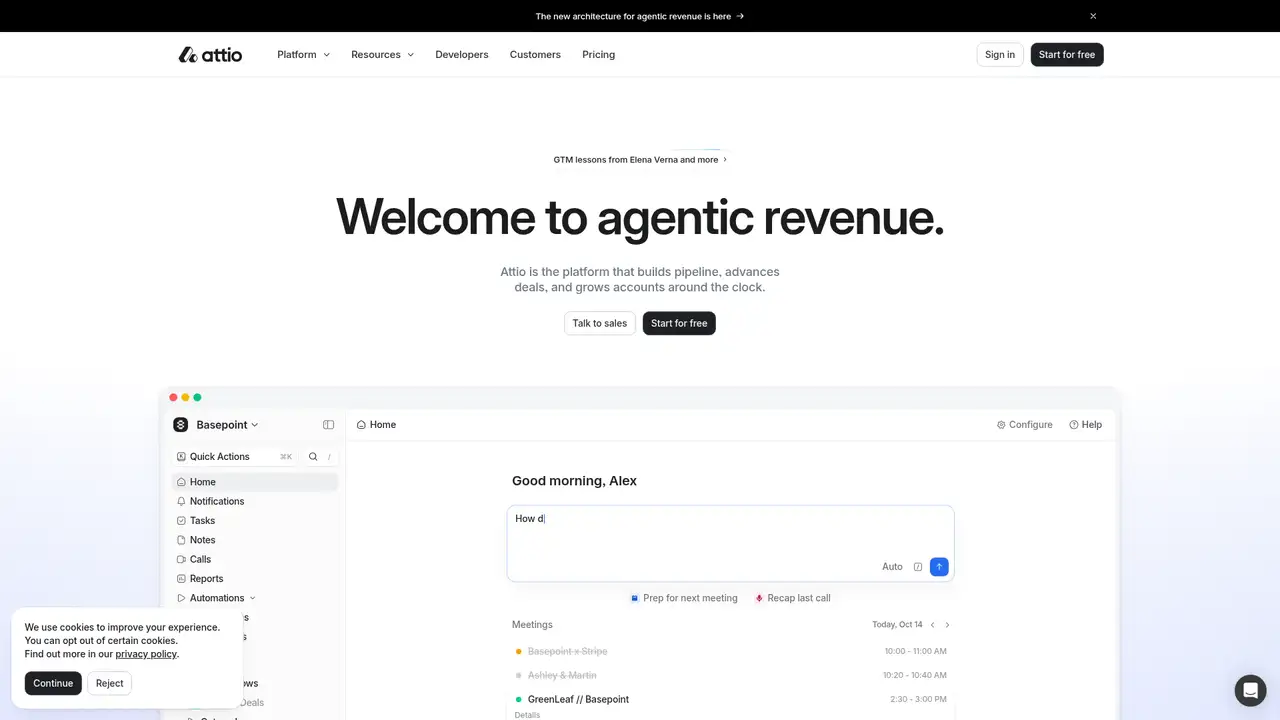
Attio was founded in 2019 by Nicolas Sharp and Alexander Christie-Miller and became generally available in March 2023 after about three years of development. The company raised $23.5 million in Series A funding, according to TechCrunch. Attio is a hosted CRM built around flexible records, custom objects, lists, views, workflows, and filtering across business information. It also supports people and company records, deals, relationship intelligence, email and calendar syncing, reporting, notes, meetings, call intelligence, enrichment, AI features, integrations, a REST API, and developer tools. This structure suits startup and scale-up teams whose sales processes do not fit fixed contact, account, and opportunity fields. Attio is proprietary and not self-hosted. Its Free plan costs $0 per user monthly, with Plus, Pro, and custom Enterprise tiers. Teams needing flexible, relationship-driven CRM operations should choose it.
Attio is a hosted commercial CRM for sales and broader go-to-market work. It provides people and company records, deals, custom objects, relationship intelligence, email and calendar syncing, sequences, reporting, notes, meetings, call intelligence, workflows, enrichment, and Ask Attio. Its REST API, OAuth, developer tools, integrations, and MCP capabilities let teams connect external services and build workflows around their own data model, subject to plan limits and service terms. Attio is proprietary software with no public open-source core or self-hosted edition, so customers use the vendor-hosted service and supported integration surfaces. It suits teams that need configurable CRM structure, relationship context, and API or workflow extensibility, particularly startup and scale-up sales teams with evolving processes. Choose Attio if you need adaptable go-to-market operations and can manage configuration.
Attio offers four pricing tiers. Free costs $0 per user per month and supports up to three seats, 50,000 records, 250 workspace credits monthly, and 100 Ask Attio seat credits per user monthly. Plus costs $44 per user monthly or $35 per user monthly with annual billing, supports up to ten seats, and includes 250,000 records, 1,500 workspace credits monthly, and 500 Ask Attio seat credits per user monthly. Pro costs $99 monthly or $79 annually per user, has no stated seat limit, and includes 10,000 workspace credits monthly and 1,000 Ask Attio seat credits per user monthly. Enterprise is custom priced annually, with no stated seat limit, unlimited objects and teams, security and administration controls, SAML, and 2,500 Ask Attio seat credits per user monthly. Teams needing flexible CRM pricing should choose it.
Attio’s recent product work focuses on AI-assisted CRM operations, developer access, and workflow automation. Its 2025 changelog lists a developer platform, App SDK, call-recording APIs, multilingual transcripts, meeting and call APIs, and integration updates. The 2026 changelog lists workflows with AI agents, Ask Attio actions, MCP, additional model support, formula attributes, mobile improvements, expanded workflow blocks, applications, and developer-platform changes. Attio’s privacy policy describes separate controller and processor roles, contractual mechanisms for international transfers, and restrictions on using Google data for advertising. These details describe documented product and policy capabilities without naming an unsupported model. Attio is best suited to teams needing a configurable CRM, API and workflow extensibility, and relationship-focused go-to-market operations.
Compared with Salesforce, Attio offers a lighter, more configurable data model, while Salesforce provides broader enterprise administration, customization, and application coverage. HubSpot delivers a bundled marketing, service, content, and sales suite, whereas Attio centers on flexible records and relationship context. Compared with Folk, Attio provides broader API, workflow, AI, and developer-platform capabilities, while Folk may suit lightweight relationship tracking. Attio is a proprietary, vendor-hosted CRM with web, desktop, mobile, REST API, integrations, and MCP access, but no self-hosted edition. Its Free plan costs $0 per user monthly, while Plus and Pro provide expanded capabilities and Enterprise is custom priced annually. Teams should consider alternatives if they need extensive enterprise controls, built-in marketing breadth, or self-hosting. Attio is best for teams prepared to define their operating model and manage configuration.
Who is Attio best for?
- Attio suits teams that need a configurable CRM data model.
- It fits startup and scale-up sales teams with evolving processes.
- It supports teams that need API and workflow extensibility.
- It works well for relationship-driven go-to-market operations.
Attio Pricing (2026)
Pricing model: Freemium. All prices in USD.
| Plan | Price | What you get |
|---|---|---|
| Free | $0 per user/month, billed monthly or annually | Up to 3 seats; 50,000 records; 250 workspace credits/month; 100 Ask Attio seat credits/user/month. |
| Plus | $44 per user/month billed monthly, or $35 per user/month billed annually | Up to 10 seats; 250,000 records; 1,500 workspace credits/month; 500 Ask Attio seat credits/user/month. |
| Pro | $99 per user/month billed monthly, or $79 per user/month billed annually | No stated seat limit; advanced permissions, reporting, sequences and call intelligence; 10,000 workspace credits/month; 1,000 Ask Attio seat credits/user/month. |
| Enterprise | Custom per user/month, billed annually | No stated seat limit; unlimited objects and teams, security and admin controls, SAML, and 2,500 Ask Attio seat credits/user/month. |
Pros and Cons
Pros
- Attio provides a flexible custom-object data model.
- It offers API, developer-platform, and integration capabilities.
- It combines email, calendar, relationship, and AI context.
- Its Free, Plus, and Pro pricing is publicly listed.
Cons
- Enterprise pricing is custom rather than publicly listed.
- Attio provides no self-hosted deployment option.
- Flexible configuration can require ongoing governance.
Who should look elsewhere?
- It is unsuitable for organizations requiring self-hosted deployment.
- It may not fit buyers seeking a broad all-in-one marketing suite.
- It can challenge teams unwilling to configure data models.
Technical Details
Frequently Asked Questions
When did Attio launch?
Attio was founded in 2019 and became generally available in March 2023. The company says it spent about three years building before general availability. Its product has since expanded from flexible CRM records into email, calendar, calls, workflows, AI, mobile applications, integrations, and a developer platform.
How much does Attio cost?
Attio has a Free plan at $0 per user per month. Plus costs $44 per user per month monthly or $35 annually. Pro costs $99 monthly or $79 annually per user. Enterprise is custom and billed annually. Annual Plus and Pro prices are presented as discounted rates.
Is Attio open source or self-hosted?
No. Attio is proprietary hosted SaaS. It provides APIs, OAuth, SDK capabilities, integrations, and developer tools, but those do not constitute an open-source or self-hosted edition. Organizations with strict deployment requirements should ask Attio about contractual, regional, and security controls before selecting it.
Does Attio have an API?
Yes. Attio provides a REST API and developer platform with OAuth, documentation, SDK and app-building capabilities. Its updates include APIs for records, notes, meetings, calls, files, and other CRM operations. Availability, rate limits, permissions, and feature access can depend on the workspace and current product terms.
How does Attio compare with HubSpot?
Attio focuses on flexible CRM structure, relationship context, extensibility, and configurable objects. HubSpot offers a broader bundled suite spanning marketing, service, content, and sales, with more predefined workflows. Attio suits teams wanting an adaptable system of record, while HubSpot may be preferable when an integrated marketing and service stack matters most.
Best Attio Alternatives in 2026
These tools do the same job as Attio, with different pricing, limits and trade-offs.