Fabi.ai Review, Pricing & Alternatives (2026)
AI-assisted analysis for teams working across SQL, Python, and business data
Last updated: October 26, 2026
What is Fabi.ai?
Fabi.ai is an AI-native business intelligence platform for product, revenue, marketing, and data teams. It combines natural-language analysis with SQL, Python, dashboards, Smartbooks, collaboration, and scheduled workflows across databases, warehouses, spreadsheets, and applications. A free Starter plan includes 25 AI requests monthly, while paid plans start at $39 per seat monthly.
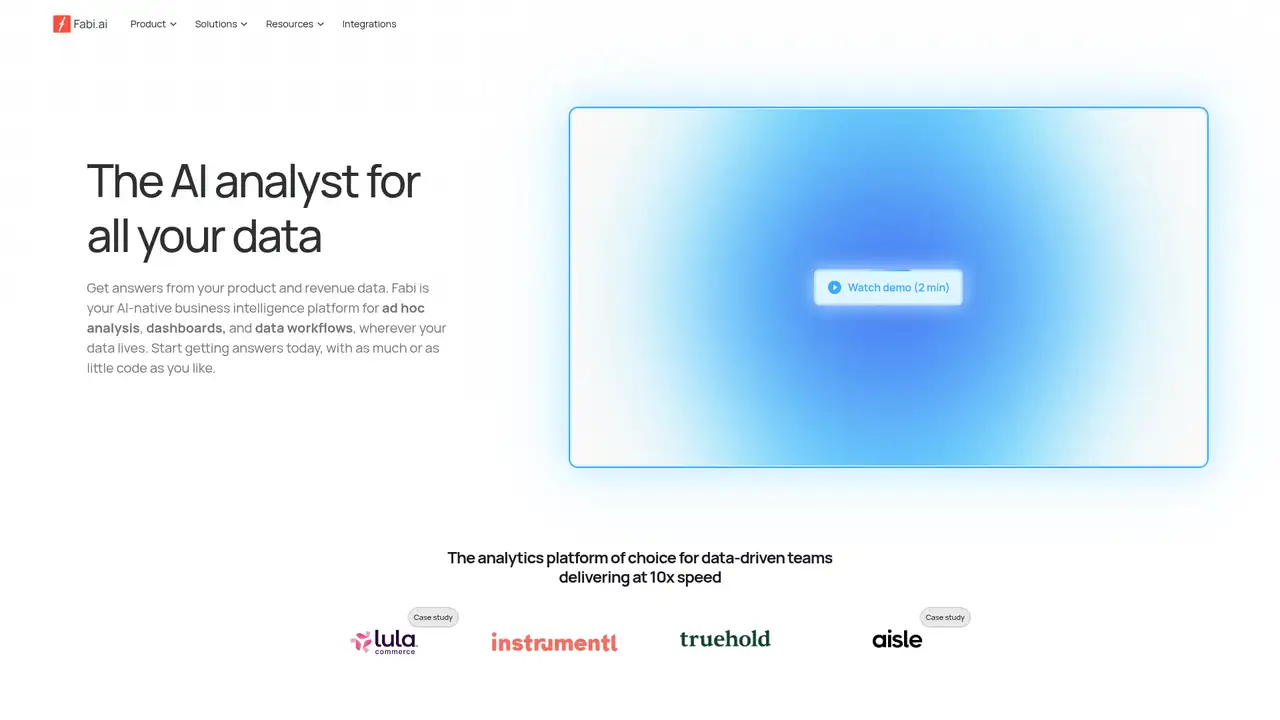
Fabi.ai is an AI-native business intelligence platform made by Fabi, Inc. The company says the product launched in 2023, when founders Marc Dupuis and Lei Tang began addressing the recurring gap between business questions and data-team capacity. Fabi announced a $3 million seed investment in July 2023, led by Eniac Ventures with Outlander and Recall Capital. The platform targets product, revenue, marketing, customer success, and data teams that need ad hoc analysis without sending every request to a specialist. Its scope is broader than a dashboard builder: Fabi combines SQL, Python, no-code analysis, AI-generated code, dashboards, Smartbooks, collaboration, and automated delivery. The company also publishes SOC 2 Type 2 compliance information and describes the service as designed for businesses.
The typical Fabi workflow starts with a Smartbook, where a user connects a database, warehouse, SaaS application, Google Sheet, or uploaded file. Supported sources include Snowflake, BigQuery, PostgreSQL, Redshift, MySQL, ClickHouse, MotherDuck, HubSpot, Google Ads, Shopify, Salesforce, and Google Analytics. A product or revenue analyst can combine SQL, Python, AI cells, and no-code steps to clean records, join tables, check results, and create charts, dashboards, or shared reports. The Analyst Agent can work from approved datasets, generate SQL or Python, run validation steps, and return findings for review. Workflows then send recurring summaries or data extracts to email, Slack, or Google Sheets. This setup suits teams that need repeatable analysis without routing every question through a data specialist.
Fabi’s technology is presented as a Python-native analysis environment with an autonomous Analyst Agent, retrieval-augmented generation over schemas and semantics, SQL and Python execution, and separate user kernels for shared reports. The company says the agent can plan a task, select tools, retrieve relevant context, dry-run generated code, and install Python packages when advanced analysis needs them. In February 2025, Fabi introduced Analyst Agent for curated, specialized data agents with dataset-level access controls. In June 2025, it introduced Workflows, which connect sources such as Snowflake, Databricks, MotherDuck, Google Sheets, and Airtable to destinations including email, Slack, and Google Sheets. Fabi also offers an MCP server with token and OAuth authentication.
Fabi’s Starter plan is free and includes 25 AI requests per month, five Smartbooks, ten dashboard viewers, one database connector, 50MB file uploads, and one builder seat. Builder costs $39 per seat monthly and raises the allowance to 300 AI requests, ten Smartbooks, 25 viewers, 100MB uploads, and up to three builder seats. Team costs $50 per seat monthly and includes unlimited AI requests and Smartbooks, 50 viewers, two database connectors, 500MB uploads, and four or more builder seats. Builder and Team include 14-day trials, not permanent paid access. Application connectors cost $100 monthly each, including 200,000 record updates, with extra records priced at $50 per 100,000 and a configurable $400 overage cap.
Fabi’s main limitation is that its strongest collaboration and automation features require paid seats, connector charges, or both. Starter works for testing a Smartbook or connecting a small sample, but 25 monthly AI requests, one database connector, five Smartbooks, and 50MB uploads can restrict regular team analysis. Teams using Salesforce, Shopify, or other application sources must also budget separately for each connector and its record updates. Julius.ai is a cheaper fit for lightweight file analysis, while Fabi adds database connections, version control, curated datasets, and scheduled workflows for professional teams. Hex is a closer alternative for collaborative SQL and Python notebooks with shareable apps, and Deepnote suits notebook-centered work with a free tier. Pick Fabi.ai when governed, AI-assisted analysis must connect business data to repeatable reports and workflow delivery.
Who is Fabi.ai best for?
- Product and revenue teams exploring operational data.
- Data teams building governed self-service analysis.
- Analysts combining SQL, Python, and no-code work.
- Teams distributing scheduled insights through Slack or email.
Fabi.ai Pricing (2026)
Pricing model: Freemium. All prices in USD.
| Plan | Price | What you get |
|---|---|---|
| Starter | Free | Includes 25 AI requests/month, 5 Smartbooks, 10 dashboard viewers, 1 database connector, 50MB file uploads, and 1 builder seat. |
| Builder | $39/month per seat | Includes 300 AI requests/month, 10 Smartbooks, 25 viewers, 1 database connector, 100MB uploads, and up to 3 builder seats. Includes a 14-day trial. |
| Team | $50/month per seat | Includes unlimited AI requests and Smartbooks, 50 viewers, 2 database connectors, 500MB uploads, and 4 or more builder seats. Includes a 14-day trial. |
| Enterprise | Custom | Custom limits with unlimited builder seats, database connectors, and AI requests, plus security reviews, roadmap reviews, and a fractional data science team. |
| Application connector | $100/month per connector | Includes 200,000 record updates monthly. Additional records cost $50 per 100,000, with a configurable $400 monthly overage cap per connector. |
Pros and Cons
Pros
- Fabi combines SQL, Python, AI, and no-code analysis in Smartbooks.
- The Analyst Agent can work from curated datasets with access controls.
- Workflows send generated insights to email, Slack, and Google Sheets.
- The MCP server supports token and OAuth authentication.
Cons
- Starter limits users to 25 AI requests and one database connector monthly.
- Application connectors add $100 monthly per connector before overages.
- Fabi does not publish a self-hosted deployment option.
Who should look elsewhere?
- Users seeking a local desktop notebook.
- Teams needing unlimited usage on a free plan.
- Organizations requiring self-hosted deployment.
Technical Details
Frequently Asked Questions
How much does Fabi.ai cost?
Fabi.ai has four plans. Starter is free. Builder costs $39 per seat monthly, and Team costs $50 per seat monthly. Enterprise pricing is custom. Application connectors are separate at $100 per connector monthly, including 200,000 record updates. Additional records cost $50 per 100,000, and Fabi sets a configurable $400 overage cap per connector.
Does Fabi.ai have a free plan?
Yes. The free Starter plan includes 25 AI requests monthly, five Smartbooks, ten dashboard viewers, one database connector, 50MB file uploads, and one builder seat. Builder and Team also offer 14-day trials without a credit card, but those trials are not permanent free plans. Cancelled paid accounts revert to Starter after the billing period ends.
How does Fabi.ai compare with Hex?
Both tools combine SQL and Python with collaborative analytical workspaces and AI assistance. Fabi emphasizes AI Analyst Agents, curated datasets, database and application connections, and scheduled insight workflows. Hex is a closer fit for teams centered on collaborative notebooks and published data apps. Fabi is the better match when nontechnical users need governed questions and recurring delivery beyond notebook sharing.
Does Fabi.ai train AI models on customer data?
Fabi’s privacy policy separates Customer Data from personal information covered by the policy. It says Customer Data is governed by customer agreements and that service providers may use it only as needed to provide the services. Fabi also says its SOC 2 Type 2 controls address data confidentiality, integrity, and availability. The published policy does not state that Customer Data is used to train public AI models.
Can I use Fabi.ai analysis commercially?
Fabi.ai is designed for business use, and its plans support business teams, dashboards, shared reports, and automated workflows. Commercial use depends on the subscription and the customer agreement. Starter, Builder, Team, and Enterprise differ in seats, limits, connectors, and enterprise services. Review the applicable Fabi terms before redistributing generated analysis or embedding outputs in a commercial product.
Best Fabi.ai Alternatives in 2026
These tools do the same job as Fabi.ai, with different pricing, limits and trade-offs.