
Julius AI Review, Pricing & Alternatives (2026)
Conversational analysis for files, databases, reports, and presentations
Last updated: October 22, 2026
What is Julius AI?
Julius AI is a cloud data analysis workspace for researchers, students, business users, and teams that want charts, reports, presentations, and database answers from natural language. Its Free plan costs $0, and the current paid entry point is Plus at $20/month, with usage measured through credits rather than fixed message counts.
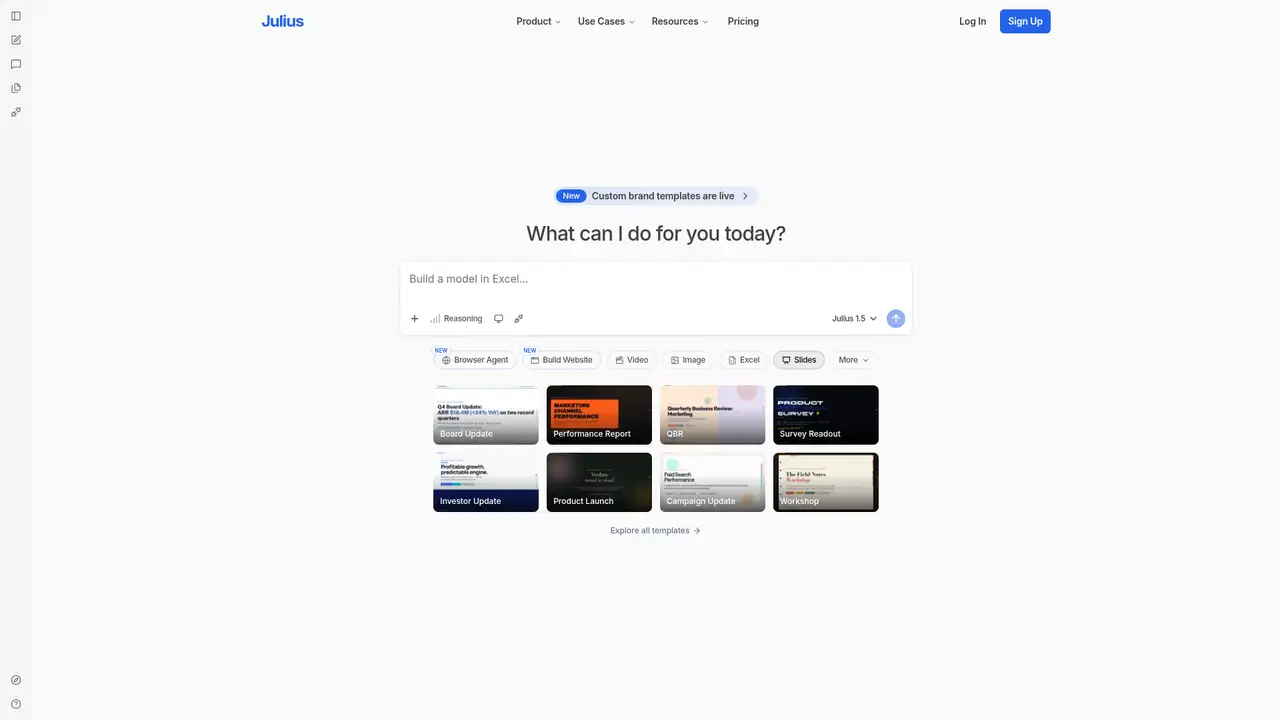
Julius AI is a cloud service for analyzing files and connected business data through natural language. The company describes it as a workspace for analysis, research, presentations, reports, dashboards, websites, images, and video. Users can upload data, ask questions, inspect generated results, and continue with follow-up requests without writing every query or chart manually. The published service description says Julius supports file uploads, Google Sheets, filtering, sorting, regression analysis, visualizations, and exports to CSV and Excel. Its current pricing page also lists database and storage connections. Julius does not publish a launch year. The product is best understood as an AI analyst rather than a traditional dashboard suite.
A normal Julius session begins with an uploaded file, a connected warehouse, or another supported source. The user asks for a calculation, comparison, visualization, report, or presentation in ordinary language. Julius can inspect the data, produce analysis, and return charts or other deliverables. The company says users can connect Snowflake, BigQuery, MySQL, PostgreSQL, and SQL Server, along with Google Drive, OneDrive, and SharePoint. Launch Week 2025 added SQL Server, MySQL, Model Context Protocol support, Databricks, and Meta Ads. Scheduled Runs can deliver recurring reports, including advertising performance reports sent to Slack. The product also supports presentations, websites, images, and video on every plan, although daily or purchased credits determine how much iteration is possible.
Julius separates its own data-focused models from third-party general models. Julius 1.2 Lite is available on every plan for quick questions. Julius 1.2 and Julius 1.2 Max are available on paid plans, while Julius 1.2 Ultra is available on Max and higher plans according to the model documentation. Paid users can also select GPT-6 Astra, Claude Opus 5.5, Claude Sonnet 5.5, Claude Fable 5.1, Grok 4.7, Muse Spark 1.3, and Kimi K3. In February 2026, Julius moved from message-based billing to usage credits while keeping plan prices unchanged. Credit consumption depends on the action, selected model, output length, dataset size, and number of steps. The company says the change supports larger context windows and more capable compute environments.
The Free plan costs $0 and gives eligible new web accounts 75 one-time welcome credits plus 25 daily credits. Daily credits reset at midnight UTC, do not accumulate, and are spent before the regular balance. The pricing page lists Plus at $20/month, Pro at $45/month, Business at $450/month, and Enterprise at Custom pricing. Julius also documents annual allowances, including 24,000 credits for Plus, 60,000 for Pro, and 720,000 for Business, granted upfront on annual billing. Purchased credits expire at the end of the monthly or annual billing term, while daily credits expire each UTC day. Additional top-ups are not currently supported. Free users receive seven-day file storage, while Enterprise includes permanent storage. Features and model access vary by plan.
Julius is a good fit for conversational analysis, but generated calculations still need review, especially when a task combines large data, code execution, and several deliverables. Credit costs vary, which makes heavy usage harder to forecast than a fixed-message service. Julius says content may be shared with AI technology providers for evaluation, improvement, and development, although users can request an opt-out by email. Compared with ChatGPT and Claude, Julius is more focused on data files, executable analysis, and visual outputs. Compared with Power BI and Tableau, it starts faster but offers less established dashboard administration. ThoughtSpot is a closer governed analytics alternative, while Rows is more spreadsheet-centered. Choose Julius for natural-language analysis and creation; choose a dedicated BI platform for strict governance and predictable reporting.
Who is Julius AI best for?
- Business users who need data answers without writing SQL.
- Researchers analyzing files with conversational follow-up questions.
- Teams connecting warehouses to reports and recurring runs.
- Users creating presentations from data and source material.
Julius AI Pricing (2026)
Pricing model: Freemium. All prices in USD.
| Plan | Price | What you get |
|---|---|---|
| Free | $0/month | Eligible new web accounts receive 75 one-time welcome credits and 25 daily credits. Includes Julius 1.2 Lite, creation features, and seven-day file storage. |
| Plus | $20/month | Includes 2,000 purchased monthly credits and 100 daily credits. Paid model access, 16 GB of RAM, collaboration, and listed data connectors are included. |
| Pro | $45/month | Includes 5,000 purchased monthly credits and 100 daily credits. Annual billing provides 60,000 purchased credits upfront. |
| Business | $450/month | Includes 60,000 purchased monthly credits and 100 daily credits. The page lists collaboration, connectors, security controls, and team features. |
| Enterprise | Custom | Custom pricing includes all models, permanent file storage, SSO, audit logging, fine-grained permissions, and additional enterprise controls. |
Pros and Cons
Pros
- It turns natural-language requests into data analysis and visualizations.
- It combines files, warehouses, reports, presentations, websites, images, and video.
- The Free plan includes daily credits and the Lite model.
- Users can choose between Julius models and several third-party models.
Cons
- Complex work can consume credits at variable rates.
- Published terms permit content sharing with AI providers unless users opt out.
- Its governance depth is less established than major BI platforms.
Who should look elsewhere?
- Teams requiring fixed costs for every complex analysis.
- Organizations requiring default exclusion from provider model improvement.
- Companies seeking mature, centralized BI administration.
Technical Details
Frequently Asked Questions
How much does Julius AI cost?
Julius AI offers a Free plan at $0. Paid access currently starts with Plus at $20/month, followed by Pro at $45/month and Business at $450/month. Enterprise pricing is Custom. Julius measures usage with credits, and the amount consumed depends on the selected model, task complexity, tools, output length, and data size.
Does Julius AI have a free plan?
Yes. Eligible new web accounts receive 75 one-time welcome credits, and Free accounts receive 25 daily credits. Daily credits reset at 00:00 UTC and do not roll over. Free users can use Julius 1.2 Lite and creation features, while paid plans add more purchased credits, models, storage, collaboration, and controls.
Is Julius AI better than ChatGPT for data analysis?
Julius is more specialized for uploaded data, connected warehouses, executable analysis, charts, reports, and presentations. ChatGPT is broader as a general assistant. Julius is the stronger choice for a focused conversational data workflow, while ChatGPT may suit users who combine analysis with writing, coding, research, and general-purpose assistance.
Does Julius AI train on user data?
Julius says it does not build its own AI models. Its published terms permit sharing prompts, uploaded files, and outputs with AI technology providers for evaluation, improvement, and development. The company says users can opt out by emailing privacy support. Organizations handling sensitive information should review the applicable agreement and privacy terms.
Can Julius AI be used commercially?
Julius supports business use through paid offerings, including Business and Enterprise plans. The pricing page lists collaboration, connectors, SOC 2 Type II compliance, and enterprise controls, while Enterprise adds features such as SSO and audit logging. Companies should review the Terms of Service, privacy terms, and any customer agreement before using regulated or confidential data.
Best Julius AI Alternatives in 2026
These tools do the same job as Julius AI, with different pricing, limits and trade-offs.