
Hex Review, Pricing & Alternatives (2026)
Collaborative notebooks and governed AI analytics for data teams
Last updated: October 22, 2026
What is Hex?
Hex is a hosted analytics workspace combining SQL, Python, no-code exploration, notebooks, conversational analytics, and data apps. It is built for data teams and business users investigating and sharing warehouse data. Community costs $0/month, Professional costs $36 per Editor per month, Team costs $75 per Editor per month, and Enterprise pricing is custom.
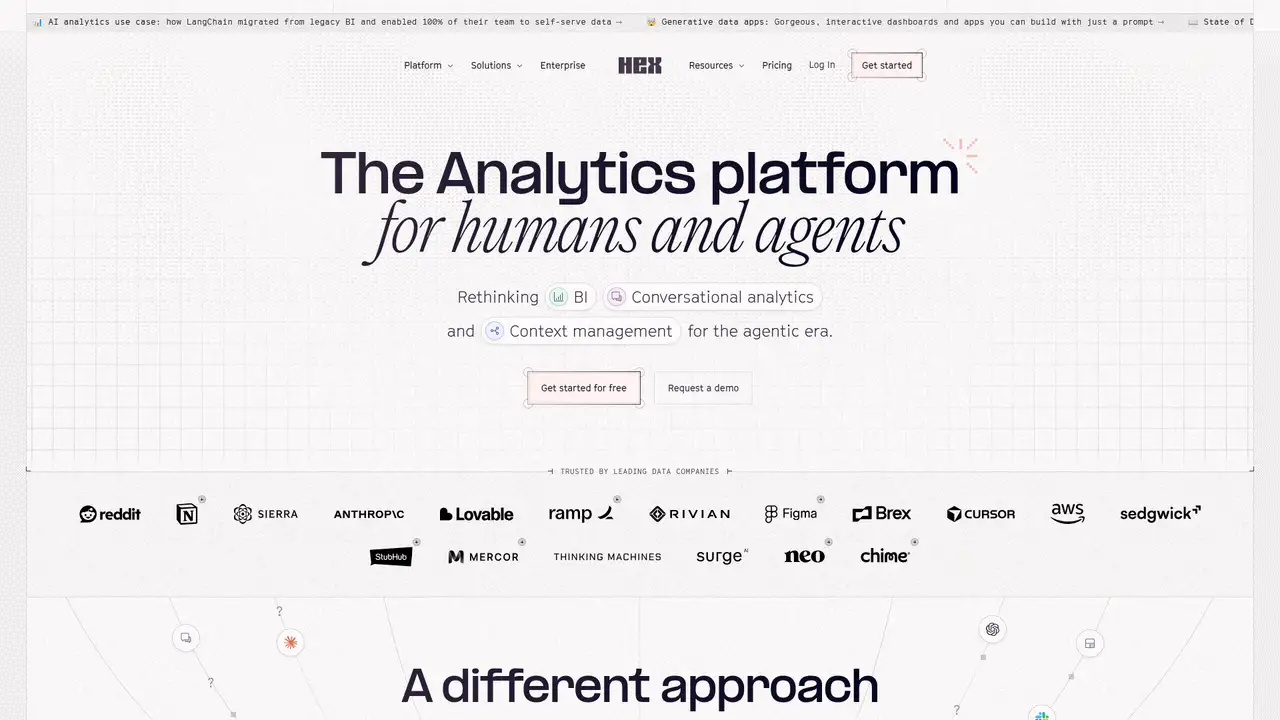
Hex Technologies makes a hosted analytics workspace for data teams and business users who consume their work. The company says it was founded in 2019 and supports more than 2,000 customers globally. Its May 2025 Series C announcement reported more than 1,500 teams and disclosed a $70 million round from Avra, a16z, Amplify, Box Group, Next Legacy, Redpoint, Sequoia, and Snowflake. Hex combines collaborative notebooks, SQL, Python, visual exploration, conversational Threads, Context Studio, and interactive data apps. That combination places it between a notebook, a business intelligence product, and an internal application builder. The hosted format suits organizations that want shared projects, connected warehouse data, and managed administration without operating the analytics service themselves.
A typical Hex workflow starts with a warehouse or another connected data source, followed by a project containing SQL, Python, charts, and markdown cells. Analysts can use Explore and Threads for natural-language questions, while Notebook Agent can help create analysis and visualizations. Context Studio adds semantic models, database descriptions, and workplace rules that shape AI responses. A completed project can become a published app, shared collection, or scheduled workflow with alerts. Hex runs live queries against connected databases, and its security documentation says project data is ephemeral in kernel memory, with configurable caching. REST APIs and integrations for Airflow, Dagster, dbt, Git, and MCP support teams that connect analytics to existing development and orchestration processes.
Hex's current AI features assist with SQL, Python, chart, and markdown cells, Threads, Notebook Agent, app conversations, and context controls. The company says it uses OpenAI and Anthropic providers, with some models hosted through Baseten. Its model documentation lists Anthropic Claude Fable 5.1, Opus 5.5, Opus 5, Opus 4.8, Opus 4.6, Sonnet 5.5, Sonnet 5, Haiku 5.5, Haiku 4.5, and several OpenAI GPT 6 and GPT 5.6 variants. Model access depends on plan and provider. Enterprise BYOK supports direct OpenAI and Anthropic keys and selected cloud routes. Hex previously called its in-product AI Hex Magic, while the current product names emphasize Threads, Context Studio, and Notebook Agent.
Community costs $0/month and includes connected data sources, all cell types, a Hex Agent trial, small compute, and five AI credits per Editor each month. Professional costs $36 per Editor per month and adds Standard credits, medium compute, up to five published apps, 30-day history, and 30 AI credits per Editor monthly. Team costs $75 per Editor per month and adds extended credits, unlimited published apps, scheduled runs, alerts, collaboration controls, and 40 credits per Editor monthly. Team Explorer seats receive 10 credits. Enterprise is custom and adds premium credits, Explorer seats, audit logs, OIDC SSO, BYOK, and optional single-tenant, HIPAA, and embedded analytics features. Self-serve billing is monthly, while order-form customers are billed annually and upfront.
Hex's main strength is the connection between exploratory code and governed, shareable output. The cost structure requires attention because editor seats, AI credits, warehouse queries, and larger compute profiles can all affect the bill. Tableau is a deeper traditional business intelligence choice for standardized dashboards and broad administration. Mode is closer for SQL-first reporting and notebook analysis. Deepnote is a closer collaborative notebook alternative, with less emphasis on published analytics apps in this comparison. Hex suits teams that want one hosted workflow from warehouse investigation to interactive application and governed natural-language access. Choose Tableau for dashboard administration, Mode for SQL-centered reporting, or Deepnote for notebook-centered collaboration. Hex is intended for data teams, analysts, and business users sharing governed analytics.
Who is Hex best for?
- Data teams combining SQL, Python, charts, and published apps.
- Organizations giving business users governed self-service analytics.
- Analysts needing conversational questions grounded in warehouse context.
- Companies wanting hosted collaboration with enterprise security options.
Hex Pricing (2026)
Pricing model: Freemium. All prices in USD.
| Plan | Price | What you get |
|---|---|---|
| Community | $0/month | For hobbyists and small projects. Includes connected data sources, all cell types, Hex Agent trial, small compute, and five AI credits per Editor monthly. |
| Professional | $36 per Editor/month | Includes Standard credits, medium compute, up to five published apps, 30-day version history, and 30 AI credits per Editor monthly. |
| Team | $75 per Editor/month | Includes extended credits, unlimited published apps, scheduled runs, alerts, collaboration features, and 40 AI credits per Editor monthly. Explorer seats receive 10 credits. |
| Enterprise | Custom | Adds premium credits, Explorer seats, audit logs, OIDC SSO, BYOK, advanced security, and optional single-tenant, HIPAA, or embedded analytics deployments. |
| Compute add-ons | $0.32/hour to $4.06/hour | Large through 4XL and GPU profiles are billed by the minute. Medium is included on paid plans, while trials are limited to Medium compute. |
Pros and Cons
Pros
- Projects combine SQL, Python, visualizations, and interactive app publishing.
- Context Studio gives AI answers semantic and organizational context.
- Community offers a usable free entry tier with connected data sources.
- Enterprise supports BYOK, OIDC SSO, audit logs, and single-tenant options.
Cons
- AI credits reset monthly, and unused grants do not roll over.
- Editor seats and compute add-ons can raise the effective cost.
- Hex is proprietary hosted software rather than an open-source deployment.
Who should look elsewhere?
- Teams requiring open-source or fully self-hosted analytics.
- Buyers seeking a flat unlimited AI price per user.
- Organizations needing a dashboard-only business intelligence platform.
Technical Details
Frequently Asked Questions
How much does Hex cost?
Hex Community costs $0/month. Professional costs $36 per Editor per month, Team costs $75 per Editor per month, and Enterprise pricing is custom. Paid plans include compute and monthly AI credit grants, while larger compute profiles and extra AI usage can add cost. Self-serve customers are billed monthly, while order-form customers are billed annually and upfront.
Does Hex have a free plan?
Yes. Community costs $0/month and includes data-source connections, all cell types, small compute, a Hex Agent trial, and five AI credits per Editor each month. Hex also offers a 14-day Team trial without a payment card. After the trial, an account can continue on a paid plan or return to Community with its smaller feature set.
How does Hex compare with Tableau?
Hex is more notebook-oriented, combining SQL, Python, visual exploration, conversational analytics, and data apps in one project. Tableau is a mature visualization and business intelligence platform with a broader dashboard and administration focus. Hex fits exploratory data teams publishing interactive analysis, while Tableau fits standardized enterprise reporting and broad dashboard distribution.
Does Hex train AI models on customer data?
Hex says its language model providers do not train on customer data and generally operate under zero-data-retention agreements. Hex may send project code, output content, prompts, schema information, and table or column names to providers to deliver AI features. Administrators can opt out of AI features and, depending on plan, opt out of AI-session improvement.
Can Hex be used commercially through an API or customer key?
Hex is designed for commercial organizational use and provides REST APIs plus integrations such as MCP, Airflow, Dagster, dbt, and Git. Enterprise customers can use Bring Your Own Key for supported OpenAI, Anthropic, AWS Bedrock, and Google routes. Hex remains a managed service, so BYOK changes inference credentials and controls, not the deployment model.
Best Hex Alternatives in 2026
These tools do the same job as Hex, with different pricing, limits and trade-offs.