
Ai2 Asta Review, Pricing & Alternatives (2026)
Cited literature search and data analysis for scientific work
Last updated: October 26, 2026
What is Ai2 Asta?
Ai2 Asta is a web-based scientific research assistant from the nonprofit Allen Institute for AI. It serves researchers, students, analysts, and science communicators who need cited literature discovery or structured-data analysis. Asta is free to use, with a one-time grant of 1,000 credits and no published paid tier.
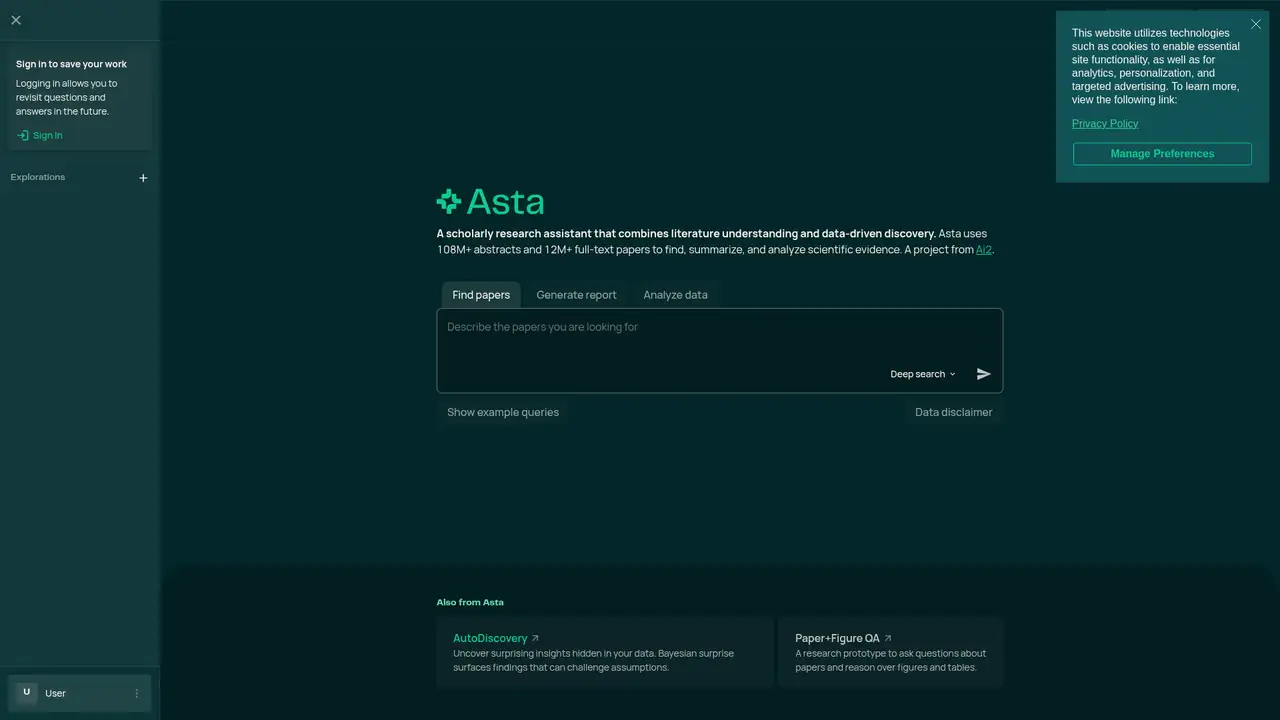
Ai2 Asta is a web-based scientific research assistant from the nonprofit Allen Institute for AI, launched publicly in 2025. Ai2 describes Asta as part of a broader initiative to build trustworthy agents for scientific work. The service combines scholarly search, cited report generation, dataset analysis, automated discovery, and theory generation. Its product page says the literature index includes more than 108 million abstracts and 12 million full-text papers. Asta targets researchers, students, analysts, instructors, and science communicators rather than general-purpose writing users. Ai2 does not publish funding figures, a founding date for the product, or a separate corporate entity for Asta. The hosted service runs on the web, and signed-in users can preserve questions and results.
Asta puts several research tasks into one browser workflow. Find papers searches its scholarly index, while Generate a report produces a cited synthesis that users can inspect and extend. Analyze data accepts structured files and returns explanations, visualizations, copyable code, assumptions, statistical tests, and a methods section. Follow-up prompts add analysis to the report while retaining prior work. AutoDiscovery runs experiments designed to surface patterns, and Theorizer retrieves source papers before generating candidate theories. Ai2 says theory runs usually take 20 to 30 minutes, while comprehensive runs can exceed an hour. Users must read the cited papers and check each claim because a generated theory is a research lead rather than a verified conclusion.
Asta's notable 2025 release was DataVoyager, announced on October 1 and made generally available in Asta on December 8. It supports CSV, Excel, JSON, HDF5, TSV, and Parquet files, then produces explanations, assumptions, code, visualizations, and status updates. Follow-up prompts add analysis cells to the report in a notebook-like workflow. Ai2 says more than 70 universities, institutes, and companies used DataVoyager during its early rollout. Asta is not documented as an open-source package or public developer API. Ai2 also describes private server, on-premises, datacenter, and private-cloud deployment options for DataVoyager, although it does not publish prices for those arrangements. The company does not identify a specific underlying model or provide public model version details.
Asta is free, with no published subscription or paid usage tier. Find papers, Generate a report, and Analyze data use no credits. New signed-in users receive a one-time grant of 1,000 credits. AutoDiscovery costs one credit per experiment. Theorizer costs one credit per source paper and can use up to 100 credits per run. Users whose balance falls below 120 credits can request 100 additional credits. Failed theory runs return unused credits. Explorations remain active for 24 hours before becoming read-only, after which users must start a new exploration. Ai2 publishes no seat pricing, recurring billing, API rate, or enterprise purchasing path. Light use therefore has a clear entry cost, while teams cannot calculate a public price for larger deployments.
Asta's main limitation is the review burden attached to its most ambitious outputs. Ai2 says generated theories are not necessarily true, and its FAQ reports that about half of predictions had a later paper available for checking. Hosted users should avoid uploading sensitive or regulated datasets. Ai2 says raw datasets are deleted within seven days and are not used for model training, while prompts and interactions may be logged unless users opt out. Semantic Scholar is better for scholarly search and metadata APIs. Elicit is stronger for structured evidence review, and Consensus focuses on fast paper-based answers. Asta covers more exploratory analysis than those products. Researchers wanting free cited literature work with small-dataset exploration should pick Asta.
Who is Ai2 Asta best for?
- Researchers needing cited literature discovery without subscription fees.
- Students exploring scientific questions with inspectable evidence trails.
- Analysts asking plain-language questions about structured datasets.
- Users who need visible assumptions, methods, code, and citations.
Ai2 Asta Pricing (2026)
Pricing model: Free. All prices in USD.
| Plan | Price | What you get |
|---|---|---|
| Free | $0 | Find papers, Generate a report, and Analyze data use no credits. New users receive 1,000 credits once; AutoDiscovery uses 1 credit per experiment and Theorizer uses 1 credit per source paper, up to 100 credits per run. |
Pros and Cons
Pros
- The free service includes literature search, reports, and data analysis.
- The index covers more than 108 million abstracts and 12 million full-text papers.
- DataVoyager exposes assumptions, methods, visualizations, and copyable code.
- Ai2 says raw uploaded datasets are deleted within seven days.
Cons
- Theory generation commonly takes 20 to 30 minutes.
- Generated theories require source-by-source scientific checking.
- Ai2 publishes no paid Asta tier or public API pricing.
Who should look elsewhere?
- Teams requiring published enterprise support commitments or service levels.
- Users processing regulated datasets on the hosted deployment.
- Developers seeking a documented public Asta API.
Technical Details
Frequently Asked Questions
How much does Ai2 Asta cost?
Ai2 Asta costs $0. It has no published paid plan or recurring subscription. Find papers, Generate a report, and Analyze data use no credits. Signing up provides a one-time 1,000-credit grant. Users whose balance falls below 120 credits can request 100 additional credits. AutoDiscovery and Theorizer consume credits, but Ai2 does not charge users for them.
Does Asta have a free plan?
Yes. Asta is free, and its core literature and data-analysis tools do not consume credits. New signed-in users receive 1,000 credits once. AutoDiscovery uses one credit per experiment. Theorizer uses one credit per source paper and can use up to 100 credits in a run. Users below 120 credits can request 100 more.
How does Asta compare with Semantic Scholar?
Semantic Scholar is primarily a scholarly search and metadata service with a documented API. Asta adds cited reports, conversational data analysis, AutoDiscovery, and theory generation. Asta is better for broader research exploration and small dataset analysis. Semantic Scholar is the more direct choice for developers building search infrastructure or retrieving scholarly metadata programmatically.
Does Ai2 train on Asta uploads?
Ai2 says raw uploaded datasets are not used for model training, sharing, redistribution, advertising, or profiling. Hosted datasets are automatically deleted within seven days, and signed-in users can delete them sooner. Prompts and interactions may be temporarily logged to improve reliability and Asta quality. Ai2 says those interactions are not used to train models without explicit opt-in.
Can Asta be used commercially?
Asta's public terms cover Ai2 services, tools, interfaces, APIs, and content, but Asta does not publish a separate commercial license or business plan. The terms grant Ai2 broad rights over User Content unless a service-specific exception applies. Commercial users should review the applicable terms before processing proprietary research or building a dependent product.
Best Ai2 Asta Alternatives in 2026
These tools do the same job as Ai2 Asta, with different pricing, limits and trade-offs.

AI-assisted search and discovery for scientific literature
AI workflows for literature search, review, and research reports

Evidence-linked search and synthesis for academic literature

Citation context and evidence checks for scientific research