
Ahrefs Review, Pricing & Alternatives (2026)
Search, site, content, and AI visibility data for serious SEO work
Last updated: October 26, 2026
What is Ahrefs?
Ahrefs is a bootstrapped Singaporean SaaS marketing platform founded in 2010. It combines backlink, keyword, competitor, technical-audit, rank-tracking, content, web-analytics, and AI-visibility tools. Public plans include free tools, Lite at $129 monthly, Standard at $249, Advanced at $449, and Enterprise at $1,499 with annual commitment. API and MCP access begin with Lite.
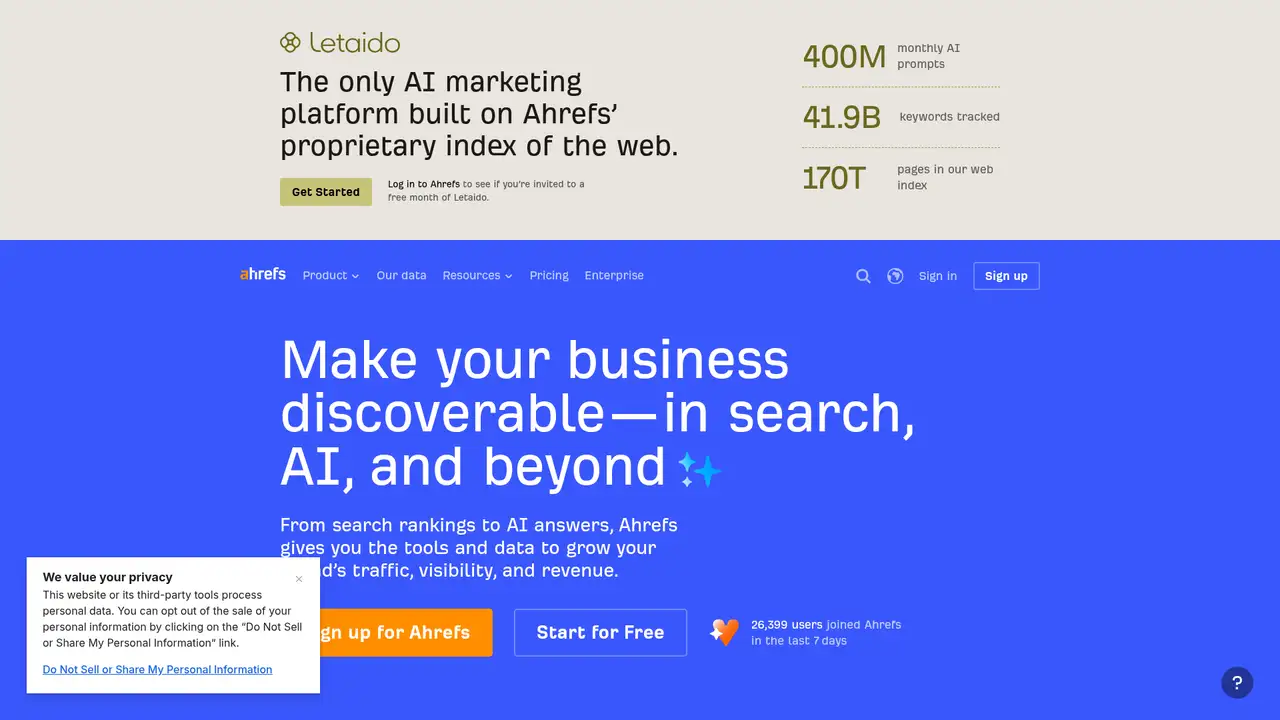
Ahrefs is a Singapore-headquartered SaaS marketing company founded in 2010 by Dmytro Gerasimenko. Its media kit describes more than ten years of web crawling, petabytes of stored data, and tools for competitor research, keyword research, site auditing, rank tracking, and content research. These capabilities support activities such as identifying search opportunities, monitoring technical problems, and comparing competing websites. The company is bootstrapped and reported 125 employees and more than $100 million in annual recurring revenue in a March 2024 interview, figures that describe that period rather than current scale. Ahrefs says its headquarters are in Singapore and its team spans 27 locations. The company began with SEO software and has since added web analytics, social publishing, AI writing, and visibility tracking for answer engines.
Ahrefs supports a research-to-monitoring workflow for teams investigating search performance and maintaining ongoing visibility checks. Users can enter a domain, URL, or keyword in Site Explorer and Keywords Explorer, inspect organic pages, backlinks, competing sites, and search results, then save findings in projects for continued reference. Site Audit crawls verified websites for technical issues, while Rank Tracker follows selected keywords by location and device. Content Explorer supports topic and publisher research. Web Analytics reports website activity, and Brand Radar measures brand mentions and citations in AI answers. Reports can be scheduled or assembled with reporting tools, helping teams share recurring updates. Eligible subscribers can query Ahrefs data through the customer API or connect the hosted MCP server to supported assistants.
Ahrefs operates its own crawler and stores large web datasets, including external and internal backlinks and HTML snapshots. In 2025, Brand Radar expanded AI visibility reporting across ChatGPT, Perplexity, Gemini, and Microsoft Copilot indexes, with citation charts, URL-supported entities, and more historical data. These features help teams compare how brands and pages appear across answer engines over time. Ahrefs announced a hosted MCP server in October 2025, allowing Lite plans and higher to connect ChatGPT, Claude, or Copilot without installing software. The release also added OAuth-based Ahrefs Connect, social publishing updates, Google Search Console report changes, and a backlink spam filter across API endpoints. Its privacy policy permits processing information for AI product development and machine-learning training, which matters when users submit sensitive business or client data.
Ahrefs currently lists free tools, Lite at $129 monthly, Standard at $249 monthly, Advanced at $449 monthly, and Enterprise at $1,499 monthly with annual commitment. Annual billing saves up to 17 percent, which can reduce costs for teams able to pay yearly. Lite includes one user, 750 tracked keywords, six months of history, 100,000 crawl credits, 150 AI-prompt checks, and API and MCP access. Standard provides 2,000 keywords, two years of history, 500,000 crawl credits, and 300 AI-prompt checks, supporting broader monitoring and deeper comparisons. Advanced provides 5,000 keywords, five years of history, 1,500,000 crawl credits, and 600 AI-prompt checks for larger research programs. Add-ons include reporting, project recrawls, and extra Brand Radar checks, allowing customers to extend selected capabilities as usage needs grow.
Ahrefs costs more than many tools aimed at occasional users, and credit-based usage can make recurring research expenses harder to forecast, especially when teams run frequent crawls or large keyword checks. Its estimates complement, rather than replace, first-party analytics, so performance decisions still require data from a site’s own measurement systems. Semrush offers a wider marketing suite with paid-search coverage. Moz Pro may suit smaller teams seeking simpler SEO budgeting, while Similarweb focuses more broadly on traffic intelligence. SE Ranking and SpyFu provide lower-cost competitive-search options for selected workflows, although their coverage may not match every Ahrefs use case. Ahrefs is best for agencies, publishers, and in-house teams that need extensive backlink data, competitive search analysis, technical auditing, and emerging AI-visibility measurement.
Who is Ahrefs best for?
- SEO agencies managing client domains.
- Publishers researching competitors and content gaps.
- In-house teams tracking search and AI citations.
- Users needing API or MCP access.
Ahrefs Pricing (2026)
Pricing model: Freemium. All prices in USD.
| Plan | Price | What you get |
|---|---|---|
| Free | $0 | Limited webmaster and research tools. |
| Lite | $129/month, annual billing available | 750 keywords, 100,000 crawl credits, 150 AI-prompt checks, API and MCP access. |
| Standard | $249/month, annual billing available | 2,000 keywords, 500,000 crawl credits, 300 AI-prompt checks, API and MCP access. |
| Advanced | $449/month, annual billing available | 5,000 keywords, 1,500,000 crawl credits, 600 AI-prompt checks, API and MCP access. |
| Enterprise | $1,499/month, annual commitment | From three users, custom access, data, and API options. |
Pros and Cons
Pros
- Ahrefs provides extensive backlink and competitive-search data.
- Site Audit connects technical findings with ongoing monitoring.
- Brand Radar measures AI mentions and citations.
- API and MCP access support repeatable workflows.
Cons
- Paid plans are costly for small users.
- Credit limits can complicate usage forecasting.
- Privacy terms permit some AI training uses.
Who should look elsewhere?
- Occasional keyword lookups.
- Teams prioritizing first-party analytics.
- Buyers seeking self-hosted SEO software.
Technical Details
Frequently Asked Questions
How much does Ahrefs cost?
Ahrefs offers free tools, Lite at $129 monthly, Standard at $249, Advanced at $449, and Enterprise at $1,499 monthly with annual commitment. Annual billing saves up to 17 percent. Optional products and usage additions can increase the bill, including report capacity, project recrawls, and additional Brand Radar checks.
Does Ahrefs have a free plan?
Ahrefs provides free webmaster and research tools with feature-specific limits. Free access can help with selected site, keyword, and backlink checks, but it does not provide the project capacity, historical depth, crawl volume, rank tracking, reporting, API access, or MCP access available on paid plans.
How does Ahrefs compare with Semrush?
Ahrefs is especially strong for backlink analysis, competitive organic research, content exploration, technical auditing, and AI visibility. Semrush covers a broader set of marketing activities, including paid search. Choose Ahrefs for link and search intelligence, or Semrush when one subscription must cover more marketing channels.
Does Ahrefs train AI models on user data?
Ahrefs says its privacy policy allows information to be processed for developing AI products and training machine-learning models. The policy also describes processing information submitted to Ahrefs services. Review the current policy and account terms before entering sensitive prompts, personal information, confidential business details, or client material.
Can I use Ahrefs commercially?
Ahrefs is designed for businesses, agencies, publishers, and marketing teams, with project, reporting, user, API, and MCP capabilities supporting commercial work. Commercial use remains subject to subscription terms, usage limits, data restrictions, and applicable API conditions. Enterprise plans provide additional access and customization for larger organizations.
Best Ahrefs Alternatives in 2026
These tools do the same job as Ahrefs, with different pricing, limits and trade-offs.

SEO and AI search visibility software for marketing teams
Integrated SEO and AI visibility tracking for marketers

Digital intelligence for researching markets, competitors, audiences, and channels

SEO and AI-search software for recurring research, tracking, and reporting
Competitor keyword and Google Ads research with deep history and unlimited exports