
Kore.ai Review, Pricing & Alternatives (2026)
Governed AI agents and workflows for complex enterprise operations
Last updated: October 26, 2026
What is Kore.ai?
Kore.ai is an enterprise platform for building AI agents, workflows, and service automation across digital and voice channels. It targets organizations that need integrations, governance, and deployment control. Pricing is sales led, with an AWS Marketplace AI for Service block priced at $6,600 per 660,000 units for 12 months; a public free trial is also listed.
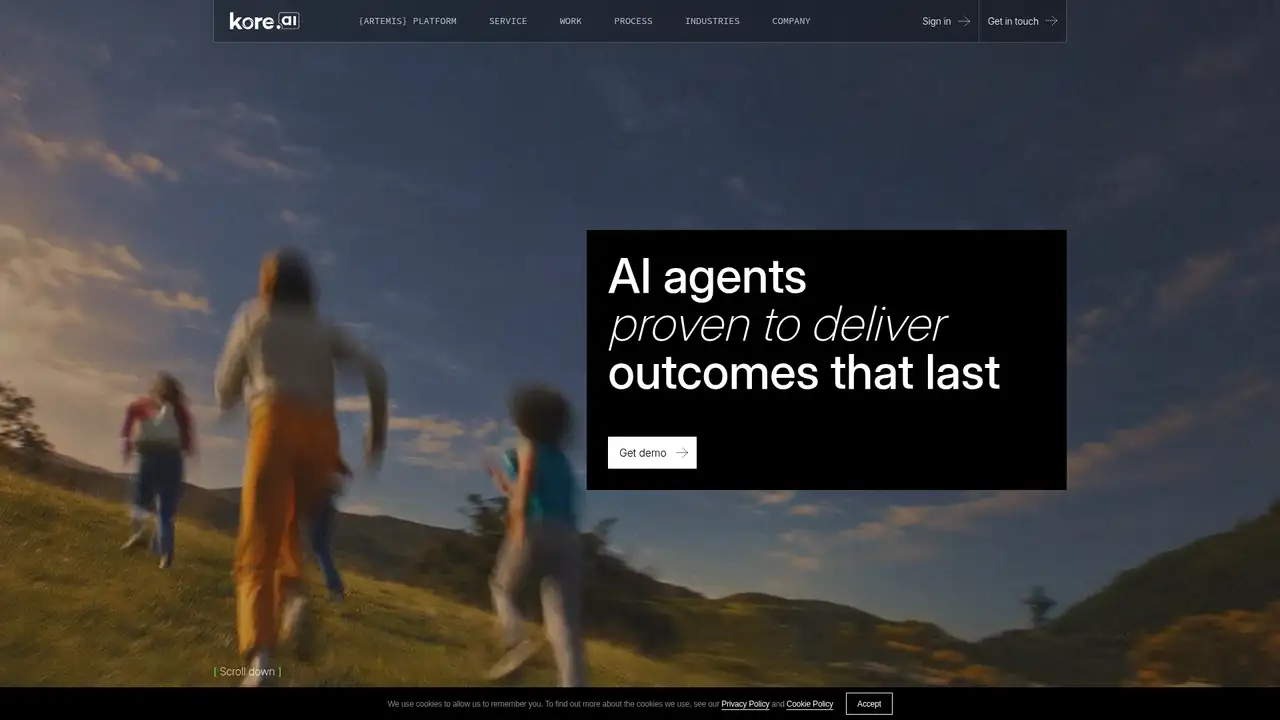
Kore.ai is an enterprise platform for AI agents, workflows, and conversational automation. The company says its software supports AI for service, AI for work, and AI for process, with deployments aimed at customer operations and employee productivity. Kore.ai says more than 500 Global 2000 organizations use its software and that it has operated in enterprise AI for more than a decade. Its current platform is the Kore.ai Agent Platform, with the Artemis edition announced on May 21, 2026. The company was founded by Raj Koneru, who is identified as CEO and founder, although the company’s site does not publish a founding year or funding total. Kore.ai remains focused on regulated, integration-heavy enterprise programs.
A typical Kore.ai workflow starts with an agent, workflow, or process definition, then adds tools, knowledge, channels, policies, and handoff rules. The platform supports no-code construction alongside formal agent definitions through Agent Blueprint Language. Arch can turn a business objective into an agent system containing agents, workflows, tools, policies, and handoffs. Runtime activity can connect to Slack, Microsoft Teams, WhatsApp Business, Twilio, SendGrid, Salesforce, HubSpot, Zendesk, SMTP, and webhooks. Teams can route conversations to staff, inspect execution traces, configure production approval, and monitor credits and usage across seven, 30, or 90 days. Voice recording is disabled by default and requires both account and project administrator activation where the Enterprise feature is enabled.
Artemis is the central 2026 technology release. Announced May 21, it adds Agent Blueprint Language, the Arch AI solution architect, six orchestration patterns, and a Dual-Brain Architecture that combines agentic reasoning with deterministic flows through shared memory. The platform is model independent, according to Kore.ai, and initially launched natively on Microsoft Azure with Microsoft Foundry, Agent 365, Entra ID, Microsoft Graph API, and Teams integrations. October 2026 release notes add reasoning-step controls, reusable MCP connections, mutual TLS for MCP servers, CI/CD release APIs, and new voice options. Decision Models answer routing checks in under half a second, compared with one to two seconds for the full AI model. Kore.ai also says its XO GPT training uses no customer data.
Kore.ai pricing combines usage blocks, custom contracts, and separately priced services. AWS Marketplace lists AI for Service at $6,600 per 660,000 units for 12 months, Interaction Gateway at $33,000 per 660,000 units, and SMS Long Code at $6,600 per 660,000 messages. It also lists a $50,000, 75-hour enterprise tune-up, $10,000 standard expert services, and a $40,000 enterprise support package. These are one-time or service fees, not subscription tiers, so they are excluded from the tier list below. A UK government marketplace listing advertises £0 per unit and a free trial with $500 starting credit, 20 requests per minute, Conversation Designer, Dialog Builder, Knowledge Graph, and Multi-Engine NLP. Workspace billing pages describe subscription plans, credit balances, top-ups, usage filters, threshold alerts, and custom deals for dedicated resources, BYOK encryption, and enterprise SLAs. That structure suits organizations needing tailored procurement, while smaller teams should pick the free trial first.
Kore.ai offers broad control, but buyers face a sales-led purchase and a substantial design burden. Cognigy is a closer match for enterprise service automation, while Microsoft Copilot Studio fits teams centered on Microsoft 365 and Power Platform. Google Dialogflow CX offers a more cloud-native conversational development route, with simpler alignment to Google Cloud services. Kore.ai differentiates itself through ABL, multi-agent orchestration, deployment choices, governance, and channels, although its marketplace units do not provide a straightforward total-cost comparison. The platform supports on-premises deployment, while private cloud is described separately as a dedicated VPC. Teams should confirm scope, residency, retention, and contract terms before buying. Organizations needing governed multi-agent enterprise automation should pick Kore.ai.
Who is Kore.ai best for?
- Global enterprises deploying governed multi-agent workflows.
- Organizations requiring on-premises or sovereign-region deployment.
- Microsoft Azure organizations needing native platform integrations.
- Service teams combining voice, digital channels, and human transfer.
Kore.ai Pricing (2026)
Pricing model: Paid. All prices in USD.
| Plan | Price | What you get |
|---|---|---|
| AI for Service | $6,600 per 660,000 units / 12 months | AWS Marketplace block for AI for Service interactions. The listing does not define a universal monthly subscription. |
| AI for Service Interaction Gateway | $33,000 per 660,000 units / 12 months | AWS Marketplace block for interaction gateway usage, separate from AI for Service units. |
| SMS Long Code Messages | $6,600 per 660,000 messages / 12 months | Outbound long-code SMS messages are billed separately from AI for Service interaction units. |
| Free trial | $0/month | The government marketplace listing describes $500 starting credit, 20 requests per minute, and builder tools. |
| Enterprise | Custom | Enterprise deployments and commercial terms are arranged through sales. |
Pros and Cons
Pros
- ABL provides formal agent behavior, tools, guardrails, and handoffs.
- The platform supports on-premises deployment and many enterprise channels.
- Usage views and alerts help administrators monitor workspace consumption.
- Kore.ai says customer data is excluded from generalized model training.
Cons
- Enterprise pricing combines units, contracts, and sales-led terms.
- Legacy AI for Service and Artemis capabilities have different scopes.
- Implementing complex deployments can require substantial specialist work.
Who should look elsewhere?
- Indie developers seeking a predictable low-cost API.
- Small teams without integration and governance capacity.
- Buyers requiring one transparent monthly seat price.
Technical Details
Frequently Asked Questions
How much does Kore.ai cost?
Kore.ai uses sales-led and usage-based pricing. The AWS Marketplace lists AI for Service at $6,600 per 660,000 units for 12 months, Interaction Gateway at $33,000 per 660,000 units, and SMS Long Code at $6,600 per 660,000 messages. Custom deals, dedicated resources, BYOK encryption, and enterprise SLAs require sales discussion. Separate services and support fees are also listed.
Does Kore.ai have a free plan?
A government marketplace listing describes a free trial with $500 starting credit and a 20 requests-per-minute limit. It includes Conversation Designer, Dialog Builder, Knowledge Graph, and Multi-Engine NLP. The listing also shows a £0 per unit price. Current workspace documentation describes credits, top-ups, and alerts, while enterprise commercial terms are handled through sales.
Kore.ai or Microsoft Copilot Studio?
Microsoft Copilot Studio suits organizations centered on Microsoft 365, Power Platform, and Microsoft business data. Kore.ai is broader for enterprise agent operations, with Agent Blueprint Language, multiple orchestration patterns, on-premises deployment, voice channels, and integrations across several systems. Microsoft may offer a simpler Microsoft-centered purchase, while Kore.ai fits programs requiring wider deployment and governance controls.
Does Kore.ai train models on customer data?
Kore.ai’s privacy policy, last updated September 7, 2026, says customer data is used to provide the services and is not used for internal training, knowledge-base updates, internal product enhancements, or generalized AI-model training. Its XO GPT specification also says customer data is not used for model training or evaluation. Contract terms and customer configuration still govern service handling.
Can Kore.ai be used commercially and deployed privately?
Yes. Kore.ai presents the platform for enterprise business workflows and publishes public APIs for programming bots and agents. Its Trust Center lists on-premises deployment and separately lists private cloud as a dedicated VPC. Those are different deployment options. Licensing, usage, support, data residency, retention, and permitted commercial use are governed by the applicable agreement.
Best Kore.ai Alternatives in 2026
These tools do the same job as Kore.ai, with different pricing, limits and trade-offs.