
Zed Review, Pricing & Alternatives (2026)
A fast, open-source editor with collaboration and model-assisted coding
Last updated: October 22, 2026
What is Zed?
Zed is a collaborative desktop code editor from Zed Industries for developers who want native performance, multiplayer editing, and optional AI agents. The editor is free, while Pro starts at $10 per month for hosted models and unlimited Edit Predictions. Business costs $30 per seat monthly and adds organization controls and consolidated billing.
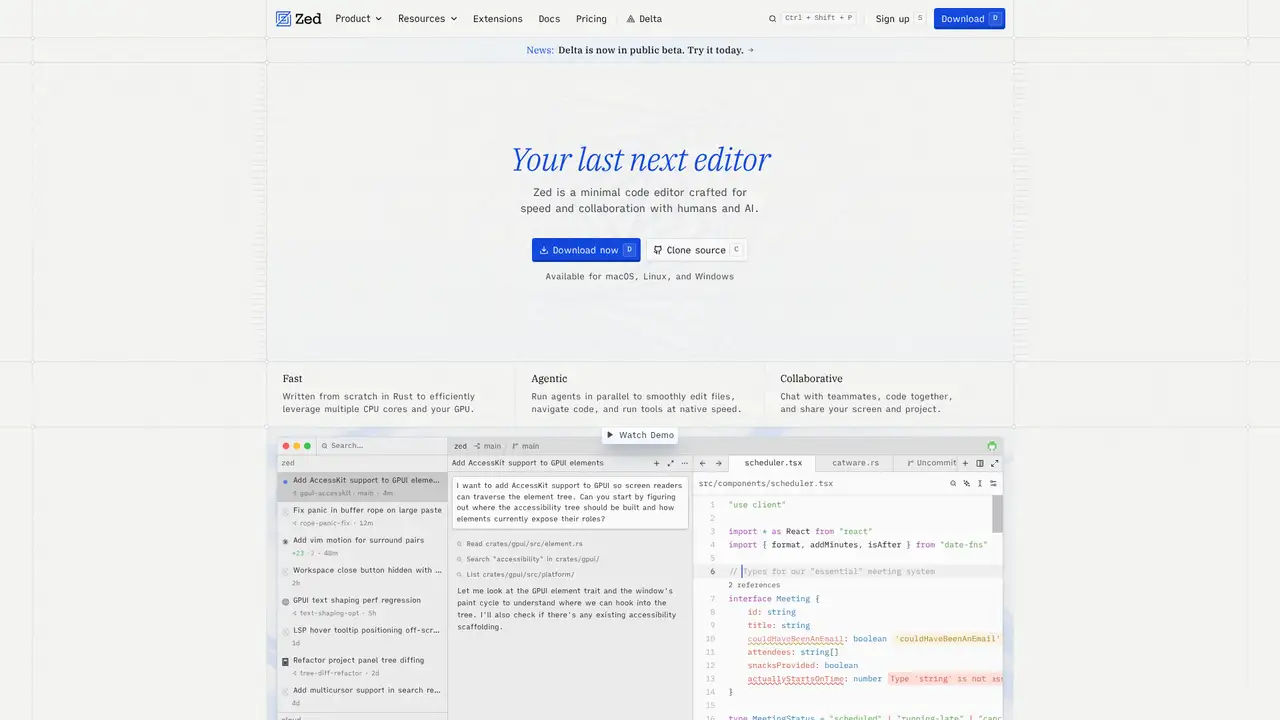
Zed is an open-source desktop code editor made by Zed Industries, Inc., a for-profit company. The repository was created in 2021, Zed entered beta in March 2023, and the project became open source in January 2024. Its source is primarily GPL-3.0-or-later, with Apache-2.0 components where marked. Zed runs on macOS, Linux, and Windows, and its release page describes weekly releases. TechCrunch reported a $10 million Series A in March 2023, bringing total investment to roughly $12.5 million. The editor combines local coding, multiplayer collaboration, and optional hosted AI services. Zed does not require authentication or a subscription for the editor itself, while paid plans cover selected hosted features.
The daily workflow combines project navigation, language tooling, terminal access, Git features, and shared sessions in a native desktop editor. Zed Agent works with repository context, while Inline Assistant, Edit Predictions, and Git commit generation support narrower tasks. External agents can connect through the Agent Client Protocol. Users can bring API keys, use provider subscriptions, select Zed-hosted models, or use local models. Multiplayer collaboration supports shared editing and communication inside the product. A typical task can move from code inspection to an agent request, then to reviewing generated changes and editing files in the same application. Users can also disable AI features. The result is an editor centered on local development, collaboration, and multiple AI connection paths.
Zed's hosted catalog includes models from Anthropic, OpenAI, and other providers, with availability updated regularly. Hosted usage is measured by tokens and billed at provider list price plus 10 percent. The October 21, 2026 stable release, version 1.25.2, reduced binary sizes across macOS, Windows, and Linux, added context compaction and session notices for external agents, and added GPT-6 Astra, Claude Fable 5.1, and Claude Opus 5.5 through Amazon Bedrock. The project says it uses Rust, its GPU-accelerated GPUI framework, and Tree-sitter incremental parsing. The repository identifies macOS, Linux, and Windows as supported platforms, with web support not yet available. Its model catalog and release notes provide users with regularly updated information about capabilities, platform support, and external-agent behavior.
Personal is free forever and supports personal API keys and external agents. Zed-hosted models and Zed Edit Predictions require Pro, although users can use edit predictions from other providers or local models. Pro costs $10 per month, includes unlimited Edit Predictions and $5 of monthly token credit, then bills hosted usage at provider list price plus 10 percent. The Pro trial lasts 14 days, includes $5 of GPT-6 Luna usage, and requires no card. Student is free for one year after verification, includes $10 per month in token credits, and excludes selected premium models. Business costs $30 per seat per month, adds organization controls and consolidated billing, and does not include a fixed AI credit allotment. Pro and Business support spending limits; Student usage is capped at its included credit.
Zed's main tradeoff is the boundary between its open-source editor and account-based services. The editor is primarily GPL-3.0-or-later, while hosted features are governed by separate service terms. Zed says it does not train on user code or prompts, but provider-designated models can retain data for safety purposes. Compared with Visual Studio Code, Zed offers built-in multiplayer collaboration but a smaller extension history. Compared with Cursor, Zed offers an open-source editor, BYOK support, and external-agent support, while Cursor is a proprietary AI-first editor built around VS Code. Cline offers a more direct open-source, BYOK agent comparison, while JetBrains provides deeper IDE language tooling. Pick Zed if native desktop performance, collaboration, licensing, and model choice matter more than plugin breadth.
Who is Zed best for?
- Developers who want a native, collaborative editor with optional AI.
- Teams that need centralized controls over hosted AI usage.
- Users who want to bring API keys or external coding agents.
- Open-source users who prefer a GPL-licensed editor.
Zed Pricing (2026)
Pricing model: Freemium. All prices in USD.
| Plan | Price | What you get |
|---|---|---|
| Personal | $0 forever | Free editor with unlimited use of personal API keys and external agents. Hosted models and Zed Edit Predictions are not included. |
| Pro | $10/month | Includes unlimited Edit Predictions and $5 of monthly hosted-token credit. Additional hosted usage costs provider list price plus 10 percent. |
| Student | Free for one year | For verified university students; includes Pro features and $10 monthly token credit, with selected premium models excluded. |
| Business | $30/seat/month | Adds organization AI policies, data controls, spend visibility, roles, and unlimited Edit Predictions. Hosted AI usage is billed separately. |
Pros and Cons
Pros
- The editor is primarily GPL-3.0-or-later with marked Apache-2.0 components.
- Personal use is free and supports provider keys and external agents.
- Pro offers unlimited Edit Predictions and a monthly hosted-token allowance.
- Zed documents no-training commitments with limited provider safety-retention exceptions.
Cons
- Hosted AI usage above included credit is metered and marked up 10 percent.
- Provider-designated models can retain prompts and outputs for safety purposes.
- The open editor and account-based hosted services have separate licensing terms.
Who should look elsewhere?
- Teams requiring a mature plugin marketplace above all else.
- Users seeking bundled, unlimited access to every AI model.
- Organizations unwilling to send code context to third-party model providers.
Technical Details
Frequently Asked Questions
How much does Zed cost?
Zed Personal costs $0 forever. Pro costs $10 per month and includes unlimited Edit Predictions plus $5 in monthly hosted-model credit. Additional hosted usage is metered at provider list price plus 10 percent. Business costs $30 per seat per month and adds organization controls, while AI usage is billed separately.
Is Zed free to use without AI?
Yes. The Personal plan is free forever and supports the editor, API keys, and external agents. Zed-hosted models and Zed Edit Predictions require Pro, but users can avoid hosted charges by using no hosted models. Personal users can connect provider keys, with those model charges paid directly to the provider.
How does Zed compare with Cursor?
Cursor is a proprietary AI-first editor built around VS Code, while Zed is an open-source editor with collaboration and several model connection options. Zed provides a GPL editor, BYOK support, external agents, and a $0 Personal plan. Cursor may suit users who value a mature VS Code extension environment and a unified proprietary AI workflow.
Does Zed train on user code or prompts?
Zed says it does not train on user code or prompts. Its hosted-provider agreements prohibit training and generally require zero retention for inference requests, with exceptions for provider-designated models that have safety retention. Provider API keys, subscriptions, gateways, local models, and external agents follow the applicable provider or service terms.
Can I use Zed commercially, and what license applies?
The editor source is primarily under GPL-3.0-or-later, with Apache-2.0 components where marked. Commercial use must follow the applicable license obligations. Zed's hosted service is separate, and its terms grant access for internal business use or personal non-commercial use. Companies should review component licenses and service terms before redistribution or resale.
Best Zed Alternatives in 2026
These tools do the same job as Zed, with different pricing, limits and trade-offs.