
Amazon Q Developer Review, Pricing & Alternatives (2026)
AWS-integrated coding help for IDEs, terminals, and cloud operations
Last updated: October 22, 2026
What is Amazon Q Developer?
Amazon Q Developer is AWS’s coding assistant for IDEs, terminals, the AWS console, and connected development services. It suits developers and organizations that want code generation alongside AWS account questions, diagnostics, security checks, and application transformation. A perpetual free tier is available, while Amazon Q Developer Pro costs $19 per user per month.
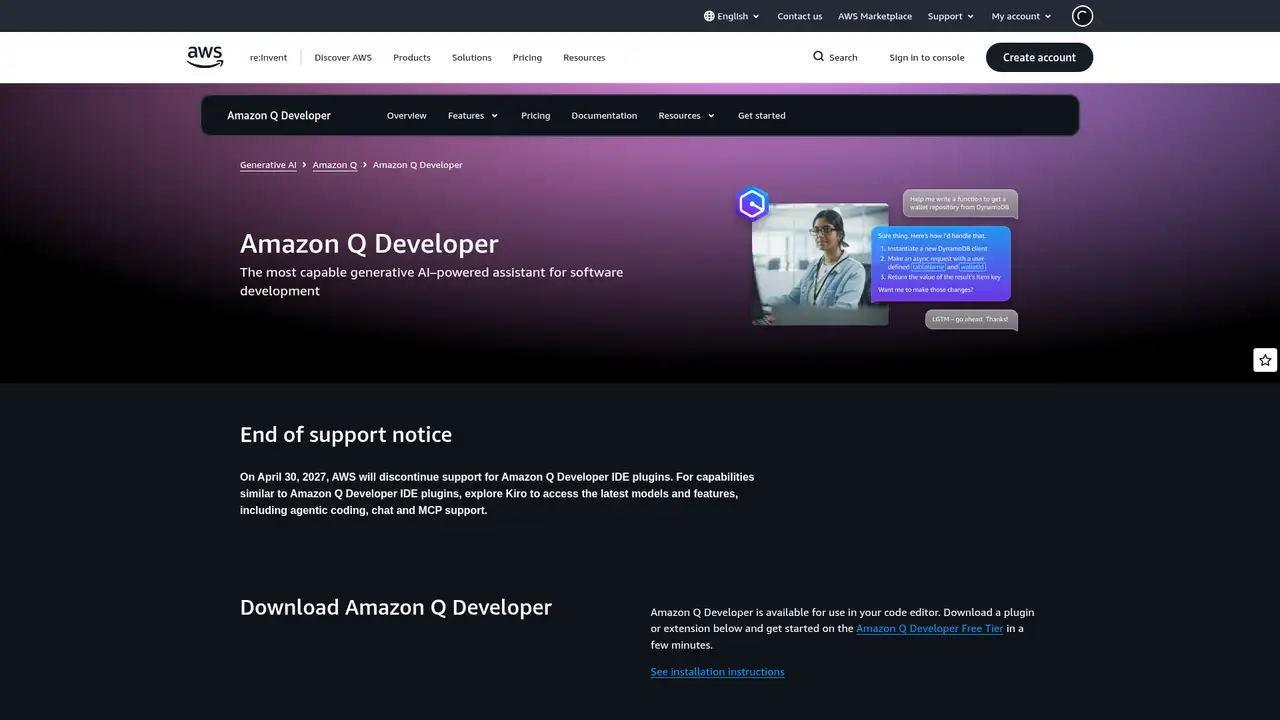
Amazon Q Developer is AWS’s software development assistant for IDEs, the command line, AWS Management Console, CodeCatalyst, SageMaker environments, AWS websites, and chat applications. It offers code suggestions, project-aware chat, code transformation, vulnerability and quality scanning, AWS account questions, generative SQL, and operational assistance. AWS announced general availability on April 30, 2024, when CodeWhisperer became part of Amazon Q Developer. The product has a perpetual free tier and a Pro tier rather than a standalone editor. Its strongest fit is an engineering organization already using AWS, because identity, account context, policy controls, analytics, and customizations connect directly to AWS services. AWS describes it as a generative AI powered assistant for software development.
A typical workflow starts with code completion or a question in an IDE or the Q command line. Developers can request explanations, debugging help, tests, refactoring, documentation, and implementation plans. Q agentic capabilities can implement features, document, test, review, refactor, and upgrade code. The transformation agent helps with Java upgrades and .NET porting. AWS console features answer account questions, diagnose common errors, analyze bills, and assist with cloud architecture. Developers can connect private repositories for more relevant recommendations and questions about internal code. Reference tracking and controls for suppressing public-code suggestions address code provenance. Pro administrators receive dashboards, user and policy management, and identity support.
AWS does not identify one public model name as the sole engine for Amazon Q Developer. It is an AWS-managed generative AI assistant that uses code and development context. Current capabilities include software-development agents, Java upgrades, .NET porting, code customizations, vulnerability scanning, quality scanning, and assistance in AWS data and machine-learning workflows. AWS documents TLS 1.2 or higher for communication and AWS encryption for stored data by default. Customer-managed KMS keys are available for selected Pro features. Recent product direction is important: AWS says IDE plugins will reach end of support on April 30, 2027, and points developers to Kiro for similar capabilities, including agentic coding, chat, and MCP support.
The free tier includes 50 agentic requests per month, public command-line completions, reference tracking, and 1,000 Java transformation lines per month. It also provides capped access to AWS console questions and related functions. Free-tier IDE limits apply only to Builder ID users, while IAM-user limits apply at the account level. Pro costs $19 per user per month and adds administration, analytics, customization, IP indemnity, and higher limits. Pro includes 4,000 submitted Java transformation lines per user, pooled at the AWS payer-account level. Extra transformation usage costs $0.003 per submitted line. AWS bills Pro monthly, with first-month proration, and activation follows a billable action such as completion, agentic coding, or transformation.
Amazon Q Developer is a strong choice for AWS-heavy teams that want coding assistance beside cloud diagnostics, identity administration, and account-aware answers. GitHub Copilot centers on GitHub-connected development workflows and offers a more cloud-neutral focus. Tabnine emphasizes private deployment options, while Sourcegraph Cody focuses on context from large codebases. Q’s main limitation is AWS coupling: its strongest features assume AWS services, accounts, identity administration, or console access. Free-tier content may be used for service improvement unless users opt out, while AWS says Pro content is not used for that purpose. Choose Q Developer when AWS operations and software development belong in one managed service. Its AWS account integration is the clearest reason to shortlist the service.
Who is Amazon Q Developer best for?
- AWS-first teams needing coding and cloud operations assistance together.
- Organizations managing developer access through IAM Identity Center.
- Developers modernizing Java applications with assisted transformation.
- Teams customizing recommendations from internal repositories.
Amazon Q Developer Pricing (2026)
Pricing model: Freemium. All prices in USD.
| Plan | Price | What you get |
|---|---|---|
| Free | Free | Includes 50 agentic requests per month, public CLI completions, reference tracking, and 1,000 Java transformation lines per month, with other capped features. |
| Pro | $19/user/month | Adds administration, analytics, customization, IP indemnity, and higher limits. Java transformation includes 4,000 lines per user per month, pooled at account level; extras cost $0.003 per submitted line. |
Pros and Cons
Pros
- The free tier offers IDE, CLI, agent, and transformation allowances.
- Pro combines coding help with AWS account questions and console diagnostics.
- Pro provides administration, analytics, customization, and identity support.
- AWS documents TLS 1.2 or higher and encryption at rest.
Cons
- Many free features have monthly or account-level limits.
- The strongest workflow assumes AWS services, accounts, and identity administration.
- Free-tier content may be used for service improvement unless users opt out.
Who should look elsewhere?
- Teams seeking a cloud-neutral assistant with minimal AWS integration.
- Developers whose free-tier usage exceeds monthly caps.
- Organizations unwilling to configure opt-out controls for free-tier content.
Technical Details
Frequently Asked Questions
How much does Amazon Q Developer cost?
Amazon Q Developer has a perpetual free tier with monthly limits. Pro costs $19 per user per month and includes administration, analytics, code customizations, IP indemnity, and higher limits. Java transformation includes 4,000 submitted lines per user per month pooled at account level, with additional lines priced at $0.003 each. AWS does not publish a separate purchasable Custom tier price.
What is included in the free tier?
The free tier includes 50 agentic requests per month, public command-line completions, reference tracking, and 1,000 Java transformation lines per month. It also provides capped access to AWS console questions and related functions. Free-tier IDE limits are available only to Builder ID users, while IAM-user limits apply at the account level.
Amazon Q Developer or GitHub Copilot?
Amazon Q Developer fits teams needing AWS account context, console diagnostics, identity administration, Java transformation, and cloud operations beside coding help. GitHub Copilot centers on GitHub-connected development workflows and has a more cloud-neutral focus. Compare repository context, identity controls, data policy, supported workflows, and expected usage before choosing.
Does Amazon Q Developer train on user data?
AWS says Pro content is not used for service improvement. Certain free-tier questions, responses, and generated code may be used for service improvement, including model training, unless users configure opt-out controls. AWS documents separate settings for IDE and command-line data sharing. Customer-managed KMS keys are available for selected Pro features.
Can businesses use Amazon Q Developer output commercially?
Amazon Q Developer Pro includes IP indemnity for output, subject to the AWS Service Terms. Both tiers include reference tracking and controls related to public-code suggestions. Organizations remain responsible for reviewing generated code, following applicable licenses, protecting sensitive information, and checking current AWS terms before commercial use.
Best Amazon Q Developer Alternatives in 2026
These tools do the same job as Amazon Q Developer, with different pricing, limits and trade-offs.
AI coding assistance across editors, terminals, and GitHub

Private AI coding assistance with optional agentic development

Permission-aware AI coding assistance for large software organizations
AI coding workspace with repository context and software agents