
Wren AI Review, Pricing & Alternatives (2026)
Governed natural-language analytics for warehouses, databases, and AI agents
Last updated: October 26, 2026
What is Wren AI?
Wren AI is an open-source GenBI engine and commercial analytics platform from Canner. It turns natural-language questions into governed SQL, charts, dashboards, and agent workflows for data teams, developers, and enterprise users. The open-source engine is free, while hosted commercial access starts at $179/month billed annually for Essential Cloud.
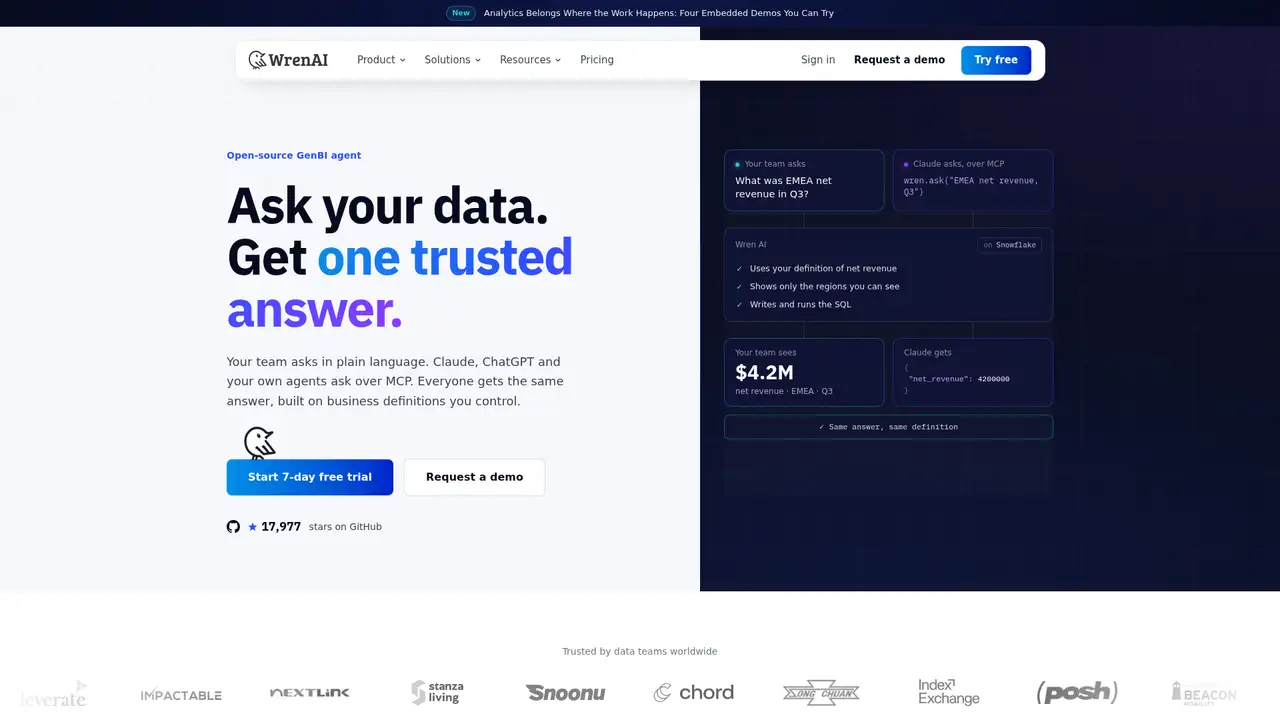
Wren AI is a generative business intelligence product developed by Canner. The open-source project began in March 2024 and was released in April, followed by Wren AI Cloud in October 2024. Its homepage lists more than 20 data sources and supports cloud, private-cloud, and air-gapped on-premises deployment. The project had over 2,670 GitHub stars and more than 30 contributors at the end of 2024, while its repository now lists over 17,000 stars. Wren is designed for data teams that want natural-language questions translated into governed SQL, charts, or dashboards while retaining warehouse controls, approved metric definitions, and query auditability. It includes a free self-hosted engine and paid team deployments, so buyers choose between operating the software themselves and using managed collaboration features.
Wren’s workflow begins with a data connection and an MDL semantic model. Teams record models, relationships, metrics, business terms, approved joins, units, and examples in YAML and Markdown files that reviewers can inspect in Git. A user or connected agent submits a question through the CLI, SDK, web application, API, MCP server, Slack, or Microsoft Teams. Wren uses that context to plan SQL, check the execution plan, enforce row limits and access policies, and return the result. The same modeled definitions can support charts, dashboards, reports, and browser applications, so teams do not need separate metric logic for each output. This approach suits data teams that can maintain definitions and need reviewable analytics across warehouse or database connections.
Wren's open-source engine combines an Apache DataFusion-based execution layer with MDL semantic modeling, retrieval across project context and memory, and governed text-to-SQL. This lets teams store metrics, relationships, approved joins, and business terms in reviewable files before users ask questions. The repository lists Python, Rust, TypeScript, JavaScript, Go Template, Shell, HTML, and Just among its languages. Current commercial materials describe agentic and classic modes, GenBI Apps, MCP access, dashboards, and row and column controls. In 2026, the documentation says the Wren Engine merged into the main repository on May 7, while the earlier wren-engine repository was archived. It identifies the former chat-first experience as Wren GenBI Classic, preserved on a legacy branch without new features or security fixes.
Wren’s current cloud pricing is usage based. Free provides 80 credits for the first 14 days, then 20 monthly credits, with two projects, two members, and 10 tables per project. Essential Cloud costs $179 per month when billed annually and includes 13,200 annual credits, unlimited projects and members, dashboards, spreadsheets, API management, and basic permissions. Enterprise Cloud costs $559 per month when billed annually and adds 24,000 annual credits, MCP, unlimited integrations, row and column controls, advanced auditing, LDAP or Active Directory, and OIDC. Enterprise Plus is custom priced and uses concurrent-session licensing for self-hosted, on-premises, or air-gapped deployments. Cloud credits roll over up to twice the included allowance, while extra credits cost $0.10 each.
Wren's main cost is semantic preparation: teams must define business meaning before the generated SQL can be trusted. The open-source edition also lacks the commercial web UI, hosted REST API, hosted MCP server, multi-user accounts, SSO, audit logs, and vendor support. Vanna AI is a lighter text-to-SQL framework that leaves more application and governance work to the team. Cube is stronger when the requirement is a headless metrics API and embedded analytics. ThoughtSpot Spotter is a more packaged enterprise search experience, but it is proprietary and depends on its wider analytics platform. Pick Wren AI when governed, version-controlled context and self-hosting matter more than a quick chat over an unmodeled database.
Who is Wren AI best for?
- Data teams maintaining governed metrics and semantic definitions in Git.
- Companies needing cloud, private-cloud, or air-gapped deployment options.
- Developers embedding natural-language analytics through APIs or MCP.
- Organizations connecting warehouses and operational databases without ETL.
Wren AI Pricing (2026)
Pricing model: Freemium. All prices in USD.
| Plan | Price | What you get |
|---|---|---|
| Free | $0 | Cloud usage includes 80 credits for the first 14 days plus 20 monthly credits. It includes two projects, two members, and 10 tables per project; free monthly credits expire each month. |
| Essential Cloud | $179/month | Billed annually with 13,200 annual credits, unlimited projects and members, unlimited dashboards and spreadsheets, API management, dbt and external integrations, basic permissions, and standard support. |
| Enterprise Cloud | $559/month | Billed annually with 24,000 annual credits, MCP, unlimited integrations, row and column controls, advanced RBAC, audit logs, LDAP or Active Directory, OIDC, evaluation tools, and priority support. |
| Enterprise Plus | Custom | Self-hosted licensing is based on concurrent active sessions rather than named users or monthly credits. It supports private cloud, on-premises, air-gapped deployment, SSO, SCIM 2.0, and support escalation. |
Pros and Cons
Pros
- The open-source engine supports governed text-to-SQL across more than 20 data sources.
- MDL stores metrics, relationships, and business context as reviewable files.
- Commercial plans support MCP, APIs, dashboards, and private deployment.
- Cloud pricing is based on usage rather than named seats.
Cons
- Reliable answers depend on upfront semantic modeling and maintained context.
- The free cloud tier has limited credits, projects, members, and tables.
- Key team controls and hosted interfaces require commercial plans.
Who should look elsewhere?
- Teams seeking a useful result from one unmodeled CSV.
- Buyers wanting a conventional BI suite with minimal setup.
- Organizations unwilling to maintain semantic definitions and access policies.
Technical Details
Frequently Asked Questions
How much does Wren AI cost?
The open-source engine is free and self-hosted. Wren AI Cloud has a Free tier with temporary and monthly credits, Essential Cloud at $179 per month billed annually, and Enterprise Cloud at $559 per month billed annually. Enterprise Plus is custom priced for self-hosted deployments and uses concurrent-session licensing. Additional cloud credits cost $0.10 each.
Does Wren AI have a free plan?
Yes. The Wren AI Cloud Free tier provides 80 credits for the first 14 days and 20 monthly credits. It includes two projects, two members, and 10 tables per project. Monthly free credits expire at the end of the month. The open-source engine is also free to run yourself, but it does not include the commercial web UI, hosted API, or team administration.
How does Wren AI compare with Vanna AI?
Wren AI is built around an MDL semantic layer, governed execution, dashboards, and a broader GenBI product path. Vanna AI is a more focused text-to-SQL framework that uses retrieval over documentation, schemas, and SQL examples, leaving more application work to its users. Wren suits teams standardizing business definitions, while Vanna suits developers assembling a custom assistant.
Does Wren AI train public models on customer data?
Wren AI says Wren AI Cloud uses a multi-LLM architecture and does not use customer data to train public foundation models. Its cloud privacy documentation also says the service has SOC 2 Type II certification. Organizations with stricter network requirements can use the self-hosted Enterprise Plus edition, including on-premises and air-gapped deployment.
Can I use Wren AI commercially?
The open-source repository is licensed under Apache 2.0, while commercial capabilities are offered through Wren AI Cloud and self-hosted Enterprise Plus. Commercial deployments add hosted interfaces, APIs, dashboards, access controls, audit features, and support. Teams embedding analytics for customers should review the commercial product terms because multi-tenant isolation, row and column controls, and embedded access are commercial capabilities.
Best Wren AI Alternatives in 2026
These tools do the same job as Wren AI, with different pricing, limits and trade-offs.