
Vanna AI Review, Pricing & Alternatives (2026)
Natural-language SQL agents for databases and internal data tools
Last updated: October 26, 2026
What is Vanna AI?
Vanna AI is an open-source Python framework and hosted service for building agents that connect language models to SQL databases. It targets developers creating natural-language analytics for internal users, with self-hosting, cloud, and hybrid deployment options. Paid hosted plans start at $50 per month, while the open-source framework is available without a subscription.
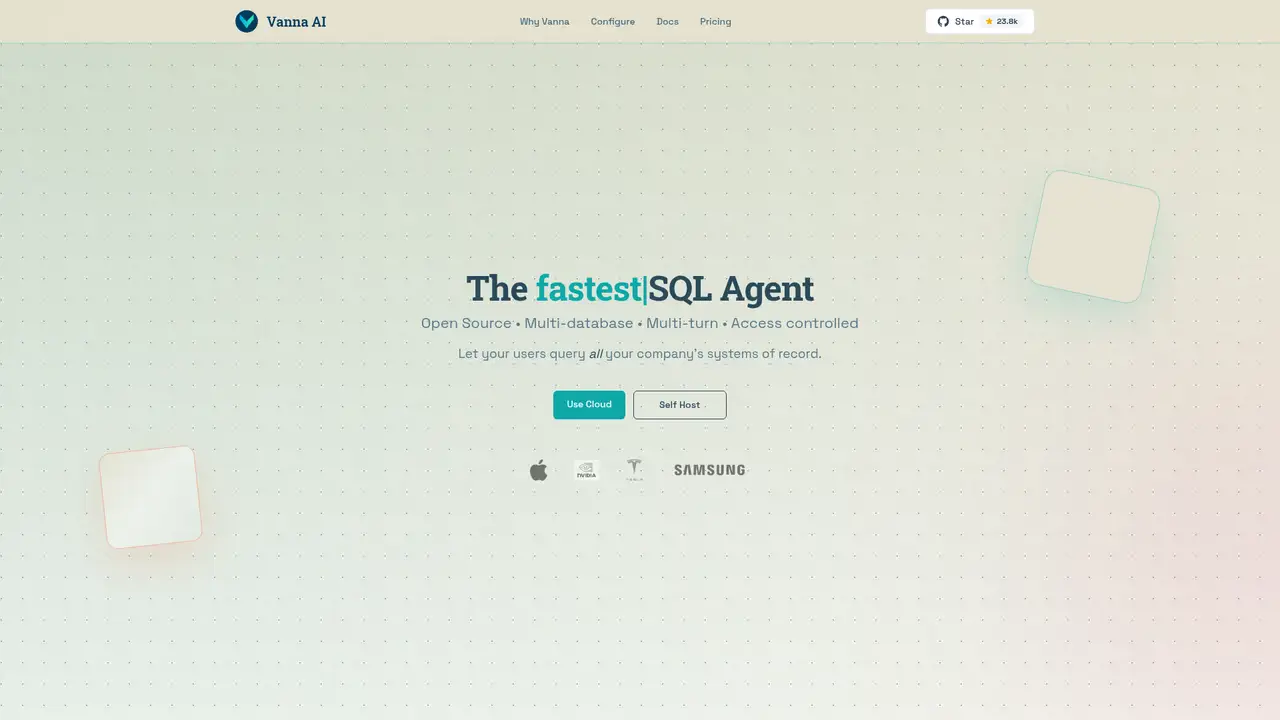
Vanna AI is an open-source Python framework and hosted product from Vanna AI, Inc. Vanna 2.0 describes itself as a user-aware agent framework that connects language models to databases, SQL tools, charts, and custom functions. The company presents the product as a way for people without SQL expertise to ask questions in natural language. It supports multiple language-model providers and database systems, including OpenAI, Gemini, SQLite, PostgreSQL, MySQL, Snowflake, and BigQuery. Vanna does not publish a founding year, employee count, user count, or funding total. The project has two distinct identities: a framework developers can assemble themselves and a commercial service that adds hosted administration, observability, memory, audit logs, file storage, and retention controls.
A typical Vanna workflow starts with a user question, then generates SQL for the connected database. The built-in flow checks the generated statement, runs it through a developer-supplied `run_sql` function, and can generate Plotly code for a chart. Developers can add database DDL, documentation, and question-to-SQL examples to the training or retrieval layer. Vanna’s documentation says successful interactions can be stored in Tool Memory, allowing later questions to retrieve related SQL and tool-use patterns. Vanna 2.0 extends the framework with an agent, tool registry, storage interfaces, prompts, lifecycle hooks, middleware, context enrichers, filters, observability, evaluations, and user authentication. Developers can use built-in connectors or implement a connector for any SQL database reachable from Python.
Vanna 2.0 uses a modular agent architecture rather than a named proprietary model. Its security FAQ describes a core agent that coordinates language-model interactions, tool execution loops, conversation management, and streaming. The framework offers pluggable integrations for Anthropic Claude, OpenAI GPT, and other providers, while its documentation says the hosted option can provide managed model endpoints. The public 2025 materials describe six extensibility points: lifecycle hooks, middleware, error recovery, context enrichment, conversation filters, and observability providers. Recent 2025 changes include the Vanna 2.0 agent framework and its October 2025 security documentation. Vanna has not announced a specific 2026 model release and does not tie the product to a fixed model or context window.
Vanna’s hosted pricing has two published monthly plans and one custom tier. Explorer costs $50 per month and includes 20 questions per day, admin features in Vanna OSS or Vanna Cloud, API access, and same-day email support. Team costs $500 per month and raises the allowance to 300 questions per day, with setup support and same-day live support. Enterprise has custom pricing, unlimited questions, on-premises deployment support, SAML SSO, an admin API, and custom work. Daily limits reset every 24 hours, and exceeding them causes rate limiting until reset or upgrade. Annual subscriptions receive a 20% discount. The open-source version can be self-hosted without a hosted subscription, but users remain responsible for their infrastructure, model provider, database, and security configuration.
Vanna’s flexibility shifts several difficult decisions onto the implementer. Its hardening guide says starter frontends have no login system, generated SQL can be arbitrary, and generated Plotly code should run in a sandbox. The premium backend security FAQ labels that backend development or demo stage, with limitations including in-memory storage, no encryption at rest, wide-open CORS, no rate limiting, and no authentication middleware. Wren AI is the stronger fit for governed metrics and semantic definitions, while DB-GPT is broader for multi-step analysis, Python, charts, and reports. Dataherald is more API-oriented for teams building their own interface. Vanna is best for developers who want an embeddable, model-flexible SQL agent and are prepared to own deployment and controls.
Who is Vanna AI best for?
- Developers building natural-language SQL features into internal tools.
- Teams needing self-hosted access to database credentials and conversation data.
- Organizations using several SQL databases or model providers.
- Small teams that can enforce database and code-execution controls.
Vanna AI Pricing (2026)
Pricing model: Freemium. All prices in USD.
| Plan | Price | What you get |
|---|---|---|
| Open source | Free | Self-hosted Python framework with no hosted question allowance. You provide the database, model provider, storage, and operational controls. |
| Explorer | $50/month | 20 questions per day, with daily throughput resetting every 24 hours. Includes API access, admin features, and same-day email support. |
| Team | $500/month | 300 questions per day, with daily throughput resetting every 24 hours. Includes Explorer features, setup support, and same-day live support. |
| Enterprise | Custom | Unlimited questions and custom deployment terms. Includes on-premises deployment support, SAML SSO, admin user provisioning, and custom work. |
Pros and Cons
Pros
- The framework supports multiple model providers and SQL databases.
- Self-hosting keeps database credentials and local data on your infrastructure.
- The API and tool abstractions support custom agents and integrations.
- Published plans include clear daily question allowances.
Cons
- Starter frontends do not include a login system.
- Generated SQL and Plotly code require permission scoping and sandboxing.
- The premium backend documentation describes unfinished security controls.
Who should look elsewhere?
- Nontechnical teams seeking a finished business-intelligence application.
- Organizations needing a production-ready hosted backend without added hardening.
- Users who need guaranteed SQL accuracy without reviewing generated queries.
Technical Details
Frequently Asked Questions
How much does Vanna AI cost?
Vanna AI has a free open-source framework for self-hosting. Its hosted Explorer plan costs $50 per month and includes 20 questions per day. Team costs $500 per month and includes 300 questions per day. Enterprise pricing is custom and includes unlimited questions, on-premises support, SAML SSO, admin provisioning, and custom work. Annual subscriptions receive a 20% discount.
Does Vanna AI have a free plan?
Yes, Vanna offers an open-source version that can be self-hosted without a hosted subscription. It does not provide a hosted-service question allowance. You supply the infrastructure, database connection, model provider, storage, authentication, and operational security. Explorer is the first paid hosted plan, priced at $50 per month for 20 questions per day.
How does Vanna AI compare with Wren AI?
Vanna is a modular Python framework that retrieves schema, documentation, and SQL examples for a language-model agent. Wren AI centers on a governed semantic model for business definitions, relationships, and metrics. Vanna suits developers who want to assemble an embeddable agent and choose their own components. Wren AI suits analytics teams willing to maintain explicit semantic definitions for repeatable business reporting.
Does Vanna AI train on user data?
Vanna’s self-hosted package handles training data, conversations, tool data, and audit logs locally when configured with local storage. The security FAQ says training data and conversations may be sent to Vanna premium services when those integrations are enabled. Questions and related context are also sent to the external language-model provider configured by the developer, subject to that provider’s retention policies.
Can I use Vanna AI commercially?
Vanna’s hosted terms say commercial use or redistribution requests should be directed to Vanna. Vanna’s documentation describes Vanna OSS as open source, but it does not spell out the full software license or commercial licensing terms. Teams should review the repository license and obtain written clarification for redistribution, resale, or embedded commercial deployments.
Best Vanna AI Alternatives in 2026
These tools do the same job as Vanna AI, with different pricing, limits and trade-offs.