
Databricks AI/BI Genie Review, Pricing & Alternatives (2026)
Governed natural language analytics for Databricks data
Last updated: October 22, 2026
What is Databricks AI/BI Genie?
Databricks AI/BI Genie is a conversational analytics layer for business users querying governed Databricks data, dashboards, and semantic definitions. It suits organizations already using Unity Catalog and Databricks Lakehouse, rather than standalone BI buyers. AI/BI has no separate license fee, while Genie usage beyond allowances follows regional Databricks usage pricing and generated-query compute remains separate.
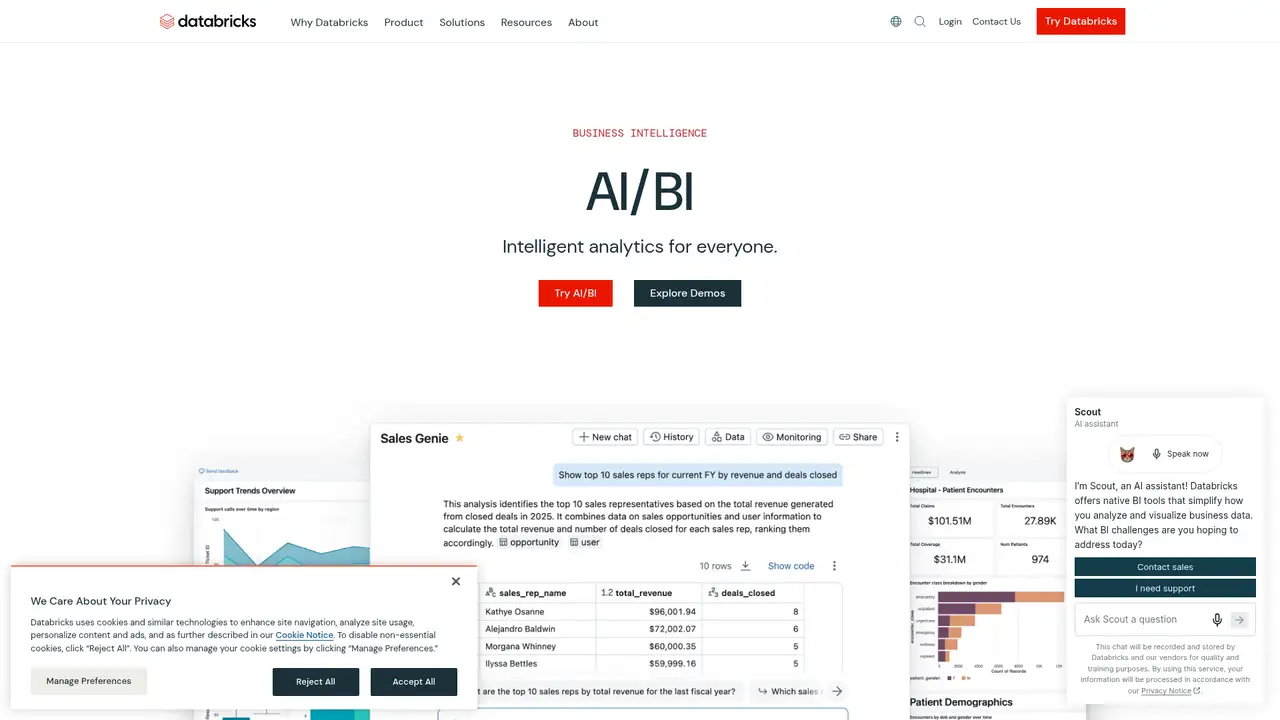
Databricks AI/BI Genie is a conversational business intelligence layer built into the Databricks Data + AI Platform. Databricks makes it for business and nontechnical users who need natural language answers from governed lakehouse data, dashboards, and business definitions. The product family includes AI/BI Dashboards, Genie Spaces, Genie One, Genie Agents, Genie Code, and Unity Catalog Business Semantics. Databricks does not publish a substantiated launch year for Genie, so a precise launch date would be misleading. Access is available to existing Databricks Lakehouse customers on Classic, Pro, or Serverless, with data managed in Unity Catalog. That requirement makes Genie a platform feature for Databricks customers, not an independent analytics service for arbitrary databases or spreadsheets.
A typical deployment starts with data and semantic preparation in Unity Catalog. Teams select tables, views, metric views, instructions, example SQL, and business rules for a Genie Agent or conversational space. Users ask questions in natural language, inspect generated answers and visualizations, ask follow-up questions, and explore AI/BI Dashboards. Genie One can route questions to Genie Agents and search data assets that users may access. Genie One and Genie Agents generate and run read-only SQL against permitted data. AI/BI Dashboards add natural language creation, interactive visualizations, dashboard insights, embedding, and scheduled outputs. The Genie API connects custom interfaces or services, including Microsoft Teams, Slack, and Glean. Admins can query billing tables and configure budgets, although Databricks describes budget enforcement as approximate rather than an absolute cap.
As of October 22, 2026, notable releases include generally available Genie One memory on September 29, which retains private user preferences and reporting conventions. October releases added streaming responses, file upload general availability, faster Agent mode models, Flash beta for simpler tasks, dashboard insights beta, secure sandbox code execution in public preview, and external-tool connections through MCP connectors in beta. Genie Agents support up to 50 tables, views, or metric views and up to 200,000 conversations. Databricks says partner-powered features can use Azure OpenAI, OpenAI on Databricks, or Anthropic on Databricks, while some features use Databricks-hosted models. Genie One and Genie Agents remain read-only for customer data, while Genie Code can run notebook and SQL editor code with configurable approval controls.
Pricing is usage-based in practice, despite AI/BI having no separate per-seat or per-license fee. Each identified user receives 150 free DBUs per month for Genie usage, equivalent to $10.50 in US East, with regional variation. Billed usage beyond the allowance uses the Serverless Real-Time Inference SKU, whose exact price varies by cloud and region. Until January 31, 2027, Genie One and Genie Agents usage by users is free, while service principals are excluded and billed. Genie Code remains billable beyond the allowance, with a 25 percent promotional discount through that date. Generated SQL still consumes Databricks compute, such as a SQL warehouse, and that compute is billed separately. Budgets track language-model usage, not warehouse execution, storage, networking, or other platform charges.
Genie is strongest when a company already has Databricks Lakehouse, Unity Catalog permissions, curated metric views, and staff able to maintain semantic context. Its main limitation is platform dependence, followed by variable costs from model usage and separately billed query compute. Power BI Copilot is a closer fit for Microsoft Fabric and Power BI estates, while Tableau AI suits organizations centered on Tableau workbooks and its analytics platform. Snowflake Cortex Analyst is the more natural choice for Snowflake-first data teams. ThoughtSpot offers a more independent search-oriented BI experience, but does not share Databricks-native governance. Pick Genie when governed Databricks access and shared semantic definitions matter most; choose Power BI Copilot, Tableau AI, Snowflake Cortex Analyst, or ThoughtSpot when another data platform or greater product independence comes first.
Who is Databricks AI/BI Genie best for?
- Databricks customers with Unity Catalog governance configured.
- Business users asking natural language questions of curated lakehouse data.
- Data teams maintaining metric views and semantic definitions.
- Organizations preferring usage pricing over separate BI seat fees.
Databricks AI/BI Genie Pricing (2026)
Pricing model: Usage-based. All prices in USD.
| Plan | Price | What you get |
|---|---|---|
| AI/BI and Genie | No separate license fee | Available to existing Databricks Lakehouse customers using Unity Catalog; standard Databricks platform and compute charges apply. |
| Genie user allowance | Usage allowance | Each identified user receives 150 free DBUs monthly; service principals do not receive this allowance. |
| Genie One and Genie Agents promotion | $0 for eligible users through Jan 31, 2027 | User usage is promotional; service-principal usage and generated-query compute remain billable. |
| Beyond allowance | Usage-based | Billed usage uses the regional Serverless Real-Time Inference SKU; Databricks does not publish one universal USD rate. |
Pros and Cons
Pros
- Unity Catalog permissions govern accessible data and metadata.
- AI/BI has no separate per-seat or per-license fee.
- Genie Agents support configured context and read-only SQL.
- Databricks exposes usage records and configurable budget controls.
Cons
- SQL warehouse compute is billed separately from Genie usage.
- Costs vary with task complexity, context, region, and volume.
- The product depends on Databricks Lakehouse and Unity Catalog.
Who should look elsewhere?
- Small teams without an existing Databricks Lakehouse deployment.
- Buyers seeking standalone BI for scattered databases.
- Teams requiring one fixed bill including model and query compute.
Technical Details
Frequently Asked Questions
Does Databricks Genie have a separate license fee?
AI/BI and Genie have no additional per-seat or per-license fee. Databricks still bills the underlying platform, including compute used by generated SQL. Genie language-model usage is metered through DBUs, with a monthly allowance for identified users and usage-based charges beyond it. Total cost depends on AI consumption and query execution.
Is Databricks Genie free?
Identified users receive 150 free DBUs each month for Genie usage. Databricks also makes Genie One and Genie Agents usage by users free through January 31, 2027. Service principals are excluded. These offers do not make SQL warehouse compute, storage, networking, or other Databricks platform charges free.
How does Genie compare with Power BI Copilot?
Genie is native to Databricks and uses Unity Catalog permissions, lakehouse data, and Databricks semantic definitions. Power BI Copilot is native to Microsoft Fabric and Power BI models. Genie fits Databricks-first organizations, while Power BI Copilot better suits teams standardized on Microsoft analytics, existing Power BI reports, and Microsoft governance.
Does Databricks train models on Genie data?
Databricks says it does not use submitted data, prompts, or responses to train generative foundation models it makes available to third parties. The company says partner model providers do not retain prompts or responses. Genie sends relevant questions, metadata, values, instructions, and examples subject to Unity Catalog permissions, while conversations are stored in the Databricks control plane.
Can companies use Databricks Genie commercially?
Yes. Genie is an enterprise feature of the Databricks platform and supports organizational analytics use. Commercial deployment requires a qualifying Databricks Lakehouse environment, Unity Catalog-managed data, suitable permissions, and cost controls. Companies should budget for Genie language-model usage and the separate Databricks compute that executes generated read-only queries.
Best Databricks AI/BI Genie Alternatives in 2026
These tools do the same job as Databricks AI/BI Genie, with different pricing, limits and trade-offs.