
Voiceflow Review, Pricing & Alternatives (2026)
Build and operate customer support agents across chat, phone, and SMS
Last updated: October 26, 2026
What is Voiceflow?
Voiceflow is a platform for building and operating AI customer support agents across web chat, phone, SMS, and custom interfaces. It targets support, CX, conversation design, and engineering teams that need workflow control, model choice, integrations, testing, and human handoff. A free plan costs $0/month; paid plan prices appear inside the dashboard.
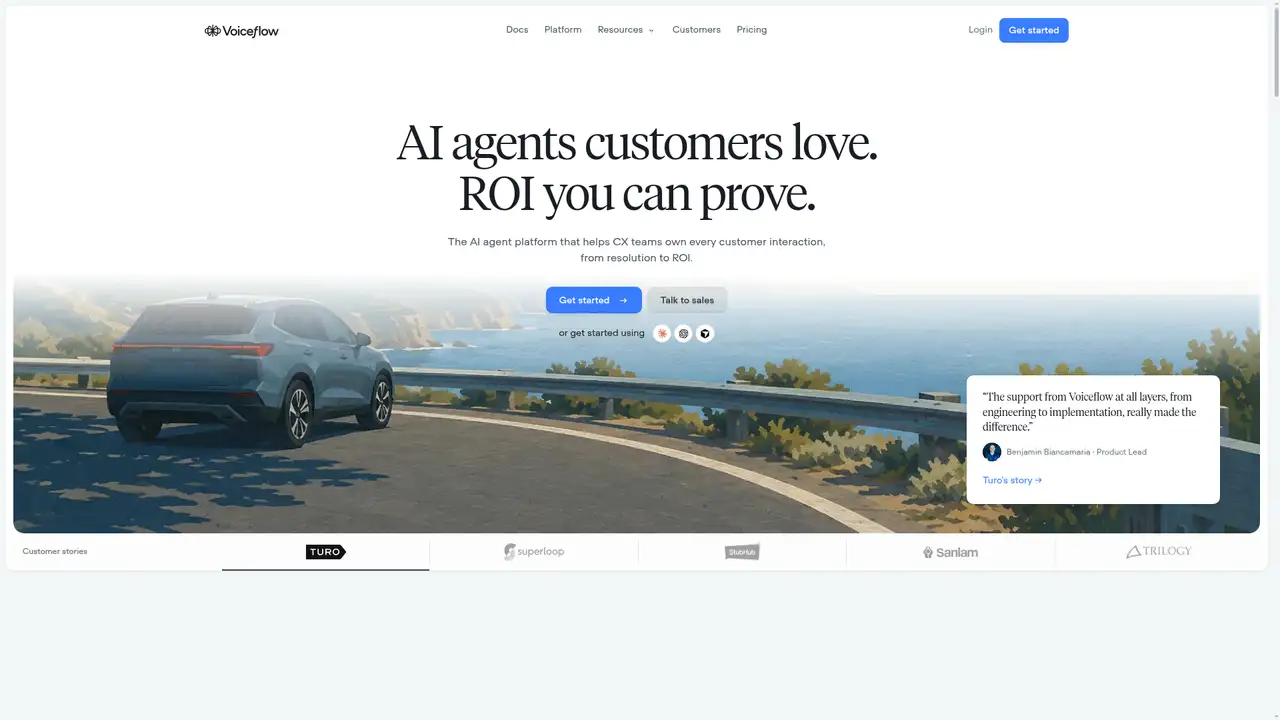
Voiceflow is a platform for building and operating AI customer support agents across chat, phone, SMS, and custom interfaces. Voiceflow, Inc. was founded in Toronto in 2018 as Storyflow, an interactive storytelling tool for Alexa, and adopted the Voiceflow name in November 2018. The company says it has raised $35 million, including a $20 million Series A led by Felicis and a $15 million round led by OpenView. Its company information page reports more than 3,000 customers and over 1 billion agent messages processed. Listed customers include General Motors, Allstate, JP Morgan, Cisco, Vodafone, Woolworths, StubHub, and Turo. Voiceflow is designed for production customer experience work and connects to existing helpdesk or contact center systems rather than replacing them.
Voiceflow projects combine global instructions, playbooks, workflows, tools, knowledge sources, models, channels, handoff rules, tests, analytics, and separate environments. A team might use a playbook for an open-ended return request, then route authentication through a fixed workflow. Tools can call APIs, custom code, MCP services, Zendesk, Salesforce, HubSpot, Shopify, and other systems. Agents can run through a web chat widget with voice mode, Voiceflow phone numbers in the United States and Canada, connected Twilio, Vonage, or Telnyx numbers, SMS, or the Conversations API. Live agent handoff supports Zendesk, Genesys, UJET, Kustomer, and Dixa. Phone calls can also transfer to a phone number or SIP address. Environments separate building, testing, and production publishing.
Voiceflow supports models from providers including Anthropic and Google, alongside Voiceflow Core, and allows model fallback during provider outages. Recent releases listed by the company include Voiceflow V4 in March 2026, Voiceflow Core and environments in May, simulated-persona tests in June, environment protection in July, Atlas copilot in beta and personal access tokens in August, and Voiceflow Core 4.2 in September. The credit table names models such as Claude, Gemini, GPT, Llama, Grok, Kimi K3, Voiceflow Core 4.0, Voiceflow Core 4.1, and Voiceflow Flash 4.2. Voiceflow says its platform provides 99.95% agent uptime and capacity for 300,000 messages per minute. Those figures are company claims, not independent performance measurements. The platform also includes transcripts, call recordings, evaluations, analytics, and production controls.
Voiceflow combines a monthly plan fee, optional add-ons, and credit-based usage. The Free plan costs $0/month, has limited features, and includes a one-time credit grant that does not renew. Pro is for individual builders, while Business adds capabilities such as model fallback and priority support. Enterprise includes unlimited product usage, single sign-on, private cloud hosting, and custom credit allotments. Current paid plan prices appear in the dashboard rather than on the pricing page. Credits are shared across an organization, and paid-plan allotments reset each billing cycle. The credit table lists chat usage at $0.005 per message and phone usage at $0.05 per minute. It also lists separate charges for model tokens, speech-to-text, text-to-speech, and other agent actions. Editor seats and phone numbers cost extra.
Voiceflow offers broad channel and model coverage, though that breadth creates billing and configuration work for smaller teams. Free credits do not renew, usage spans messages, phone minutes, model tokens, speech services, and orchestration actions, and PII redaction is a paid add-on that detects English text only in future production conversations. Botpress is a closer option for teams seeking a visual agent builder with publicly listed self-serve pricing. Microsoft Copilot Studio fits organizations centered on Microsoft business systems, while Cognigy targets larger contact center automation programs. Voiceflow's strengths are inspectable playbooks, deterministic workflows, model choice, testing, environments, and handoff connections. Pick Voiceflow if your support or CX team needs multi-channel agents with control over behavior and production operations.
Who is Voiceflow best for?
- Support teams building customer service agents across several channels.
- CX leaders who need inspectable workflows and human handoff.
- Engineers connecting agents to business systems through APIs and MCP.
- Agencies managing multiple client deployments and workspaces.
Voiceflow Pricing (2026)
Pricing model: Freemium. All prices in USD.
| Plan | Price | What you get |
|---|---|---|
| Free | $0/month | Limited features and a one-time credit grant that does not renew. The plan is intended for trying Voiceflow and is not suitable for production usage. |
| Pro | Custom | For individual builders, with access to all LLM models and a higher agent limit than Free. Current pricing appears in Plans and Billing. |
| Business | Custom | For growing teams, with features including LLM fallback models and priority support. Current pricing appears in Plans and Billing. |
| Enterprise | Custom | Includes unlimited product usage, single sign-on, private cloud hosting, and custom credit allotments. Enterprise customers are billed by contract. |
Pros and Cons
Pros
- It supports chat, phone, SMS, and custom interfaces through one agent platform.
- Teams can combine goal-driven playbooks with deterministic workflows.
- Model choice spans multiple providers and Voiceflow Core.
- Testing, evaluations, transcripts, analytics, and environments support production work.
Cons
- Current paid plan prices appear inside account billing rather than publicly.
- Usage charges cover credits, models, phone, speech, and orchestration actions.
- PII redaction is a paid add-on and detects English text only.
Who should look elsewhere?
- Teams seeking a conventional helpdesk rather than an agent platform.
- Small projects that do not need production environments or integrations.
- Buyers requiring public current subscription prices before signup.
Technical Details
Frequently Asked Questions
How much does Voiceflow cost?
Voiceflow does not publish current paid plan prices on its pricing page. Billing combines a monthly plan fee, optional add-ons, and credit-based usage across Free, Pro, Business, and Enterprise. The credit table lists chat usage at $0.005 per message and phone usage at $0.05 per minute. Paid plan prices, credit allotments, and add-ons appear in the Plans and Billing area.
Does Voiceflow have a free plan?
Yes. Voiceflow's Free plan costs $0/month and includes limited features plus a one-time credit grant. The grant does not renew, and billing documentation says the plan is not suitable for production usage. Paid plans provide recurring monthly credits, while Enterprise can use custom credit allotments and contract billing. Additional usage can involve models, phone, speech, and other actions.
How does Voiceflow compare with Botpress?
Voiceflow and Botpress both provide visual tools for building AI agents, integrations, and production deployments. Voiceflow emphasizes customer support across chat, phone, SMS, model choice, playbooks, workflows, testing, and handoff. Botpress is a direct alternative with publicly listed self-serve plans. Voiceflow suits teams prioritizing multi-channel CX control, while Botpress suits buyers prioritizing visible self-serve pricing.
Does Voiceflow train AI models on customer data?
Voiceflow says customer data is not used to train AI models and that model providers operate with zero data retention. It also offers encrypted secrets, project and environment controls, and optional PII redaction. Redaction runs within Voiceflow infrastructure, applies only to production conversations, is not retroactive, and detects English text. These settings do not replace an organization's own privacy review.
Can Voiceflow agents be used commercially?
Voiceflow is designed for business customer support and customer experience deployments. Agents can connect to business systems, operate across web chat, phone, SMS, and custom interfaces, and hand conversations to human teams. Commercial costs depend on the selected plan, add-ons, credit usage, models, channels, and contract terms. Teams should review those terms before launching a customer-facing deployment.
Best Voiceflow Alternatives in 2026
These tools do the same job as Voiceflow, with different pricing, limits and trade-offs.