
Tabnine Review, Pricing & Alternatives (2026)
Private AI coding assistance with optional agentic development
acquired: Tricentis acquired Tabnine on July 30, 2026. Existing customers continue receiving support, while Tabnine technology is being integrated into the Tricentis Agentic Quality Engineering Platform.
Last updated: October 22, 2026
What is Tabnine?
Tabnine is an AI coding platform for developers and enterprise engineering teams that need code completions, chat, repository context, agents, and private deployment. Code Assistant costs $39 per user per month with annual billing, while Agentic Platform costs $59. The pricing page does not show a free plan, and Tabnine-provided model access adds consumption charges.
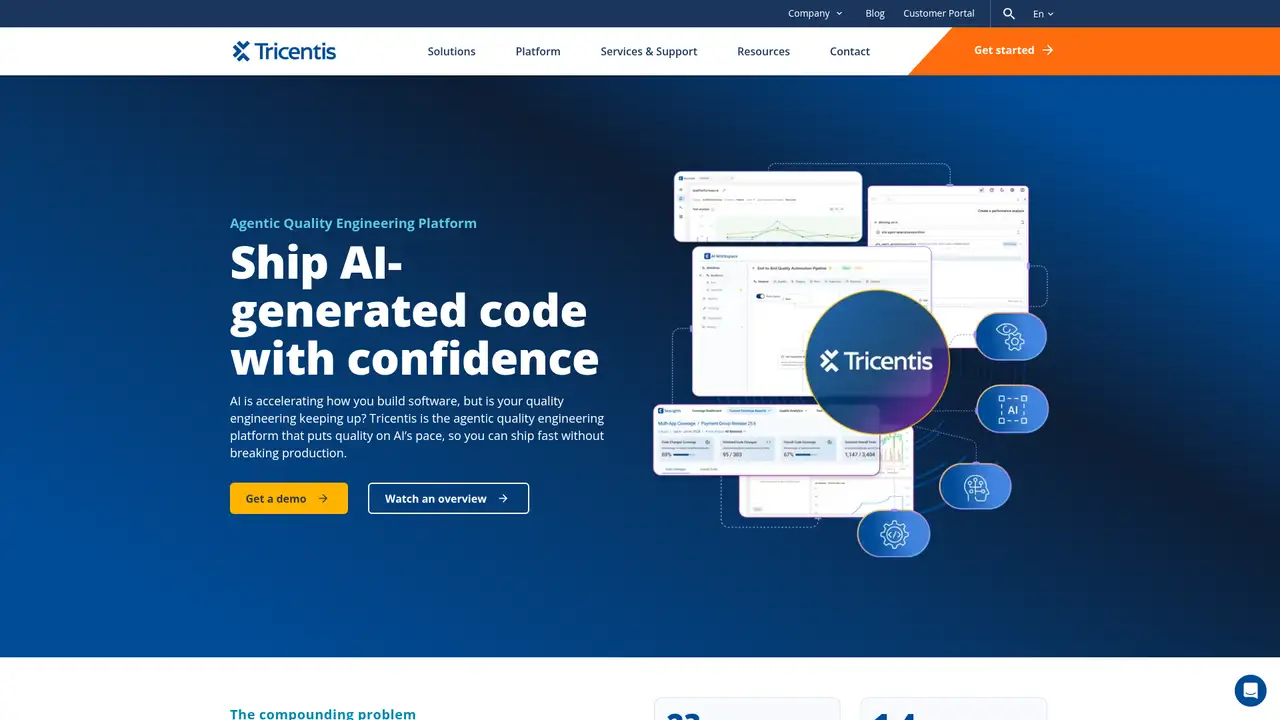
Tabnine is an AI software development platform for individual developers and enterprise engineering teams. It combines code completions, IDE chat, codebase context, agentic workflows, and a command line agent. The company says the platform supports major IDEs, languages, cloud providers, and model providers. Tabnine was founded in 2013 as Codota, and its first AI code completion for a Java IDE appeared in 2018. Tricentis acquired Tabnine on July 30, 2026. Tabnine says its technology is becoming part of the Tricentis Agentic Quality Engineering Platform and that existing customers will continue receiving support. Financial terms were not disclosed. CB Insights lists $63.05 million in total funding, although Tabnine does not publish a current customer count on the cited product pages.
A typical Tabnine workflow starts in a supported IDE, where inline completion suggests the current line, multiple lines, or a complete function. IDE chat can explain code, generate tests, refactor files, and answer questions using connected repository context. Agentic Platform adds autonomous agents with optional user oversight, customizable Coaching Guidelines, and Model Context Protocol connections. These connections can reach Git operations, testing frameworks, linters, Docker, package managers, CI/CD systems, Jira, Confluence, databases, and APIs. The included Tabnine CLI runs in local environments, remote sessions, and CI pipelines, handling code changes, refactoring, and pull requests. Context Engine connections cover Bitbucket, GitHub, GitLab, and Perforce, while Jira Cloud and Data Center can inform assistant responses.
Tabnine presents its model layer as a provider choice rather than one named model. The pricing page lists Anthropic, OpenAI, Google, Meta, Mistral, and other providers for chat and coding assistance. Its Context Engine organizes architecture, dependencies, organizational standards, APIs, documentation, and code examples so agents can use repository context. In March 2025, Tabnine announced an on-premises AI Factory partnership with Dell and NVIDIA, supporting private deployments with NVIDIA GPUs, open-source models such as Llama 3.1, and private cloud endpoints. In July 2026, Tricentis announced that Tabnine's Enterprise Context Engine would be integrated into its quality engineering platform. Tabnine describes the engine as maintaining an evolving understanding of systems, dependencies, standards, repositories, documentation, tickets, APIs, and infrastructure metadata.
The current pricing page lists two paid plans. Code Assistant costs $39 per user per month with annual billing and includes completions, chat, major IDE support, Jira integration, security controls, private deployment choices, and business-hours ticket support. Agentic Platform costs $59 per user per month with annual billing and adds agents, the CLI, Coaching Guidelines, MCP tool connections, and Context Engine. When customers use their own on-premises model or cloud endpoint, usage is unlimited under the listed plan terms. Tabnine-provided model access adds reserved token consumption priced at the provider's actual rate plus a five percent handling fee. The pricing page does not show a free, student, or separate business tier. Headless Agents are an optional add-on, but no public price is shown.
Tabnine is best suited to organizations that require VPC, on-premises, or fully air-gapped deployment, repository-aware assistance, and controls for permissions, provenance, analytics, and model access. Its $39 starting price and separate provider charges are less suitable for hobbyists seeking a documented free allowance. GitHub Copilot offers a broad assistant connected to GitHub and common IDEs, Amazon Q Developer fits teams working heavily with AWS services, and Sourcegraph Cody emphasizes large-codebase context. Tabnine's acquisition requires buyers to confirm product packaging, support commitments, and roadmap direction before a broad rollout. Choose Tabnine when private infrastructure and organizational context matter more than a lower-cost individual plan.
Who is Tabnine best for?
- Enterprise teams requiring VPC, on-premises, or air-gapped deployment.
- Developers wanting repository-aware chat and agent workflows inside their IDE.
- Organizations standardizing coding guidance across repositories and teams.
- Teams connecting AI coding work to Jira, Git, CI, and developer tools.
Tabnine Pricing (2026)
Pricing model: Paid. All prices in USD.
| Plan | Price | What you get |
|---|---|---|
| Code Assistant | $39/user/month, annual subscription | Completions, chat, major IDEs, Jira integration, security controls, private deployment, and support. Own-model usage is unlimited; Tabnine-provided models add provider cost plus 5%. |
| Agentic Platform | $59/user/month, annual subscription | Adds agents, CLI, Context Engine, Coaching Guidelines, and MCP connections. Own-model usage is unlimited; Tabnine-provided models add provider cost plus 5%. |
Pros and Cons
Pros
- Private deployment includes SaaS, VPC, on-premises, and air-gapped options.
- Agentic Platform connects coding agents to repositories and developer tools.
- Customers can use their own model endpoint without Tabnine token charges.
- Tabnine says customer code is not stored, used for training, or shared.
Cons
- Current paid plans require annual subscriptions at $39 or $59 monthly.
- Tabnine-provided model usage adds provider charges plus five percent.
- The acquisition creates uncertainty around future packaging and roadmap priorities.
Who should look elsewhere?
- Individual hobbyists seeking a prominently documented free plan.
- Teams unwilling to manage model consumption charges or annual commitments.
- Buyers needing a settled post-acquisition roadmap before broad adoption.
Technical Details
Frequently Asked Questions
How much does Tabnine cost?
The current pricing page lists Code Assistant at $39 per user per month with an annual subscription and Agentic Platform at $59 per user per month with annual billing. Customers using Tabnine-provided models also pay reserved token consumption based on the provider's price plus a five percent handling fee. Using an organization's own model endpoint is listed as unlimited.
Does Tabnine have a free plan?
The current pricing page presents Code Assistant and Agentic Platform as paid plans and does not show a free tier. It also does not list a student plan or a separate business plan. Earlier Tabnine pages may describe older offers, but those prices are not the current published pricing structure. Buyers should confirm any trial terms with Tabnine.
How does Tabnine compare with GitHub Copilot?
GitHub Copilot is a developer assistant integrated with GitHub and common IDEs. Tabnine differentiates itself through VPC, on-premises, and air-gapped deployment, support for an organization's own model endpoint, and enterprise context features connecting repositories and developer tools. Teams centered on GitHub may prefer Copilot, while private-infrastructure teams may find Tabnine's deployment controls more important.
Does Tabnine train on customer code?
Tabnine's code privacy page says customer code is never stored, used to train its models, or shared. Its pricing page also describes zero code retention, encryption, TLS, private deployment, and compliance controls. These are company statements, so customers should review contractual terms, deployment configuration, and any model-provider arrangement before sending proprietary code through the service.
Can companies use Tabnine commercially?
Tabnine sells organizational subscriptions and describes license-safe AI usage, code-generation provenance, and IP indemnification subject to terms and conditions. Commercial customers should review the applicable agreement because generated-code rights, indemnification, provider-model charges, deployment responsibilities, and support commitments can differ by plan and negotiated contract.
Best Tabnine Alternatives in 2026
These tools do the same job as Tabnine, with different pricing, limits and trade-offs.
AI coding assistance across editors, terminals, and GitHub

AWS-integrated coding help for IDEs, terminals, and cloud operations
Permission-aware AI coding assistance for large software organizations
AI coding workspace with repository context and software agents