
Sourcegraph Cody Review, Pricing & Alternatives (2026)
Permission-aware AI coding assistance for large software organizations
Last updated: October 22, 2026
What is Sourcegraph Cody?
Sourcegraph Cody is an AI coding assistant for engineering organizations that need code search, repository context, chat, completions, and enterprise controls. Cody Enterprise is sales-led, while Sourcegraph’s broader Enterprise plan starts at $16,000 per year with a minimum annual contract. Cody Free and Cody Pro ended in July 2025, leaving no current individual entry plan.
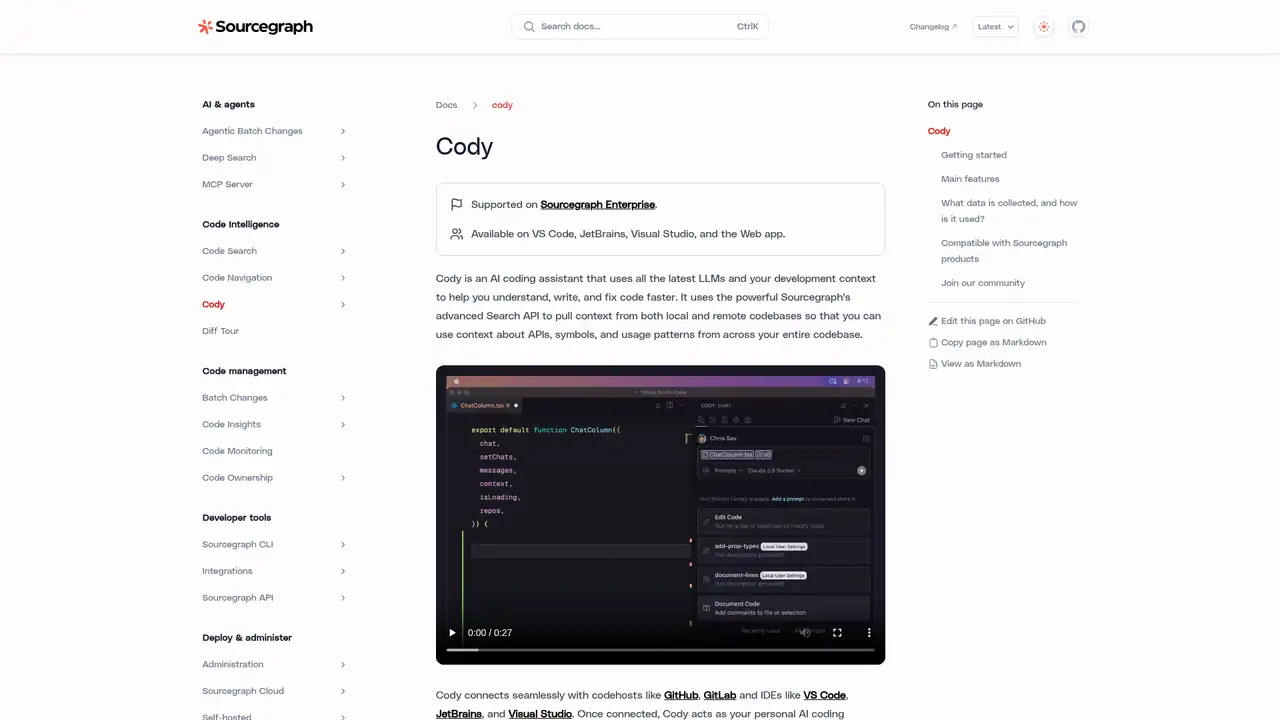
Sourcegraph Cody is an AI coding assistant made by Sourcegraph for organizations working with large codebases. Sourcegraph introduced Cody in Sourcegraph 5.0 in March 2023, and Cody 1.0 became generally available in December 2023. Cody uses Sourcegraph code intelligence to answer questions, generate code, and suggest editor completions. Cody Free and Cody Pro ended July 23, 2025, while Cody Enterprise continued. Sourcegraph and Amp became separate companies in December 2025. Sourcegraph focuses on code search and enterprise infrastructure, while Amp focuses on frontier coding agents. Cody remains an enterprise capability, rather than a current self-serve developer subscription. Its positioning therefore centers on governed access, repository scale, and organizational deployment rather than casual individual experimentation or a low-cost personal plan.
Cody handles questions, completion requests, and edits inside supported editors and Sourcegraph interfaces. Sourcegraph retrieves relevant code snippets and enforces the user’s read permissions during retrieval. Cody supports completions, chat, code explanations, documentation, unit-test generation, quick fixes, and natural-language code search. Agentic chat can gather context from code search, files, the terminal, the web, and OpenCtx providers. Terminal commands are among the available tools for agentic context gathering. Enterprise administrators can control access through Sourcegraph’s role-based controls, and Cody supports multi-repository context for up to 10 repositories. This combination lets teams apply existing repository permissions while giving developers contextual assistance across larger software estates.
Cody uses Sourcegraph code intelligence and can work with language-model providers including Anthropic and OpenAI in Enterprise configurations. Cody’s FAQ says self-hosted Sourcegraph sends code snippets, up to 28 KB per request, to a third-party cloud service by default. Enterprise deployments replaced embeddings with Sourcegraph Search. In January 2025, Sourcegraph announced agentic chat and enterprise AI agents. The announced agents included a code-review agent in early access, plus planned migration, testing, documentation, and notification agents. Cody supports languages including JavaScript, TypeScript, PHP, Python, Java, C and C++, C#, Ruby, Go, SQL, Rust, Kotlin, Scala, and shell scripting languages. These capabilities make it suitable for varied codebases and established enterprise workflows.
Cody has no current public Free or Pro checkout. Sourcegraph stopped new Free and Pro signups on June 25, 2025, and discontinued Cody Free, Cody Pro, and Cody in Enterprise Starter on July 23, 2025. Cody Enterprise has no published standalone per-seat rate. Sourcegraph’s broader Enterprise plan starts at $16,000 per year with a minimum annual contract. That plan includes credits for AI features, with credits scaling with team size, organization-wide pooling, and volume pricing. It also lists search, Deep Search, API and CLI access, single-tenant cloud, self-hosted deployment, security controls, and support. Contract terms determine Cody access and usage allowances. Buyers should confirm the exact entitlement and commercial scope during sales discussions.
Cody is a poor fit for an individual seeking a current free assistant or transparent monthly pricing. The FAQ says there is no public-facing Cody API, and self-hosted deployments still send snippets to a third-party cloud service for model interactions. GitHub Copilot has a clearer self-serve route, while Cursor and Claude Code target accessible local coding workflows. Cody’s strongest case is permission-aware, multi-repository context combined with Sourcegraph Search and enterprise deployment choices. Choose Cody Enterprise when repository governance and centralized administration matter most. Choose Copilot, Cursor, or Claude Code when individual access and local agentic workflows matter more. Organizations should also weigh provider handling, contract terms, and deployment requirements before adoption.
Who is Sourcegraph Cody best for?
- Engineering organizations with many repositories and strict access controls.
- Teams already using Sourcegraph Search and code navigation.
- Enterprises requiring single-tenant cloud or self-hosted deployment.
- Administrators that need centralized model and access controls.
Sourcegraph Cody Pricing (2026)
Pricing model: Paid. All prices in USD.
| Plan | Price | What you get |
|---|---|---|
| Enterprise | Starting at $16,000/year | Minimum annual contract. Includes AI-feature credits that scale with team size; exact Cody access and volume pricing are customized. |
Pros and Cons
Pros
- Repository retrieval enforces user read permissions.
- Enterprise deployment supports hosted and self-hosted configurations.
- Sourcegraph combines Cody with search, Deep Search, and APIs.
- Agentic chat can gather code and terminal context.
Cons
- Free and Pro plans ended on July 23, 2025.
- Enterprise pricing and Cody entitlements require a sales contract.
- Self-hosted use still sends snippets to a third-party cloud service.
Who should look elsewhere?
- Individuals seeking a current free Cody plan.
- Small teams requiring transparent monthly pricing.
- Developers primarily seeking an autonomous local coding agent.
Technical Details
Frequently Asked Questions
How much does Sourcegraph Cody cost?
Cody has no current public individual price. Sourcegraph ended Cody Free and Cody Pro in July 2025. Cody remains available to Enterprise customers through a sales-led agreement. Sourcegraph’s current Enterprise pricing starts at $16,000 per year, but that covers the broader platform and does not state a standalone Cody seat price. Contract terms determine Cody access, credits, deployment, and support.
Is there a free Cody plan?
No current Cody Free plan is available. Sourcegraph stopped new Free and Pro signups on June 25, 2025, and discontinued those plans on July 23, 2025. Enterprise Starter also lost Cody. Evaluators should treat Cody as an enterprise capability rather than expect a free trial or individual subscription. Sourcegraph continues supporting Cody Enterprise.
Is Cody the same product as Sourcegraph Amp?
No. Sourcegraph announced in December 2025 that Sourcegraph and Amp would become separate companies. Cody remains the enterprise coding assistant tied to Sourcegraph code search and governance. Amp is a separate agentic coding product. Transition messaging directed former Free and Pro users toward Amp, but Amp is not a Cody rename and should not be treated as the same service.
Does Cody train on customer code?
For Enterprise customers, Sourcegraph says it will not train on company data, and third-party model providers do not train on the customer’s specific codebase. Cody retrieves permitted snippets, sends context to a selected model, and returns the response. Organizations should review contracts, provider retention terms, deployment settings, and BYOK configuration before sending proprietary code through a model provider.
Can businesses use Cody commercially?
Yes, Cody Enterprise is intended for commercial engineering organizations and remains supported after the consumer-plan shutdown. It provides administration, repository permissions, model configuration, and deployment choices. Commercial access is contract-based, with broader Sourcegraph Enterprise pricing starting at a $16,000 annual minimum. Buyers should confirm seats, credits, support, data handling, API availability, and deployment terms before signing.
Best Sourcegraph Cody Alternatives in 2026
These tools do the same job as Sourcegraph Cody, with different pricing, limits and trade-offs.
AI coding assistance across editors, terminals, and GitHub
AI coding workspace with repository context and software agents
An agentic coding assistant for terminal, IDE, desktop, and web

AWS-integrated coding help for IDEs, terminals, and cloud operations

Open coding agent for editors, terminals, desktops, and custom apps