
Paperguide Review, Pricing & Alternatives (2026)
AI workspace for literature reviews and systematic evidence.
Last updated: October 26, 2026
What is Paperguide?
Paperguide serves students, researchers, faculty, and review teams with scholarly search, reference management, PDF chat, extraction, systematic reviews, and cited writing. A free plan starts at $0 and includes 1,500 AI credits monthly. Paid annual plans add larger credit pools, review capacity, collaboration, exports, screening, and Search API requests.
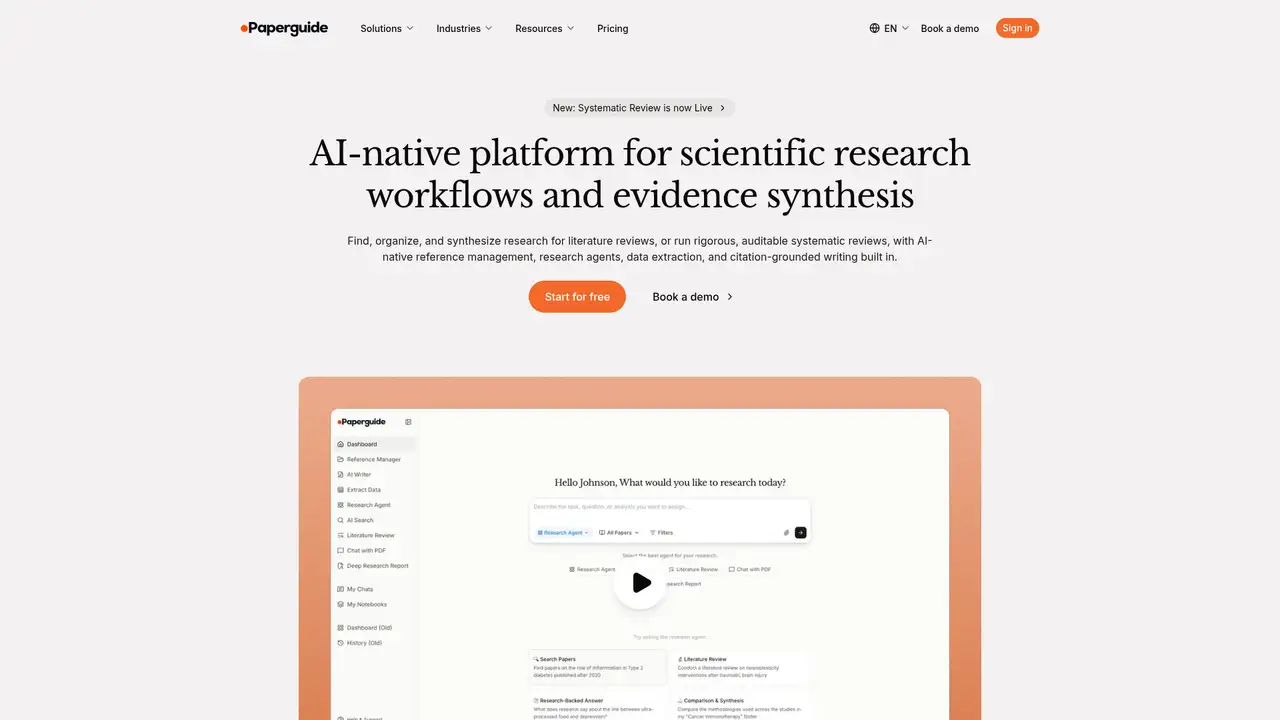
Paperguide is an AI scientific research workspace from a company founded in 2023, according to Tracxn, which lists no disclosed funding. The company presents it as a place to find, organize, and synthesize scholarly material from an initial question through a cited draft. Its scope combines literature discovery, reference management, PDF conversations, evidence extraction, systematic review work, and AI assisted writing. Paperguide says its searchable corpus contains more than 200 million papers, with coverage from PubMed, arXiv, OpenAlex, and Semantic Scholar. That makes it broader than a reference manager alone, while its scholarly focus distinguishes it from general purpose chat tools. The website displays G2 and Product Hunt recognition, but those signals indicate visibility rather than proving research quality, factual accuracy, or suitability for every discipline and review standard. Its identity is therefore centered on assisted evidence work.
Paperguide’s workflow begins with a plain language question and can end with material for a cited draft. AI Search returns a synthesized response, relevant papers, and a reference list intended to make supporting sources easier to inspect. Users can import libraries from Zotero or Mendeley, add papers by DOI, chat with PDFs, and search saved references. Research Agent assists with discovery, comparison, synthesis, gap identification, screening plans, structured extraction, and draft improvement. Literature Review and Deep Research Report support longer outputs. Extract Data places information from multiple papers into tables, while AI Writer creates or edits citation aware drafts. A browser extension provides institutional library access, and Paperguide MCP connects supported assistants with papers and PDFs. These features let users move from collected sources to organized evidence within one service, rather than switching between separate tools for each stage of a review.
The technology is focused on scholarly sources rather than the general web, blogs, or other internet content. Paperguide can search its corpus or a selected library, which keeps results research centered but may leave broader background material outside the workflow. Available features include systematic reviews, PRISMA grade dual reviewer screening on eligible plans, collaboration, citation exports, plagiarism checking, and a Search API. AI credits cover Research Agents, Research Reports, Systematic Reviews, and AI Writer usage, with failed calls not charged. Free users receive limited AI Searches, while paid plans add larger review capacities and extraction tables. Image and table extraction is marked coming soon on paid plans. Generated summaries and drafts require checking against cited papers, particularly when methods, eligibility decisions, or extracted values affect a review. Paperguide is assistance, not a replacement for critical appraisal or expert responsibility.
Paperguide uses a freemium pricing model. The Free plan costs $0 and includes 1,500 AI credits monthly, limited reference management, 20 AI Searches according to documentation, 4,000 checker words, 10 Search API requests, and extraction up to five columns and ten papers. Plus costs $12 per seat monthly when billed annually, with 12,500 credits and reviews up to 1,000 papers. Pro costs $29 per seat monthly when billed annually, with 50,000 credits and reviews up to 5,000 papers. Evidence Teams costs $89 per seat monthly when billed annually, with 150,000 credits, PRISMA grade dual reviewer screening, and reviews up to 5,000 papers. Enterprise has custom pricing and reviews up to 20,000 papers. Users should compare expected activity with credits, review limits, checker words, extraction capacity, and API requests, since paid access is not unlimited processing.
Paperguide suits students, faculty, independent researchers, and teams wanting discovery, references, extraction, review work, and cited drafting in one service. Elicit and Consensus are close competitors for scholarly discovery and evidence synthesis. Rayyan focuses more on systematic review screening, Zotero on reference management, and ResearchRabbit on finding connections among papers. These comparisons describe product emphasis rather than unsupported judgments about quality or price. Paperguide is less suitable for unrestricted web research, clinical decisions, or organizations that need security and governance terms confirmed before sensitive uploads. Its Zotero and Mendeley imports can reduce library migration work. Users needing basic reference management or screening alone may prefer a narrower tool. Pick Paperguide when credit based assistance and review workflows belong in one workspace, and choose alternatives when those narrower needs dominate.
Who is Paperguide best for?
- Students drafting literature reviews can combine search, references, and cited writing.
- Researchers running systematic reviews can use screening, extraction, and collaboration features.
- Teams sharing references and review work can use seats, administration, and usage tracking.
- Zotero or Mendeley users can import existing libraries into an AI research workspace.
Paperguide Pricing (2026)
Pricing model: Freemium. All prices in USD.
| Plan | Price | What you get |
|---|---|---|
| Free | $0 | 1,500 AI credits monthly; limited reference management; 20 AI Searches according to documentation; 4,000 checker words; 10 Search API requests; extraction up to 5 columns and 10 papers. |
| Plus | $12 per seat/month, billed annually | 12,500 AI credits monthly; systematic reviews up to 1,000 papers; unlimited AI Searches; 100 Search API requests; 20,000 checker words. |
| Pro | $29 per seat/month, billed annually | 50,000 AI credits monthly; systematic reviews up to 5,000 papers; 500 Search API requests; 100,000 checker words; image and table extraction coming soon. |
| Evidence Teams | $89 per seat/month, billed annually | 150,000 AI credits monthly; PRISMA grade dual reviewer screening; systematic reviews up to 5,000 papers; 1,500 Search API requests; dedicated support channel. |
| Enterprise | Custom | Custom AI credits, review capacity up to 20,000 papers, extraction table limits, Search API requests, and support; image and table extraction coming soon. |
Pros and Cons
Pros
- Search results connect claims with scholarly references.
- One workspace covers discovery, extraction, review work, and drafting.
- Paid tiers support systematic review workflows and collaboration.
- Zotero and Mendeley imports reduce library migration work.
Cons
- AI usage is constrained by monthly credit pools.
- The search workflow excludes general web sources and blogs.
- Image and table extraction remains marked coming soon.
Who should look elsewhere?
- Researchers needing unrestricted web search should use a service that includes general internet sources.
- Clinical teams seeking decision support should not treat generated research synthesis as clinical guidance.
- Users wanting a basic manager only may find Paperguide broader and more usage constrained.
Technical Details
Frequently Asked Questions
How much does Paperguide cost?
Paperguide starts at $0 with its Free plan. Paid annual pricing lists Plus at $12 per seat monthly, Pro at $29, and Evidence Teams at $89. Enterprise pricing is custom. Each tier has different monthly AI credits, review limits, extraction capacity, checker words, and Search API requests, so paid seats do not provide unlimited processing.
Is Paperguide free?
Yes. The Free plan costs $0 and includes 1,500 AI credits monthly, limited reference management, limited AI Searches, AI Writer, PDF chat, Literature Review Report, Deep Research Report, Zotero and Mendeley import, and institutional library access through the browser extension. It also includes 4,000 checker words monthly and 10 Search API requests.
What is Paperguide's closest competitor?
Elicit is a close competitor for question based scholarly discovery, paper comparison, and evidence synthesis. Consensus is another discovery focused alternative, while Rayyan concentrates on systematic review screening and Zotero focuses on reference management. Paperguide is broader when users want discovery, library management, extraction, review workflows, and citation aware writing together.
How does Paperguide handle privacy?
Paperguide provides library and PDF workflows, institutional library access, paid team administration, and Enterprise options. Paperguide does not specify every retention, training, residency or security control needed for sensitive research. Organizations should confirm current contractual and security terms before uploading confidential manuscripts, proprietary datasets, or restricted research materials.
Can businesses use Paperguide commercially?
Yes. Paperguide lists Evidence Teams and Enterprise plans for organizations running systematic reviews and collaborative research. Evidence Teams includes seats, administration, usage tracking, collaboration, higher quotas, PRISMA grade dual reviewer screening, and a dedicated support channel. Enterprise provides custom credits, review capacity, extraction limits, Search API requests, and institutional support terms.
Best Paperguide Alternatives in 2026
These tools do the same job as Paperguide, with different pricing, limits and trade-offs.