
Neuphonic Review, Pricing & Alternatives (2026)
Small, fast text-to-speech models that run on CPUs, phones and private servers
Last updated: October 19, 2026
What is Neuphonic?
Neuphonic is a London voice AI startup offering a cloud text-to-speech API and open NeuTTS models that run on ordinary CPUs and devices without a GPU. It suits developers building private, offline or low-latency voice features. A free plan includes 25,000 characters a month, and commercial use starts at $5 a month.
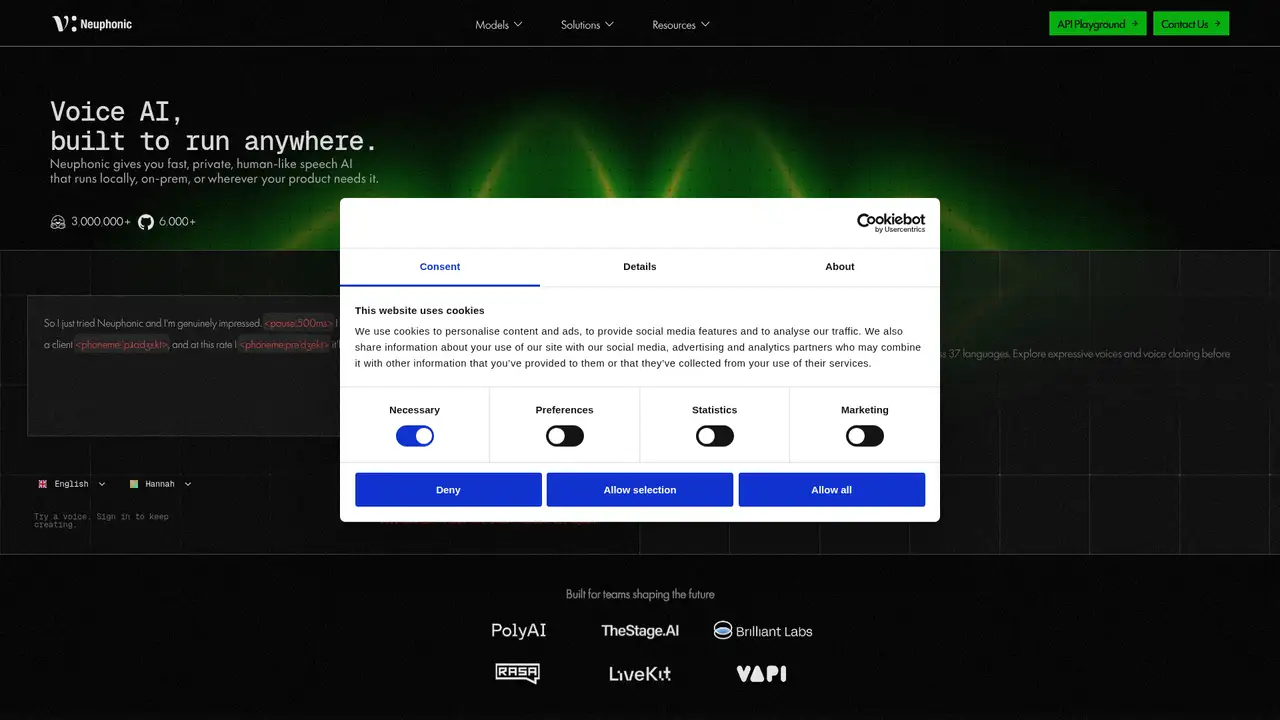
Neuphonic is a London startup founded by Sohaib Ahmad, a former hedge fund quantitative trader who is now chief executive, and Jiameng Gao, previously a co-founder of the AI dubbing company Papercup. The two met while studying machine learning at Cambridge University. In October 2024 Neuphonic raised a £3 million pre-seed round led by Moonfire VC, with Tiny VC, Salica Oryx Fund and Cur8 Capital participating, according to Tech.eu. At that point its API was in closed beta and the company said its streaming method could start speaking in 25 milliseconds. Since then it has opened the cloud API to self-serve customers, published a family of open-weight models on Hugging Face and GitHub, and signed a distribution deal that puts its voices inside the Vapi voice agent platform.
There are three ways to use Neuphonic. The cloud API at app.neuphonic.com streams text-to-speech in more than 40 languages, with a browser playground for testing voices and instant cloning from a few seconds of audio. Developers who need data to stay local can download the NeuTTS models and run them on a laptop, phone, Raspberry Pi or private server with no internet connection. Enterprise customers can have Neuphonic deploy and fine-tune models inside their own infrastructure. A typical voice agent build sends a language model's output to the API word by word, and Neuphonic begins speaking before the full sentence has arrived. Voice agent frameworks including Vapi and LiveKit list Neuphonic as a supported voice provider.
NeuTTS Air, released in 2025, was the company's first open model. It is built on Alibaba's Qwen 0.5B language model plus NeuCodec, Neuphonic's own single-codebook audio codec, and it clones a voice from three to 15 seconds of reference audio. It ships in quantised GGUF formats so it generates speech in real time on mid-range CPUs. Smaller NeuTTS Nano models followed for English, Spanish, French and German. The newer NeuTTS-2M adds cloning in seven languages including Japanese, Korean and Chinese, while NeuTTS-2E offers English speech with seven emotion modes and four fixed speakers. NeuDecide turns spoken commands into tool calls. Every NeuTTS output carries an inaudible Perth watermark so generated audio can be identified later.
Neuphonic's pricing page lists four plans. Free gives personal-use access to every voice and language with 25,000 characters a month, about 30 minutes of speech. Starter costs $5 a month for 250,000 characters (about five hours), one concurrent request, instant voice cloning and a commercial licence. Business costs $499 a month for 30 million characters (about 600 hours), 15 concurrent requests, team management and dedicated support on Discord and Slack. Enterprise is quoted and covers fine-tuned voices, on-device and on-premises deployment, custom concurrency, SLAs and round-the-clock support. The open models carry no usage fees, though licences differ by model: NeuCodec and NeuDecide use Apache 2.0, and NeuTTS-2E uses Neuphonic's own NeuTTS Open License, so check the terms before shipping a product.
Neuphonic is a small company, and its voice library and studio tools are much thinner than ElevenLabs, which also offers dubbing, sound effects and a large community voice marketplace. The gap between the $5 Starter and $499 Business plans leaves growing teams with a large jump. Open-model quality is good for the size but behind the largest cloud models on expressiveness. Cartesia competes most directly, with low-latency cloud voices and its own on-device option, backed by far more funding. Kokoro and Piper are free open-source alternatives for local speech without cloning. Pick Neuphonic when you need voice cloning that runs offline on ordinary hardware, such as in toys, kiosks, healthcare devices or privacy-sensitive apps, or a cheap commercial cloud API for a hobby or early-stage project.
Who is Neuphonic best for?
- Hardware makers adding offline voice to toys, kiosks or embedded devices.
- Healthcare and finance apps that cannot send text or voice samples to a cloud API.
- Developers who want open-weight TTS with voice cloning that runs on a CPU.
- Hobby projects needing commercial cloud TTS rights for $5 a month.
Neuphonic Pricing (2026)
Pricing model: Freemium. All prices in USD.
| Plan | Price | What you get |
|---|---|---|
| Free | $0/month | Personal use only. All voices and languages, 25,000 characters (about 30 minutes) of speech a month. |
| Starter | $5/month | 250,000 characters (about 5 hours) a month, one concurrent request, instant voice cloning and a commercial licence. |
| Business | $499/month | 30 million characters (about 600 hours) a month, 15 concurrent requests, team management, Discord and Slack support. |
| Enterprise | Custom | Fine-tuned voices, on-device and on-premises deployment, custom concurrency and credits, SLAs and 24/7 support. |
Pros and Cons
Pros
- Open NeuTTS models clone voices from about three seconds of audio and run without a GPU.
- Offline deployment keeps text and voice data on your own hardware.
- Built-in Perth watermarking marks every open-model output as synthetic.
- Commercial cloud use starts at $5 a month.
Cons
- Licences vary by model, and some NeuTTS models use a custom licence instead of Apache 2.0.
- Small voice library and few editing tools compared with ElevenLabs.
- Large pricing gap between the Starter and Business plans.
Who should look elsewhere?
- Video producers who want dubbing, sound effects and a large voice marketplace.
- Mid-size teams whose usage falls between the $5 and $499 plans.
- Non-technical users looking for a finished voiceover studio.
Technical Details
Frequently Asked Questions
How much does Neuphonic cost?
Neuphonic's cloud API has a free plan with 25,000 characters a month for personal use. Starter costs $5 a month for 250,000 characters, about five hours of speech, with a commercial licence and voice cloning. Business costs $499 a month for 30 million characters and 15 concurrent requests. Enterprise pricing covers on-device and on-premises deployment. The open NeuTTS models have no usage fees.
Is Neuphonic free and open source?
Partly. Neuphonic publishes NeuTTS Air, NeuTTS Nano, NeuCodec and NeuDecide on Hugging Face and GitHub, and you can run them locally for free. Licences differ: NeuCodec and NeuDecide use Apache 2.0, while NeuTTS-2E uses the company's NeuTTS Open License, which has its own conditions. The hosted cloud API is a paid service with a limited free tier.
Neuphonic vs Cartesia: which should I choose?
Both focus on low-latency speech for voice agents and both offer on-device deployment. Cartesia is larger and better funded, with Sonic voices that top independent listening tests and a hosted voice agent product. Neuphonic's advantage is open-weight models you can download and run on a CPU with voice cloning. Choose Cartesia for cloud quality and Neuphonic for offline or self-hosted use.
Does Neuphonic keep my data private?
With the on-device and on-premises options, text and audio never leave your hardware, and the open models work offline once installed. The cloud API processes requests on Neuphonic's servers under its privacy policy, so data handling there depends on your plan and contract. Every NeuTTS output includes a Perth watermark that marks it as AI-generated without being audible.
Can I use Neuphonic voices commercially?
On the cloud API, commercial use requires the Starter plan or higher, since the free plan is for personal use only. For the open models, commercial rights depend on each model's licence. Apache 2.0 models such as NeuCodec allow commercial use with attribution, while NeuTTS-2E's custom licence needs a closer read. Cloned voices should only use audio from speakers who have consented.
Best Neuphonic Alternatives in 2026
These tools do the same job as Neuphonic, with different pricing, limits and trade-offs.