
Mem Review, Pricing & Alternatives (2026)
An AI memory for notes, tasks, projects, and voice capture
Last updated: October 26, 2026
What is Mem?
Mem is an AI note-taking and work assistant for capturing, finding, and using information. It combines notes, conversational search, voice transcription, task and project tracking, routines, connections, email capture, and API access. A free plan is available, while paid plans start at $9 per month.
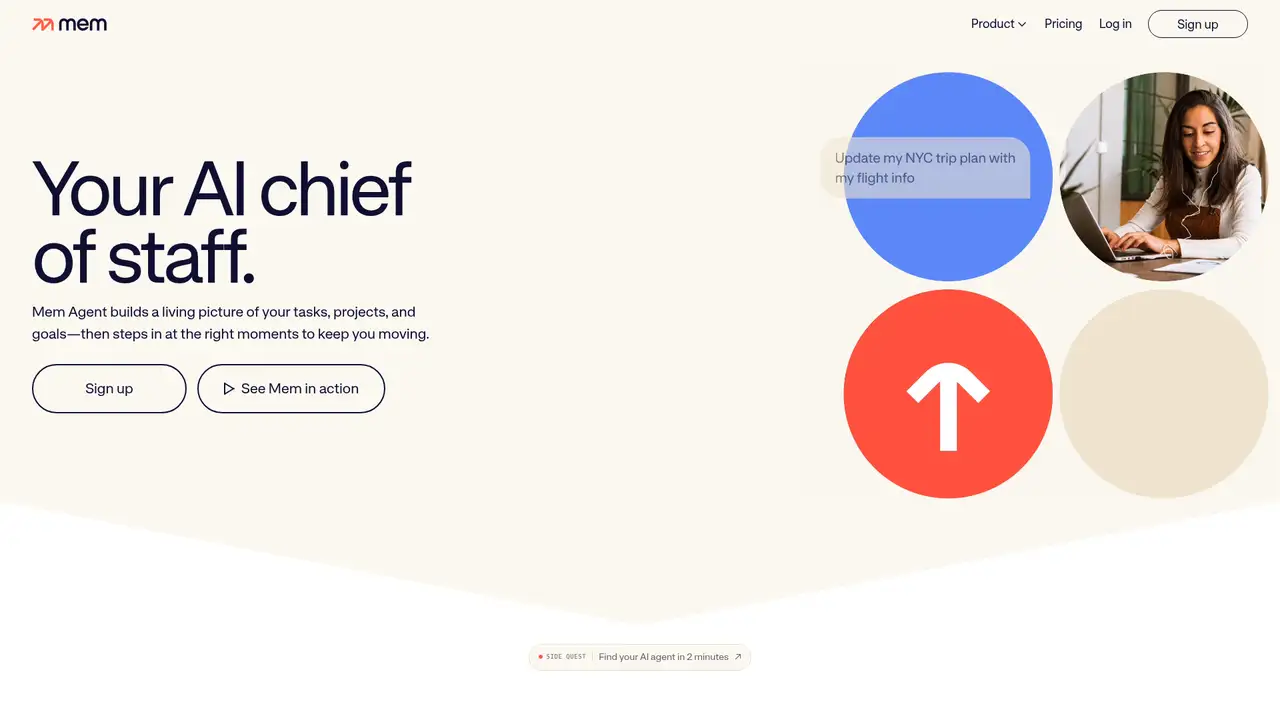
Mem was founded by Kevin Moody and Dennis Xu after they began the company in late 2019, followed by a public product announcement in 2021. The founders reported a $5.6 million seed round led by Andreessen Horowitz and a $23.5 million Series A led by the OpenAI Startup Fund in 2022. TechCrunch reported total funding of $29 million and a $110 million post-money valuation after that round. Mem’s current product is an AI work assistant, not a conventional folder-first notebook. Its stated audience includes entrepreneurs, executives, and creatives seeking capture and retrieval without manual organization. The Free plan includes 25 messages, 25 new notes, tracking across 25 notes, 15 open tasks and projects, and three Voice Mode hours monthly; paid plans begin at $9 monthly.
Mem centers on creating notes, asking questions, and finding related information through search and conversation. Voice Mode records meetings or spoken thoughts and produces structured transcripts and notes. Mem Agent tracks tasks and projects across notes, while Custom Routines can prepare briefings, research, organize notes, and send scheduled reminders. Connections add sources such as Gmail, Slack, or Todoist to context, and Email and WhatsApp provide capture channels. Users can also export Markdown with one click, apply templates, use Deep Search, or open floating chat before asking Mem to connect information. The Free plan includes 25 messages and new notes, tracking across 25 notes, 15 open tasks and projects, and three Voice Mode hours monthly. Paid plans increase these limits and add routines and connections.
Mem 2.0 launched in October 2025 after a reported two-year rebuild. The company says it added full offline support across web, desktop, and mobile, with faster capture and retrieval. Its technology combines a searchable knowledge store with AI processing, task detection, transcription, routines, and external connections. Developer documentation provides bearer-authenticated API keys and an MCP integration compatible with Claude, ChatGPT, Claude Code CLI, Codex CLI, and Gemini CLI. Mem publishes capabilities and limits but does not identify one underlying foundation model or promise a fixed context window. Pricing ranges from Free to $199 monthly, with increasing allowances for messages, notes, tracked notes, tasks and projects, Voice Mode hours, routines, and connections. Extra Usage costs $50 monthly. No later October 2026 release is claimed here.
Mem uses monthly activity limits across messages, new notes, tracked notes, open tasks and projects, Voice Mode hours, Custom Routines, and Connections. The Free plan costs nothing and includes 25 messages, 25 new notes, tracking across 25 notes, 15 open tasks or projects, and three Voice Mode hours. Plus costs $9 monthly and provides 50 messages, 50 new notes, tracking across 50 notes, 25 open tasks or projects, and 10 Voice Mode hours. Pro costs $29 monthly and includes 100 messages, 100 new notes, tracking across 100 notes, 50 open tasks or projects, one Custom Routine, one Connection, and 25 Voice Mode hours. Pro tiers cost $49, $99, $149, or $199 monthly. Each $50 Extra Usage unit adds Pro 20x capacity. Terms allow monthly or annual billing.
Mem’s value depends on trusting a hosted service with material it processes for intelligence features. Mem says data is encrypted at rest with AES-256 and in transit with TLS, but it is not end-to-end encrypted. It says it does not sell data or mine it for advertising, and its privacy policy says MCP queries are not used to train AI models. Mem is closer to Reflect or Notion AI than to a local notebook, while Obsidian offers greater local control and Roam Research emphasizes linked notes. Choose Mem for proactive capture, voice, and task follow-through, not offline ownership or unlimited low-cost notes. The Free plan includes 25 messages and new notes monthly; paid plans start at $9 and impose usage limits that increase with price.
Who is Mem best for?
- Knowledge workers capturing ideas across multiple channels.
- People wanting AI-assisted task and project tracking.
- Users who prefer voice capture with structured transcripts.
- People connecting notes with Gmail, Slack, or Todoist.
Mem Pricing (2026)
Pricing model: Freemium. All prices in USD.
| Plan | Price | What you get |
|---|---|---|
| Mem Free | Free | 25 messages, 25 new notes, tracking across 25 notes, 15 open tasks and projects, and 3 Voice Mode hours monthly. |
| Mem Plus | $9/month | 50 messages, 50 new notes, tracking across 50 notes, 25 open tasks and projects, and 10 Voice Mode hours monthly. |
| Mem Pro | $29/month | 100 messages, 100 new notes, tracking across 100 notes, 50 open tasks and projects, 1 Custom Routine, 1 Connection, and 25 Voice Mode hours monthly. |
| Mem Pro 2x | $49/month | 200 messages, 200 new notes, tracking across 200 notes, 100 open tasks and projects, 2 Custom Routines, 2 Connections, and 50 Voice Mode hours monthly. |
| Mem Pro 5x | $99/month | 500 messages, 500 new notes, tracking across 500 notes, 250 open tasks and projects, 5 Custom Routines, 5 Connections, and 125 Voice Mode hours monthly. |
| Mem Pro 10x | $149/month | 1,000 messages, 1,000 new notes, tracking across 1,000 notes, 500 open tasks and projects, 10 Custom Routines, 10 Connections, and 250 Voice Mode hours monthly. |
| Mem Pro 20x | $199/month | 2,000 messages, 2,000 new notes, tracking across 2,000 notes, 1,000 open tasks and projects, 20 Custom Routines, 20 Connections, and 500 Voice Mode hours monthly. |
| Extra Usage | $50/month | Adds 500 messages, 500 new notes, tracking across 500 notes, 250 open tasks and projects, 5 Custom Routines, 5 Connections, and 125 Voice Mode hours. |
Pros and Cons
Pros
- Mem combines notes, tasks, routines, and connections.
- Voice Mode creates structured notes from spoken input.
- The public API supports server-side integrations.
- Markdown export can preserve notes outside Mem.
Cons
- Plans impose several monthly activity limits.
- The published privacy text does not promise end-to-end encryption.
- Mem's underlying model is not identified in published texts.
Who should look elsewhere?
- Users requiring end-to-end encrypted notes.
- People wanting unlimited notes at a low fixed price.
- Users seeking a local or self-hosted knowledge base.
Technical Details
Frequently Asked Questions
How much does Mem cost?
Mem Free costs nothing and includes 25 messages, 25 new notes, tracking across 25 notes, 15 open tasks and projects, and 3 Voice Mode hours monthly. Mem Plus costs $9 monthly, Mem Pro costs $29, and higher plans cost $49, $99, $149, or $199 monthly. Extra Usage costs $50 monthly.
Is Mem free?
Yes. The free plan includes 25 monthly messages, 25 new notes, tracking across 25 notes, 15 open tasks and projects, and 3 Voice Mode hours. The pricing text also says Deep Search and templates are available on Mem plans. Monthly activity resets each billing period.
Mem or Notion AI: which fits better?
Mem focuses on automatic capture, conversational retrieval, voice transcription, task detection, routines, and connections. The company identify Notion as a competing collaborative workspace. Choose Mem when those capture and recall functions matter most, and compare Notion when collaborative workspace features are the priority.
Does Mem train on my notes?
The published privacy text says Mem uses connected-service information to provide requested connected features and describes information collection and processing. It does not provide a general statement in the published excerpt about training on notes. Review Mem's current privacy policy and connected-service terms before storing sensitive material.
Can I use Mem commercially?
Mem's sources describe it as a work-focused application and list features for notes, tasks, routines, connections, and API use. Its terms say subscriptions may use monthly or annual billing. Organizations should review the current terms, privacy policy, and connected-service conditions before storing confidential or regulated information.
Best Mem Alternatives in 2026
These tools do the same job as Mem, with different pricing, limits and trade-offs.
AI assistance for pages, search, meetings, and recurring work

Private, linked notes in plain Markdown with optional AI using your own keys
Local Markdown notes with backlinks, Bases and plugins that add AI on your terms
Team wiki and documentation space with Rovo AI, databases and whiteboards