
Mastra Review, Pricing & Alternatives (2026)
A TypeScript stack for agents, workflows, memory, and operations
Last updated: October 26, 2026
What is Mastra?
Mastra is an open-source TypeScript framework for agents and AI applications, aimed at JavaScript teams building tools, workflows, memory, evaluations, and observability into web or server applications. Its framework and Starter platform tier cost $0/month, while Teams costs $250/month. Model, gateway, storage, and infrastructure usage can add separate charges.
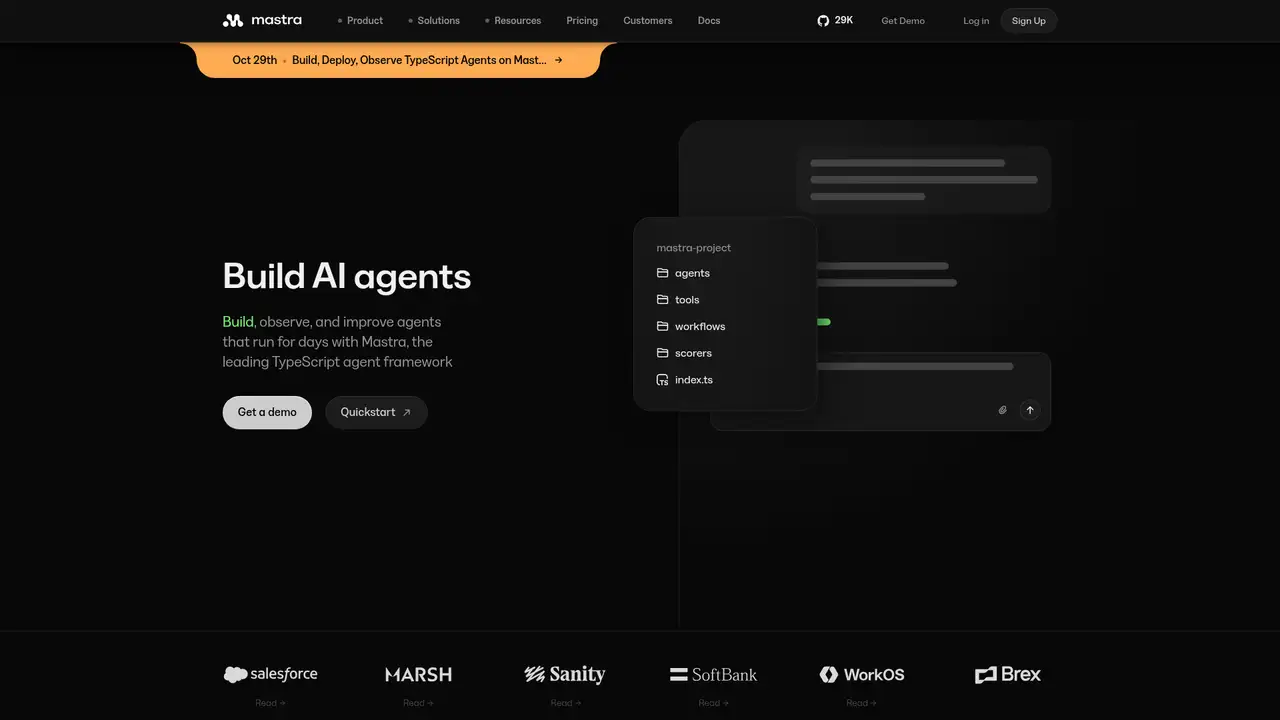
Mastra is an open-source TypeScript framework for agents and workflows, made by Kepler Software and the team behind Gatsby. Work began in October 2024, and Kepler Software was founded in 2024. Mastra joined Y Combinator’s Winter 2025 batch, giving the project an early company and funding context. The company announced a $13 million seed round in October 2025 and a $22 million Series A in April 2026, bringing reported total funding to $35 million. Developers can use Mastra with React, Next.js, Node.js, or a standalone server. Its GitHub repository lists nearly 29,000 stars and 3,000 forks. The company says more than 300 teams ran the 1.0 beta in production. The core framework uses Apache 2.0, while enterprise code has a separate license.
A typical Mastra project begins with an agent configured with a model, instructions, and typed tools. Agents can generate or stream responses, keep conversation history, retrieve information from APIs, databases, or files, and pause for human approval before taking an action. Workflows cover processes that need more predictable control, using typed steps, branches, parallel execution, retries, suspension, and resumption. Storage preserves workflow state and memory between runs. Mastra Studio provides a place to build and test agents, while evaluations support model-based or code-based scoring. Datasets make experiments repeatable, and tracing records model, tool, and workflow calls. The framework also supports MCP servers, server adapters, guardrails, metrics, and connections to external observability services, so teams can inspect behavior as projects move from tests into deployed applications.
Mastra uses a unified model interface, so applications do not need to rely on a separate provider SDK for every model connection. In October 2025, Mastra introduced a router covering more than 600 models from 45 providers, with automatic fallback chains when a provider fails. Its January 2026 1.0 release stabilized the public APIs and made server adapters the default deployment path. The release also added composite storage, thread cloning, AI SDK v6 support, a unified observability schema, and workflow changes. Composite storage lets teams choose different backends for memory, workflows, scores, and observability, rather than tying every function to one database. Mastra also offers Observational Memory, which uses background agents to compress growing conversation history. The 1.0 release followed production use by hundreds of teams during the beta.
Mastra separates its free framework from charges for the hosted platform. Platform Starter costs $0 per month and includes 100,000 observability events, 24 CPU hours, 10 GB of egress, 15-day retention, and unlimited users, deployments, and projects. Starter overages cost $10 per 100,000 events, $0.35 per CPU hour, and $0.10 per GB of egress. Teams costs $250 per month and includes 1 million events, 250 CPU hours, 100 GB of egress, six months of retention, multiple teams, SSO, and SOC 2 documentation. Its gateway adds 5.5 percent to market-rate model pricing. Memory, retrieval storage, database use, and persistent servers carry separate rates, including $100 per project for persistent uptime. Enterprise pricing is custom, with controls, support, retention, and service terms negotiated separately.
Mastra’s main limitation is scope. Agents, workflows, storage, memory, evaluations, deployment, and tracing give teams many parts to understand, creating a larger surface area than a single-purpose model SDK. The framework also requires TypeScript, and model charges remain separate from the framework price. LangGraph is the closer choice for teams centered on durable graph orchestration and explicit state transitions. Vercel AI SDK is a lighter foundation for applications that need model and user interface primitives without Mastra’s broader platform layer. Letta is more focused on persistent agent identity and memory than on combining deployment, workflows, evaluations, and traces. Mastra is best suited to TypeScript teams that want those capabilities in one framework, while smaller applications may prefer a narrower toolset.
Who is Mastra best for?
- TypeScript teams building agents inside web applications.
- Applications combining agents with deterministic workflows.
- Teams needing evaluations, traces, datasets, and Studio.
- Organizations requiring self-hosted deployment and regional control.
Mastra Pricing (2026)
Pricing model: Freemium. All prices in USD.
| Plan | Price | What you get |
|---|---|---|
| Framework | $0/month | Apache 2.0 core framework. Model, hosting, database, and infrastructure charges are separate. |
| Platform Starter | $0/month | 100K observability events, 24 CPU hours, 10 GB egress, 15-day retention, and unlimited users, deployments, and projects. |
| Platform Teams | $250/month | 1M observability events, 250 CPU hours, 100 GB egress, six-month retention, multiple teams, SSO, and SOC 2 documentation. |
| Platform Enterprise | Custom | Custom volume and retention, RBAC, audit logs, support, uptime SLAs, and a dedicated support engineer. |
Pros and Cons
Pros
- Agents, workflows, memory, MCP, evaluations, and traces share one stack.
- Apache 2.0 covers the core framework and commercial use.
- The router supports more than 600 models and automatic fallbacks.
- Server adapters fit Express, Hono, Fastify, and Koa applications.
Cons
- Platform, model, gateway, storage, and infrastructure charges are separate.
- The broad API surface takes time to learn.
- Enterprise features use a separate license from the core framework.
Who should look elsewhere?
- Python-first teams that do not want TypeScript.
- Small scripts requiring one model call.
- Buyers seeking bundled inference pricing.
Technical Details
Frequently Asked Questions
How much does Mastra cost?
Mastra’s core framework costs $0/month under Apache 2.0. Platform Starter also costs $0/month and includes 100,000 observability events and 24 CPU hours. Teams costs $250/month. Additional charges can apply to events, CPU time, egress, gateway usage, memory, retrieval storage, databases, persistent servers, and model providers.
Does Mastra have a free plan?
Yes. The framework is free, and Platform Starter costs $0/month. Starter includes 100,000 observability events, 24 CPU hours, 10 GB of egress, 15-day retention, and unlimited users, deployments, and projects. It does not make model inference free, because provider, gateway, storage, and infrastructure charges remain separate.
How does Mastra compare with LangGraph?
Mastra is a broader TypeScript framework that combines agents, workflows, memory, MCP, evaluations, Studio, deployment, and observability. LangGraph centers on graph-based agent orchestration and supports Python as well as JavaScript. Teams should choose Mastra for a wider TypeScript application stack and LangGraph for graph orchestration as the primary abstraction.
Does Mastra train on customer data?
Mastra’s September 2026 GDPR guidance says the hosted platform does not train on personal data for Mastra or its subprocessors, including model gateways and providers. Self-hosted framework deployments run in infrastructure chosen by the customer, and Mastra says anonymous CLI telemetry is collected by default and can be disabled.
Can Mastra be used commercially and self-hosted?
Yes. Mastra announced Apache 2.0 licensing for the core framework in July 2025, allowing commercial use, modification, private use, and redistribution subject to the license. The framework can run in Node.js-compatible environments, while enterprise code in directories named ee uses the Mastra Enterprise License.
Best Mastra Alternatives in 2026
These tools do the same job as Mastra, with different pricing, limits and trade-offs.

Open-source framework for building model-powered agents

Build and run collaborative AI agents with Python-native control

Persistent memory for agents that keep state across sessions

Open-source context engineering for RAG, agents, and workflows