
CrewAI Review, Pricing & Alternatives (2026)
Build and run collaborative AI agents with Python-native control
Last updated: October 22, 2026
What is CrewAI?
CrewAI is an open-source Python framework for building multi-agent workflows with autonomous Crews and controlled, event-driven Flows. It suits developers and enterprise teams that need custom tools, model choice, and deployable automation. The hosted entry plan is Free, with 50 workflow executions per month, while Enterprise pricing is Custom.
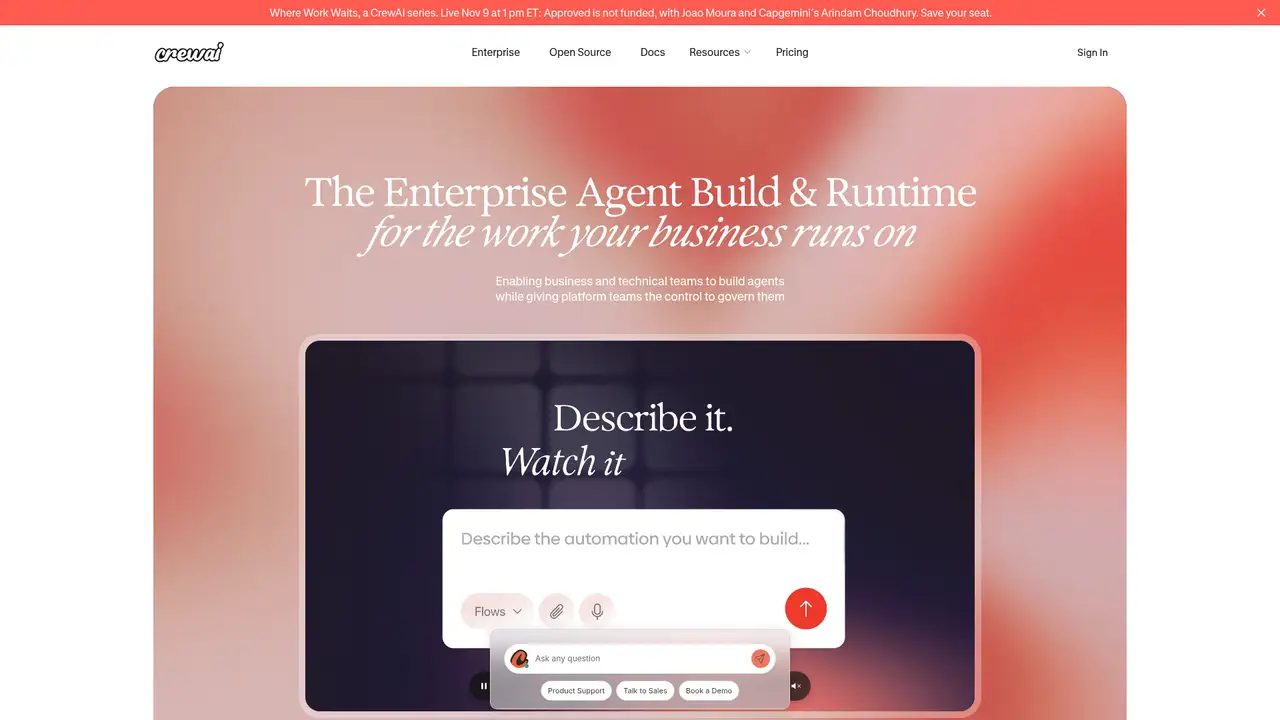
CrewAI is an open-source Python framework for orchestrating AI agents, Crews, and Flows. João Moura finished the framework in October 2023, released it on GitHub in November, and officially launched the company in January 2024 with Rob Bailey as COO. The GitHub repository is MIT licensed, lists Python as its primary language, and was created on October 27, 2023. Insight Partners reported $18 million in funding by October 2024, 150 enterprise customers within six months, and more than 10 million open-source agent executions per month at that time. CrewAI later reported 1.4 billion agentic executions, 40,000 GitHub stars, and 60 percent of the Fortune 500 running Crews or Flows in its October 2025 OSS 1.0 announcement.
CrewAI separates autonomous collaboration from explicit workflow control. A Crew contains role-based agents, tasks, tools, processes, memory, knowledge, guardrails, and structured outputs. A Flow adds event-driven starts, listeners, routers, state, branching, persistence, retries, and human input. A typical project begins with a local Python installation through uv, then defines agents and tasks in Python or JSONC, connects an LLM and tools, and runs the project through the CLI. Developers can use sequential, hierarchical, or hybrid processes, then place a Crew inside a Flow when an autonomous step needs deterministic surrounding logic. The hosted platform adds Studio, integrations, deployment, tracing, team management, and production monitoring. Documentation lists triggers for Gmail, Slack, Salesforce, and other services.
CrewAI is model-neutral rather than tied to one provider. Documentation describes native connections for OpenAI, Anthropic, Google, Azure, Amazon Bedrock, Snowflake Cortex, LiteLLM, custom endpoints, and local models through tools such as Ollama. CrewAI OSS 1.0, announced in October 2025, added stable Crew and Flow APIs, a unified CLI, native free tracing, improved logging, deterministic runs, memory, training, testing, hooks, and broader MCP and integration support. The June 2026 version 1.15.0 changelog lists conversational Flow telemetry, declarative Flow loading, typed tool outputs, inline crew definitions, conditional steps, and improved nested-crew progress. Crew Studio, announced in July 2026, added natural-language Flow creation, more than 1,000 connectors, testing, traces, deployment, and source-code export.
The current pricing page lists Basic as Free, with a visual editor, AI copilot, GitHub integration, and 50 workflow executions per month. It lists Enterprise as Custom, adding governance features such as SSO, role-based access control, workload identity, PII redaction, policies, dedicated VPC deployment, customer infrastructure deployment, onboarding, and optional engineering and training. The page does not publish a recurring paid amount or a public per-execution overage price. The open-source framework itself is MIT licensed and can run locally, but model-provider charges and infrastructure costs remain separate from CrewAI pricing. Hosted use therefore ranges from a small free allowance to negotiated enterprise spending, with execution volume, models, integrations, and deployment requirements affecting total cost.
CrewAI is a practical choice when a Python team needs both agent collaboration and explicit workflow logic, though it demands more engineering judgment than a purely visual automation product. Compared with LangGraph, CrewAI presents higher-level Crews alongside lower-level Flows; compared with AutoGen, its current product includes a hosted builder and enterprise runtime controls; compared with Microsoft Copilot Studio, its open-source core and Python customization are more central, while Copilot Studio is more closely tied to Microsoft business software. CrewAI's free hosted allowance is small for production work, and public paid pricing is unavailable. Pick it for developers building model-flexible, self-hostable agent systems with custom orchestration and deployment control.
Who is CrewAI best for?
- Python teams building multi-agent workflows with custom tools.
- Developers combining autonomous Crews with deterministic Flows.
- Organizations requiring self-hosted or customer-infrastructure deployment.
- Teams that need model-provider choice and workflow tracing.
CrewAI Pricing (2026)
Pricing model: Freemium. All prices in USD.
| Plan | Price | What you get |
|---|---|---|
| Basic | $0/month | Includes the visual editor, AI copilot, GitHub integration, and 50 workflow executions per month. |
| Enterprise | Custom | Adds governance, SSO, RBAC, workload identity, PII redaction, dedicated VPC options, customer-infrastructure deployment, onboarding, and optional engineering or training. |
Pros and Cons
Pros
- The MIT-licensed framework supports local and hosted deployment.
- Crews and Flows cover autonomous and deterministic orchestration.
- The framework supports multiple hosted and local model providers.
- Studio includes workflow building, tracing, testing, and source export.
Cons
- The free hosted plan allows only 50 workflow executions monthly.
- Enterprise pricing and additional execution costs are not publicly listed.
- Multi-agent runs can increase model usage and debugging complexity.
Who should look elsewhere?
- Teams seeking a fully managed no-code automation product.
- Small projects needing more than 50 hosted executions monthly at no cost.
- Buyers requiring transparent public enterprise pricing.
Technical Details
Frequently Asked Questions
How much does CrewAI cost?
CrewAI's hosted Basic plan costs $0/month and includes 50 workflow executions per month, a visual editor, an AI copilot, and GitHub integration. The current pricing page lists Enterprise as Custom. It does not publish a standard paid monthly amount or public overage price. Running the open-source framework locally avoids a CrewAI subscription, but model and infrastructure charges still apply.
Does CrewAI have a free plan?
Yes. The hosted Basic plan costs $0/month and includes a visual editor, AI copilot, GitHub integration, and 50 workflow executions per month. The open-source Python framework is also MIT licensed and can run locally. Enterprise adds governance, SSO, RBAC, deployment choices, onboarding, and optional services under custom pricing.
How does CrewAI compare with LangGraph?
CrewAI provides two main abstractions: Crews for role-based agent collaboration and Flows for event-driven control. LangGraph focuses on graph-based orchestration and explicit state transitions. CrewAI also offers hosted Studio and enterprise runtime controls, while its open-source core remains Python based and self-hostable. The better fit depends on whether Crews or graph-level control matches the application.
Does CrewAI train on user data?
CrewAI documentation says its default anonymous telemetry excludes prompts, task descriptions, agent backstories and goals, tool usage, API calls, responses, processed data, secrets, and environment variables. Users can disable telemetry with OTEL_SDK_DISABLED set to true. Enabling share_crew permits more detailed execution data, including task information and outputs, so teams should review that setting.
Can I use CrewAI commercially?
The CrewAI repository is released under the MIT License, which permits commercial use subject to the license terms. Hosted enterprise features are separately priced and include governance, deployment, support, and onboarding options. Commercial users should review the repository license, hosted service terms, model-provider terms, and obligations attached to third-party tools or integrations.