
Magic Review, Pricing & Alternatives (2026)
Frontier code models for ultra-long-context software engineering
Last updated: October 22, 2026
What is Magic?
Magic is a private AI research company building proprietary code models and software-engineering systems for developers, enterprises, and AI researchers. Its public site lists no self-serve plan, API price, or free tier as of October 2026. Commercial access is therefore a custom discussion, with terms and availability requiring direct confirmation.
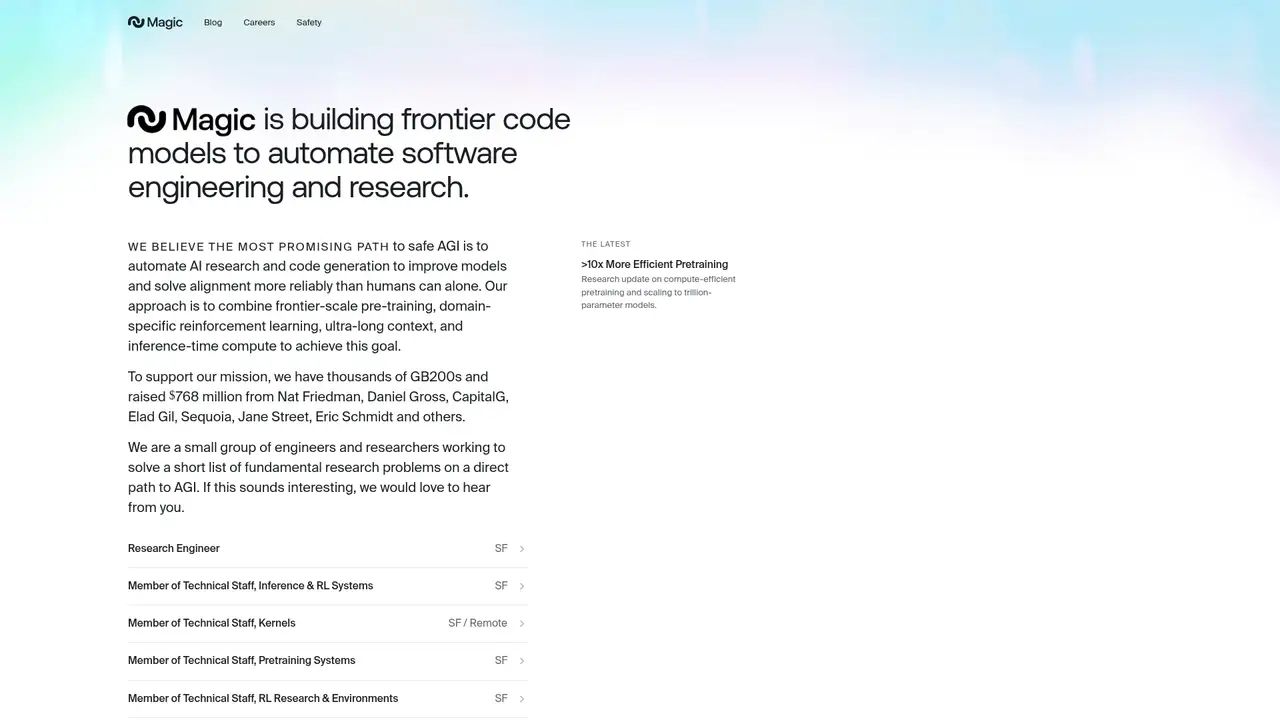
Magic is a San Francisco AI company founded in 2022 by Eric Steinberger and Sebastian De Ro. It develops code-generating systems intended to help software engineers write, review, debug, and plan code changes. Magic’s public positioning now emphasizes frontier code models, software-engineering automation, and AI research. The company says it combines frontier-scale pretraining, domain-specific reinforcement learning, ultra-long context, and inference-time compute. A 2024 funding announcement described a $320 million round and nearly $465 million raised in total. Magic’s homepage now reports $768 million raised and thousands of GB200s. Those are separate company updates, so the homepage figure is the latest public funding claim rather than an amount that should be added to earlier totals.
Magic’s most distinctive published capability is repository-scale context. LTM-1 used a 5-million-token context window and was described as able to see an entire code repository. A later research update described models reasoning over up to 100 million tokens during inference. Magic says this could place code, documentation, libraries, and private project material in one context. A typical workflow would provide a large software repository, ask for code synthesis or changes, and use the model’s response as part of an engineering task. Magic’s current homepage does not offer a signup flow for a general developer product. Its research posts describe model capabilities more clearly than they describe an available customer workflow.
Magic develops proprietary models and training systems. Its research combines long-context modeling with pretraining, reinforcement learning, and inference-time computation. In September 2026, Magic said its pretraining recipe was more than ten times as compute-efficient as leading open-weight base models. The company also said it matched DeepSeek V4 Pro Base with about 50 times fewer FLOPs, based on its own evaluations. Those results covered private code repositories, research papers, and other held-out data, and remain company-reported research claims. Magic’s homepage says it has thousands of GB200s. Its 2024 update also described a Google Cloud partnership. The published 2025 and 2026 material centers on training efficiency and long-context research, rather than a named generally available coding model.
Magic does not publish a pricing page, per-token rate, per-seat subscription, free tier, API rate card, student plan, business plan, or checkout flow. The practical entry is therefore Custom commercial access, with price, billing interval, and usage limits undisclosed. Buyers should not turn funding totals, hardware scale, or research context windows into a subscription estimate. Magic’s public site emphasizes research and recruiting, and the company’s research-access-only Magic offering is not a generally available paid product. No public page describes a standard launch date, quota, service-level agreement, or data-residency option. Contact may be required, but Magic does not publish prices and offers no self-serve plan or public API.
Magic’s public site does not document current supported IDEs, production limits, a public API, or a self-hosting package. GitHub Copilot and Cursor offer clearer individual onboarding, while Sourcegraph Cody Enterprise provides a more explicit business product. Magic’s 100-million-token context work is a concrete research distinction, but it is not a documented production entitlement. The company is best suited to AI research teams and large engineering organizations willing to discuss a bespoke evaluation. Pick GitHub Copilot or Cursor when immediate coding access and clearer pricing matter. Pick Sourcegraph Cody when enterprise administration and deployment details are the priority. Teams should confirm product availability, evaluation access, and data-handling terms directly before committing repositories or planning adoption.
Who is Magic best for?
- AI research teams investigating long-context code models.
- Large engineering organizations willing to run a bespoke evaluation.
- Buyers interested in repository-scale model context.
- Researchers following model training and inference efficiency.
Magic Pricing (2026)
Pricing model: Paid. All prices in USD.
| Plan | Price | What you get |
|---|---|---|
| Research access | Custom | Magic does not publish public subscription plans, prices, API quotas, or a self-serve free tier. Contact the company about access; this is not a published paid plan. |
Pros and Cons
Pros
- LTM-2-mini research targets a 100-million-token context window.
- Magic develops code models and training systems in-house.
- The company reports substantial funding and specialized compute.
- Its research targets software-engineering automation.
Cons
- No public subscription, API rate card, or free tier is listed.
- Public product access and supported integrations remain unclear.
- Research claims are not production documentation.
Who should look elsewhere?
- Developers wanting an immediately usable self-serve coding assistant.
- Teams requiring public prices and documented API quotas.
- Organizations needing published compliance and deployment guarantees.
Technical Details
Frequently Asked Questions
How much does Magic cost?
Magic publishes no public price as of October 22, 2026. Its site lists no per-seat billing, per-token rates, free plan, student plan, business plan, or checkout flow. Any commercial access should be treated as a custom discussion with the company. Funding totals, hardware scale, and research context windows do not provide a reliable customer price.
Can I try Magic for free?
There is no publicly documented free tier or self-serve trial. Magic’s website emphasizes research, model work, and recruiting, while its LTM announcements describe research results rather than general developer signup. An individual developer should not assume that an API, IDE plugin, or trial is available without direct confirmation. The same applies to student access.
How does Magic compare with GitHub Copilot or Cursor?
GitHub Copilot and Cursor provide established developer products with documented onboarding and clearer commercial paths. Magic’s differentiator is research on very large code context, including the 100-million-token LTM-2-mini experiment. That is not a documented production feature set. Choose Magic for a bespoke long-context evaluation, and Copilot or Cursor for immediate day-to-day coding.
Is Magic open source, and does it train on user code?
Magic’s models and commercial system are presented as proprietary, and the company has not published a customer-data training policy supporting a definitive conclusion. Its research describes training models and evaluating code, but that is not a customer contract. Prospective users should request written terms covering training, retention, privacy, and permitted data before sharing repositories.
Can businesses use Magic commercially?
Magic is building technology for software engineering and has raised substantial private funding, but its public site does not publish a standard product, license, API agreement, service-level agreement, or deployment menu. A business can contact the company to explore access, yet availability, price, usage rights, security controls, and support remain matters for negotiation. Public research does not grant commercial rights.
Best Magic Alternatives in 2026
These tools do the same job as Magic, with different pricing, limits and trade-offs.
AI coding assistance across editors, terminals, and GitHub
AI coding workspace with repository context and software agents

Permission-aware AI coding assistance for large software organizations
An agentic coding assistant for terminal, IDE, desktop, and web

AWS-integrated coding help for IDEs, terminals, and cloud operations