
Lex Machina Review, Pricing & Alternatives (2026)
Litigation analytics built from court dockets, documents and case outcomes
Last updated: October 26, 2026
What is Lex Machina?
Lex Machina is a subscription legal analytics service for litigators, in-house legal teams and business development professionals. It analyzes court dockets and documents to compare judges, parties, counsel, experts, damages and outcomes. Lex Machina does not publish a standard entry price, so prospective customers must use checkout or contact sales for a quote.
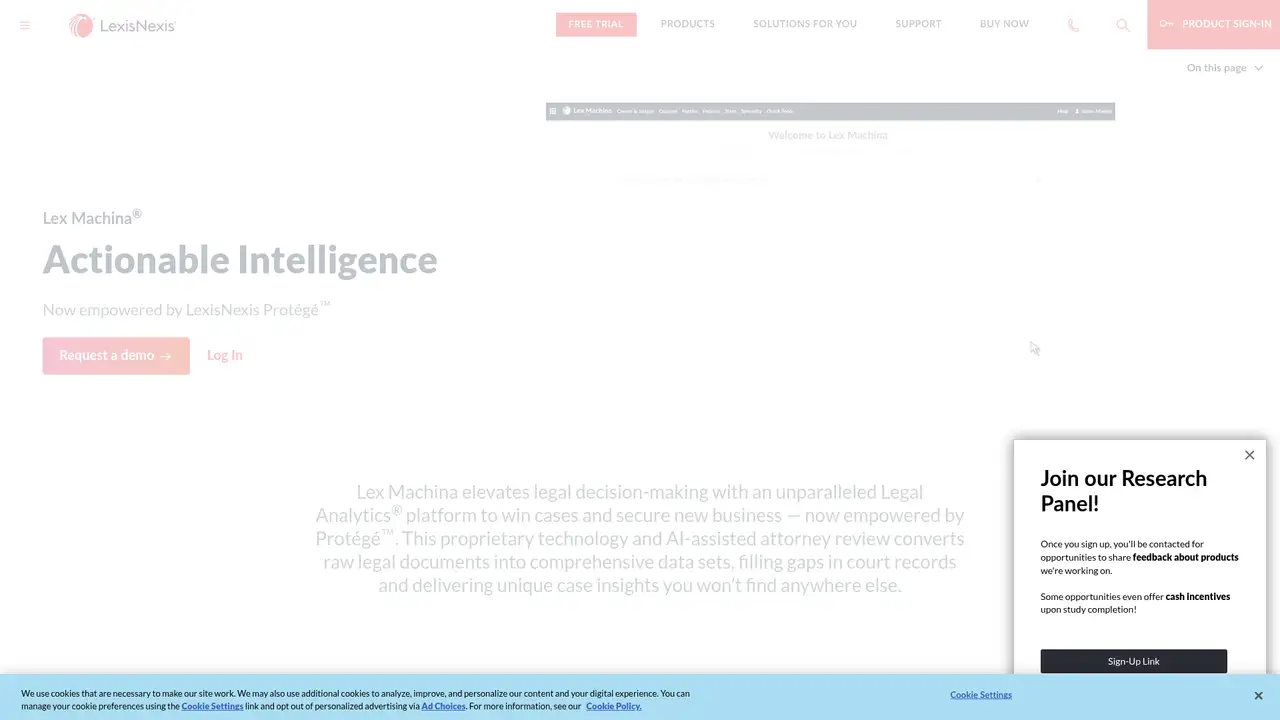
Lex Machina is a commercial legal analytics service made by LexisNexis. Its roots are in Stanford Law School's Intellectual Property Litigation Clearinghouse, launched in December 2008, while Stanford announced the private commercial spinout on January 5, 2010. Joshua Walker and George Gregory were identified as founders, with Stanford retaining a stake at launch. LexisNexis acquired the company on November 23, 2015, with terms undisclosed. Lex Machina continued as a stand-alone entity within LexisNexis North American Research Solutions. Stanford CodeX records a 2009 founding date and $10 million in total funding, reflecting a company date that differs from the earlier clearinghouse origin. Its intended users include litigators, in-house legal teams and business development professionals.
The service turns court dockets and documents into searchable litigation profiles. A typical workflow starts with a query for a party, judge, counsel, expert, case type or venue, then narrows results with filters and reviews timelines, filings, resolutions, damages and outcomes. Lex Machina says its coverage includes all 94 federal district courts, 13 appeals courts, the Patent Trial and Appeal Board, specialty venues and enhanced state courts. Its current figures include more than 10 million cases, 45 million customer-facing documents, 8,000 judges, 6,000 experts, 146 million counsel mentions and 149 million party mentions. Separate party analytics include 18 million state cases. These views support case strategy, opponent assessment, budgeting and business development.
Lex Machina's technology combines docket and document collection with tagging, categorization and structured analytics. The current product page presents LexisNexis Protégé for generative analytics and AI-assisted attorney review, alongside API integration for customer systems. LexisNexis says its privacy-by-design and security measures include a policy against using customer data to train AI models. The platform organizes historical litigation into searchable filings, case attributes, timelines, parties, counsel, judges, experts, outcomes and damages. Its documented coverage spans federal district and appeals courts, the Patent Trial and Appeal Board, specialty venues and enhanced state courts. LexisNexis publishes current coverage figures and product positioning, but no dated 2025 or 2026 release log. The timing of individual feature releases therefore remains unspecified. This tool suits legal professionals who need structured comparisons across litigation records.
Lex Machina does not publish a standard public rate card or self-serve plan. A third-party Theorem listing directs buyers to custom pricing, while the official API requires a Lex Machina subscription and a demo or subscription inquiry. LexisNexis announced an Enterprise package in 2021 with unlimited access and organizational users, but those terms were historical and should not be treated as current limits. Buyers should expect a sales-led quote based on organization, coverage and access requirements. Paid pricing is shown at checkout or through sales, with the price field listed as “See checkout.” API access is a customer capability, not a separately documented public plan. Organizations should confirm current coverage, user permissions and contract terms before purchase.
The main limitation is cost transparency: small firms cannot estimate a subscription from a public rate card, and the service is designed around historical litigation analytics rather than general legal research. Its sales-led pricing also makes budgeting harder for teams that need predictable software costs, while API access requires a subscription or sales inquiry. Docket Alarm is the better fit when docket retrieval, alerts, PACER access and per-use pricing matter most. Bloomberg Law Litigation Analytics and Westlaw Edge Litigation Analytics are stronger choices for teams already centered on those research platforms. Trellis deserves consideration when state-court analytics are the priority. Pick Lex Machina when judge, party, counsel, expert, damages and outcome comparisons drive litigation strategy, especially for litigation teams planning cases across federal courts.
Who is Lex Machina best for?
- Litigation teams comparing judges, parties, counsel, experts, damages and outcomes.
- In-house legal groups assessing opponents and litigation exposure.
- Law firms developing case strategy from historical court data.
- Business development teams identifying litigation patterns and opportunities.
Lex Machina Pricing (2026)
Pricing model: Paid. All prices in USD.
| Plan | Price | What you get |
|---|---|---|
| Lex Machina subscription | See checkout | Lex Machina does not publish standard plan limits or a public rate card. Paid pricing is shown at checkout or provided through sales. |
| API access | Custom | API access is for Lex Machina customers and covers cases, parties, counsel, judges, outcomes and alerts across listed court types. Subscription or demo inquiry required. |
Pros and Cons
Pros
- Covers all 94 federal district courts and 13 federal appeals courts.
- Combines docket documents with structured litigation analytics.
- Includes judge, party, counsel, expert, damages and outcome views.
- LexisNexis says customer data is not used to train AI models.
Cons
- Lex Machina does not publish standard subscription prices.
- Current plan limits and organizational terms are not publicly detailed.
- API use requires a customer relationship and agreed access.
Who should look elsewhere?
- Small firms requiring transparent self-serve pricing.
- Users seeking ordinary legal research without analytics.
- Teams needing a public API without a subscription.
Technical Details
Frequently Asked Questions
How much does Lex Machina cost?
Lex Machina does not publish a standard public subscription price. Theorem lists the product as custom priced, while the official API requires a Lex Machina customer relationship and a subscription or demo inquiry. Paid pricing is shown at checkout or quoted by sales, so organizations should request a quote based on users, coverage and access needs.
Does Lex Machina have a free plan?
Lex Machina does not advertise a free plan or a public self-serve trial in its cited product and pricing material. It presents the service as a subscription product with sales contact for access. Prospective customers can request a demo or pricing discussion, but the company does not publish a free tier with stated document, search or user limits.
How does Lex Machina compare with Docket Alarm?
Lex Machina is the stronger choice for structured comparisons involving judges, parties, counsel, experts, damages and case outcomes. Docket Alarm is better suited to docket retrieval, alerts, PACER-related workflows, normalized API access and per-use purchasing. Teams should compare court coverage, analytics depth, document costs and API terms against the work they perform most often.
Does Lex Machina train AI models on customer data?
LexisNexis says on the current Lex Machina product page that it does not use customer data to train AI models. The page also describes privacy-by-design and security measures. Customers should review the applicable subscription agreement and privacy terms for their deployment, since contractual conditions can define handling, access and retention details beyond the product summary.
Can businesses use Lex Machina commercially?
Lex Machina is a commercial subscription service intended for law firms, in-house legal teams and related professional work. Its API terms identify the service as a LexisNexis offering and restrict account sharing, automated use without written agreement, competing republication and continued use of API-derived data after termination. Commercial use should follow the subscription and API terms.
Best Lex Machina Alternatives in 2026
These tools do the same job as Lex Machina, with different pricing, limits and trade-offs.

Court dockets, alerts, analytics, and API access for legal teams
State trial court research, judge analytics and AI drafting built on court filings

Cited legal research and drafting across a global legal library

Professional legal research with West content, editorial tools, and AI