
Docket Alarm Review, Pricing & Alternatives (2026)
Court dockets, alerts, analytics, and API access for legal teams
Last updated: October 26, 2026
What is Docket Alarm?
Docket Alarm is a legal research and litigation monitoring service for lawyers, legal operations teams, and organizations tracking court activity. It combines docket search, alerts, document retrieval, analytics, and an API across US courts. A free plan is available, while paid access starts at $39.99 per month plus document and alert charges.
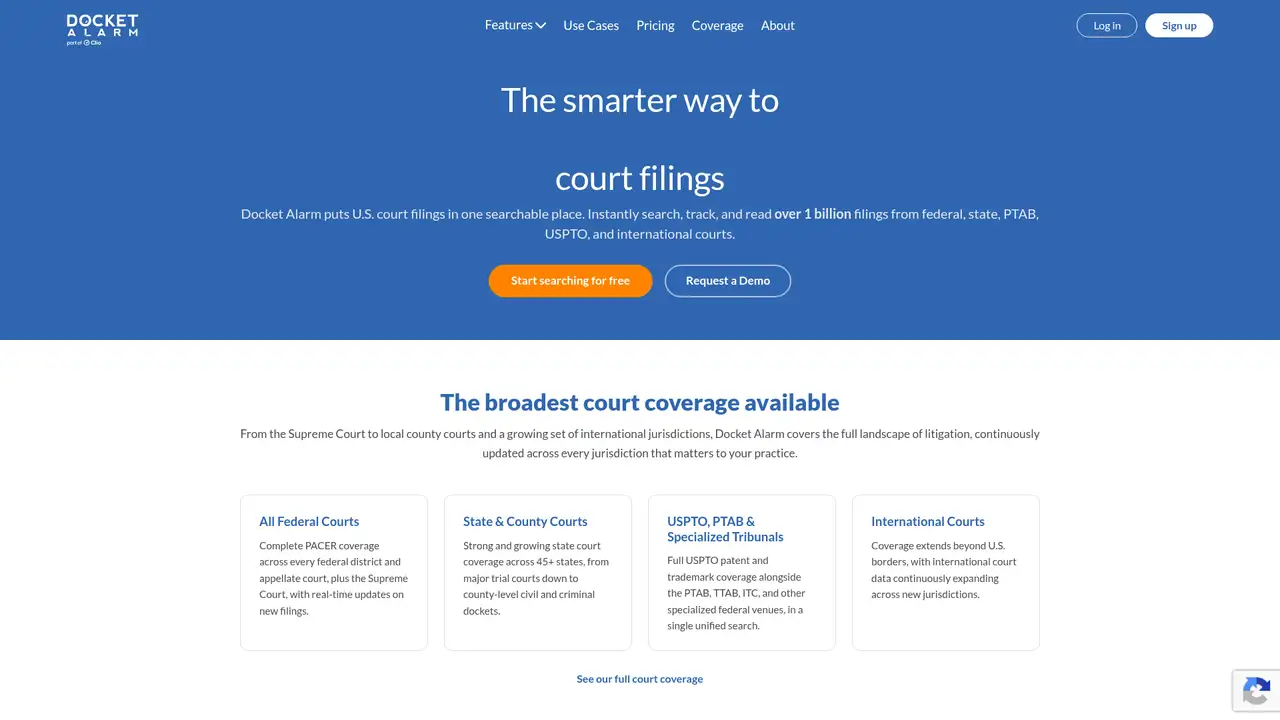
Docket Alarm is a legal research and litigation monitoring service founded by Michael Sander in 2011. Fastcase acquired the company in January 2018, and Sander became its Managing Director. Fastcase joined vLex in 2023, while Clio acquired vLex in 2025, placing Docket Alarm within Clio. The product covers federal and state courts, the USPTO, PTAB, ITC, and specialized jurisdictions. Its About page claims more than 1 billion dockets and documents. A separate API page describes more than 675 million tagged dockets and OCR PDFs, reflecting different counting scopes. Current plans range from a free tier to $99 per user monthly, with PACER charges separate. Docket Alarm is best understood as an operating legal data product under new ownership, rather than an independent startup.
Docket Alarm combines unified search, docket monitoring, document retrieval, alerts, and litigation analytics for legal teams handling active matters. A typical workflow begins with Boolean searching across federal and state courts, the USPTO, PTAB, and other specialized jurisdictions, followed by review of docket entries or purchased filings. Users can track cases for new activity, receive docket updates, and inspect judges, parties, firms, counsel, motions, and outcomes. Its public REST API provides docket metadata and PDF filings, supports alerts and legal automation, and covers hundreds of US courts, including PACER. The API documentation describes normalized, tagged records and OCR PDFs, with motion metadata available through support. Free accounts allow five weekly actions. PACER documents carry separate charges, and plan exclusions apply.
The product uses normalized legal records, tagged dockets, OCR PDFs, search, alerting, and analytics rather than a disclosed proprietary language model. Docket Alarm’s API documentation describes a version 1.14 service released in August 2013 and updated in July 2024. Current pages place the service within the Clio and vLex family, with litigation and motion analytics central to the offering. The company provides API access across federal courts, state courts, PTAB, ITC, and other jurisdictions. Its About page claims more than 1 billion dockets and documents, while its API page cites more than 675 million tagged dockets and OCR PDFs, figures that reflect different counting scopes. No dated feature release during 2025 or 2026 appears on the company pages. Buyers should treat availability as plan dependent.
Docket Alarm has a free plan with no card required and five weekly actions shared across searches, docket views, and document views. Pay As You Go costs $39.99 per month, plus $4 per document, $3 per day for each case alert, and $3 per docket update. It includes unlimited search with no usage minimum. Flat Fee costs $99 per user per month and includes listed features, while PACER remains separately billed. Enterprise pricing is custom and adds litigation analytics, motion analytics, SSO, and a dedicated account manager. Organizations with five or more employees may need multi-user licensing. Plans are month to month, although enterprise agreements may use annual contracts. Taxes are excluded, and API pricing and quotas require a sales conversation.
Docket Alarm’s strongest case is practical docket work, especially when a team needs alerts, document retrieval, PACER access, and an API with usage based options. Lex Machina is the stronger fit for historical litigation analytics focused on judges, parties, damages, and case outcomes. Trellis is a more natural comparison for teams centered on state court analytics. Bloomberg Law and Westlaw litigation analytics suit organizations that want broader legal research platforms alongside analytics. Docket Alarm’s free plan allows five weekly actions, while paid options start at $39.99 per month plus document, alert, or docket charges. Its API covers hundreds of US courts, including PACER, but pricing and quotas require a sales conversation. Pick Docket Alarm for active docket tracking and automated legal data workflows.
Who is Docket Alarm best for?
- Law firms monitoring active cases across multiple US court systems.
- Legal operations teams needing docket alerts and document retrieval.
- Developers building workflows around normalized court records.
- Researchers who prefer usage based access to filings and alerts.
Docket Alarm Pricing (2026)
Pricing model: Freemium. All prices in USD.
| Plan | Price | What you get |
|---|---|---|
| Free | $0 | Five actions per week shared across searches, docket views, and document views. No card required; government sourced documents such as PACER purchases are excluded. |
| Pay As You Go | $39.99/month | Unlimited search with $4 per document, $3 per day per case alert, and $3 per docket update. There is no usage minimum. |
| Flat Fee | $99/user/month | Everything is included except PACER charges, which are billed separately. Organizations with at least five employees may need multi user licensing. |
| Enterprise | Custom | Adds litigation analytics, motion analytics, SSO, and a dedicated account manager. Volume or per seat pricing is available through sales. |
Pros and Cons
Pros
- The free plan includes five weekly actions without requiring a card.
- Pay As You Go pricing supports teams with uneven research demand.
- The API covers docket metadata, filings, alerts, and hundreds of courts.
- Analytics include judges, parties, counsel, motions, and outcomes.
Cons
- PACER documents and charges remain separate from subscription pricing.
- API pricing and quotas are not publicly listed.
- Five free actions are shared across several activity types.
Who should look elsewhere?
- Teams seeking a fully free source for PACER documents.
- Buyers requiring published API quotas and service terms.
- Researchers focused only on deep historical outcome analytics.
Technical Details
Frequently Asked Questions
How much does Docket Alarm cost?
Docket Alarm has a free plan with five weekly actions. Pay As You Go costs $39.99 per month, plus $4 per document, $3 per day for each case alert, and $3 per docket update. Flat Fee costs $99 per user per month. Enterprise pricing is custom. PACER charges are separate from subscription fees.
Does Docket Alarm have a free plan?
Yes. The free plan requires no card and permits five actions per week, shared across searches, docket views, and document views. It excludes documents purchased from government systems such as PACER. Users who need more searches, alerts, filings, or analytics must move to a paid plan.
How does Docket Alarm compare with Lex Machina?
Docket Alarm is the better fit for active docket tracking, alerts, document retrieval, PACER connected workflows, and API access. Lex Machina is the stronger choice for historical litigation analytics centered on judges, parties, counsel, damages, and case outcomes. Both address litigation intelligence, but their practical emphasis differs.
Does Docket Alarm sell customer data or use it to train AI?
Docket Alarm’s privacy policy says it does not sell litigation activity to third party marketers and keeps organization search history confidential, while using it for aggregated statistics and support. The company pages do not state that customer data is used to train an AI model. Buyers should review current contractual terms for organization specific handling.
Can businesses use Docket Alarm commercially?
Yes. Docket Alarm offers individual, multi user, and enterprise subscriptions for legal organizations. Enterprise adds litigation analytics, motion analytics, SSO, and a dedicated account manager. Its terms govern named and institutional users, subscriptions, orders, and pricing. API use is available, but commercial automation details and quotas should be confirmed with the company.
Best Docket Alarm Alternatives in 2026
These tools do the same job as Docket Alarm, with different pricing, limits and trade-offs.

Litigation analytics built from court dockets, documents and case outcomes
State trial court research, judge analytics and AI drafting built on court filings

Cited legal research and drafting across a global legal library

Professional legal research with West content, editorial tools, and AI