
Kokoro TTS Review, Pricing & Alternatives (2026)
An Apache-licensed 82M model for low-cost, self-hosted speech synthesis
Last updated: October 26, 2026
What is Kokoro TTS?
Kokoro is an open-weight text-to-speech model from the Hexgrad project for developers who want local inference or a hosted service foundation. Its 82 million parameters and Apache 2.0 license support commercial deployment, while downloading the model costs $0. Hosted providers charge separately, including DeepInfra at $0.99 per million characters. It is not a subscription voice app.
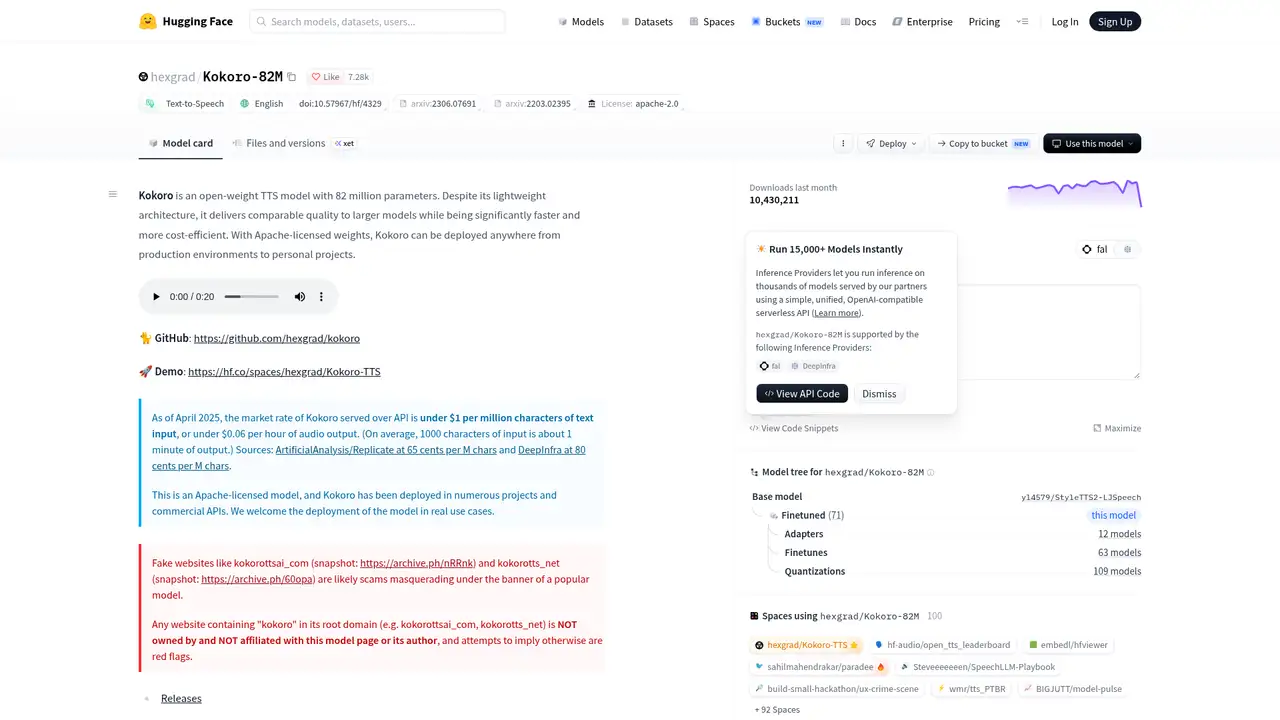
Kokoro is an open-weight text-to-speech model, not a subscription voice application. The Hexgrad project published v1.0 on January 27, 2025, following v0.19 on December 25, 2024. The model contains 82 million parameters, and its release documentation describes a few hundred hours of training audio and about $1,000 in A100 compute for 1,000 training hours. The Apache 2.0 model license permits personal and commercial deployment, subject to its terms. Kokoro's small weight count makes it practical for developers who want to run inference themselves. There is no central Hexgrad dashboard, account system, or official hosted subscription attached to the model. Developers incorporate its software and weights into their applications or services. A standard workflow uses the Kokoro Python package, an audio library, and espeak-ng when documented fallback support is needed.
A standard workflow starts with the Kokoro Python package, an audio library, and espeak-ng where documented fallbacks are needed. The developer creates a KPipeline, chooses a language code and voice such as af_heart, submits text, and receives 24 kHz audio chunks. Misaki supplies grapheme-to-phoneme processing, with language-specific packages for Japanese and Mandarin. Official examples expose speed control, text splitting, phonemes, graphemes, and saved WAV files. Independent wrappers add HTTP endpoints, Docker images, streaming, timestamps, SSML, and hardware-specific deployment. Those additions are not part of the core model. Their authentication, security, quotas, and maintenance depend on the wrapper or hosting company selected by the developer. This separation leaves deployment choices flexible but increases operational responsibility.
Kokoro uses a decoder-only architecture derived from StyleTTS 2 and ISTFTNet, with no released diffusion component or encoder. The v1.0 documentation lists eight language categories and 54 voices across American and British English, Japanese, Mandarin Chinese, Spanish, French, Hindi, Italian, and Brazilian Portuguese. The voice catalogue warns that non-English results can suffer from thin training data or weak grapheme-to-phoneme support. It recommends roughly 100 to 200 tokens for many voices, reports weakness below 10 to 20 tokens, and warns that passages above 400 tokens can rush. The documented release table contains no 2026 model launch. An August 2025 Modal survey lists Kokoro v1.0 alongside larger open models, highlighting its 82M parameter count for comparison.
Kokoro's model weights and inference code cost $0, with no official hosted quota or per-character subscription. Self-hosting shifts the bill to the user's hardware or cloud account, plus storage, serving, monitoring, and wrapper maintenance. DeepInfra lists $0.99 per million characters for its Kokoro endpoint and documents zero retention on that service. Replicate lists approximately $0.00022 per run for one hosted implementation, while warning that inputs affect the cost. These are third-party prices, not Hexgrad fees. Replicate documents an Nvidia T4 deployment and says predictions typically complete within one second, although runtime varies significantly by input. Actual self-hosting cost depends on hardware, concurrency, and audio volume. Third-party hosting therefore adds provider-specific authentication, quotas, retention policies, uptime, and security practices that are separate from Kokoro's model license.
Kokoro's practical limits are uneven multilingual pronunciation, short and long utterance edge cases, the absence of native voice cloning, and the engineering work required for production serving. ElevenLabs offers a managed commercial service with voice cloning, while Kokoro requires local deployment or a third-party endpoint. Piper is another lightweight local TTS option, and Coqui XTTS is a closer open deployment choice when cloning matters. Kokoro has a smaller documented model and a more permissive Apache 2.0 license than some alternatives, but it is not a finished voice platform. Kokoro’s documented workflow returns 24 kHz audio chunks through a Python pipeline with selectable language codes, voices, speed, phonemes, and text splitting. Choose Kokoro if you need Apache-licensed weights, local control, and low serving requirements, rather than managed controls or cloning.
Who is Kokoro TTS best for?
- Developers needing Apache-licensed speech model weights.
- Teams running inference on their own CPU or GPU infrastructure.
- Products seeking low per-character serving costs.
- Engineers comfortable building an API around a model.
Kokoro TTS Pricing (2026)
Pricing model: Free. All prices in USD.
| Plan | Price | What you get |
|---|---|---|
| Model weights and inference code | $0 | Apache 2.0 weights with no official hosted quota or built-in API. |
| DeepInfra hosted Kokoro | $0.99/1M characters | Third-party metered endpoint; provider terms, limits, and retention policies apply. |
| Replicate hosted implementation | About $0.00022/run | Third-party estimate; actual cost varies with input and runtime. |
Pros and Cons
Pros
- Apache 2.0 licensing supports commercial deployment.
- The 82M model is comparatively light to serve.
- Version 1.0 documents 54 voices across eight language categories.
- Local inference avoids a mandatory vendor account.
Cons
- Hexgrad does not provide a built-in hosted API.
- Multilingual pronunciation and voice quality vary.
- Production serving requires independent infrastructure work.
Who should look elsewhere?
- Users wanting a polished hosted voice editor.
- Teams requiring built-in voice cloning.
- Projects needing consistent quality across many languages.
Technical Details
Frequently Asked Questions
Is Kokoro TTS free?
The Kokoro-82M weights and documented inference code are free to download under Apache 2.0. Running them still consumes local or cloud compute. Hosted endpoints are separate services: DeepInfra lists $0.99 per million characters, and Replicate lists an approximate per-run cost. Those prices are not a Kokoro subscription or an official Hexgrad API.
Does Kokoro have an official API?
No built-in hosted API is documented for the model. Developers can run the Python pipeline locally, use an independent wrapper, or pay a third-party inference provider. A wrapper's authentication, quotas, retention, uptime, and security practices are determined by its operator, not by the Apache 2.0 model license.
Kokoro versus ElevenLabs: which is better?
Kokoro fits self-hosting, permissive licensing, and developer control. ElevenLabs is a managed service with voice cloning and a commercial API workflow. Kokoro does not provide that turnkey product experience, and its documentation warns that multilingual output can vary because some languages have limited grapheme-to-phoneme support and training data.
Does Kokoro train on user data?
A local Kokoro installation processes text on the hardware where it runs and does not require a Hexgrad account. Hosted providers can process submitted text under their own terms. The model documentation describes training data and licensing, while a self-hosted installation has no central service that automatically receives prompts for training.
Can Kokoro be used commercially?
The model documentation identifies the weights as Apache 2.0, which permits commercial use subject to that license and its notices. Commercial users remain responsible for their text, generated audio, dependencies, datasets, voices, and deployment provider terms. Review the repository license and any third-party hosting agreement before shipping a product.
Best Kokoro TTS Alternatives in 2026
These tools do the same job as Kokoro TTS, with different pricing, limits and trade-offs.