
Inworld TTS Review, Pricing & Alternatives (2026)
Realtime speech APIs with expressive controls, cloning, and usage-based pricing
Last updated: October 26, 2026
What is Inworld TTS?
Inworld TTS is a hosted text-to-speech service with a playground, APIs, SDKs, voice cloning, and voice design. It serves developers building games, assistants, voice agents, and interactive products. On-Demand costs $0 monthly plus usage, starting at $25 per million characters for Realtime TTS-2 or $15 for TTS-2 Flash. Plans add credits, concurrency, voices, and cloning capacity.
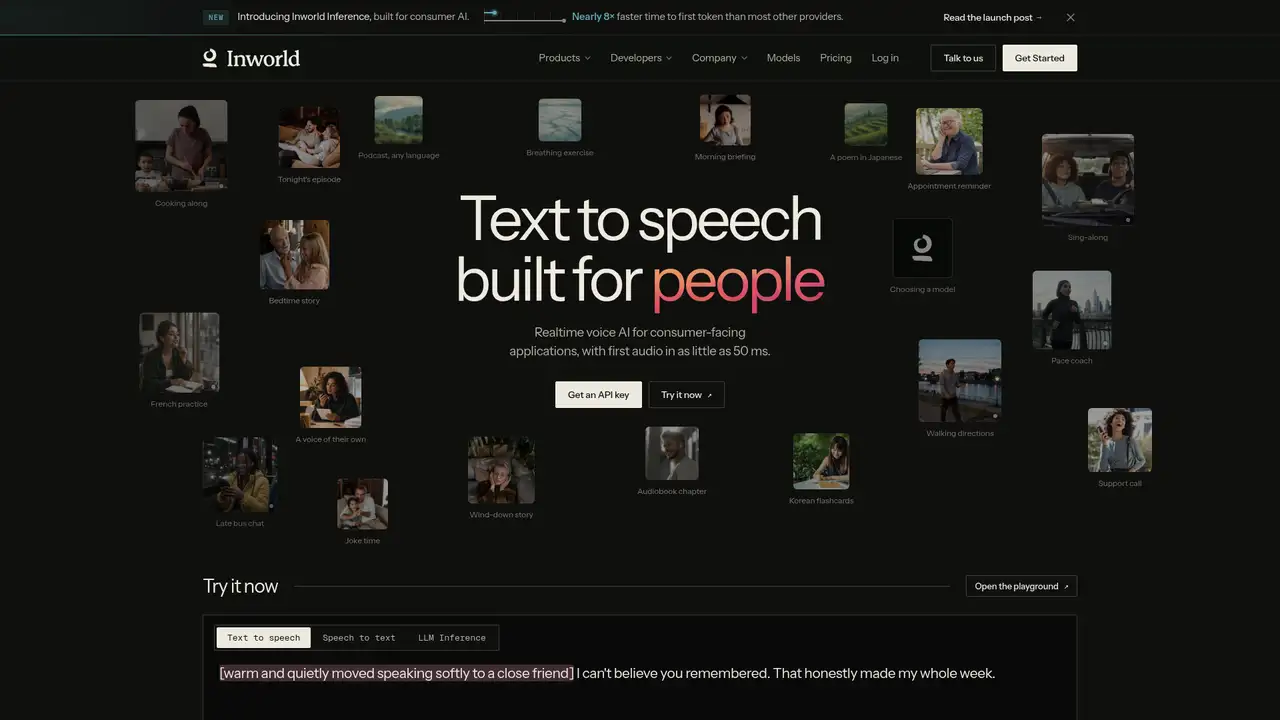
Inworld TTS is Inworld AI’s hosted speech service, available through its Portal, playground, SDKs, and HTTP APIs. It targets developers building games, companions, assistants, and interactive applications rather than consumers seeking a desktop narration tool. Inworld launched its first TTS models in 2025, including TTS-1 and the larger TTS-1-Max. The technical report describes 1.6 billion parameter TTS-1 and 8.8 billion parameter TTS-1-Max systems. Current product documentation centers on Realtime TTS-2 and TTS-2 Flash. Inworld lists API access, commercial licensing, GDPR, and SOC 2 Type II coverage across its plans. Enterprise customers can add custom limits, data residency, an SLA, and a DPA. A typical workflow uses the TTS Playground for voice selection or design, followed by API-key authentication and synthesis through HTTP, streaming, or WebSocket requests.
A typical workflow begins in the TTS Playground, where developers compare stock voices, create voice designs, or preview instant clones. Production code creates an API key and sends text, a voice, and a model to the synthesis service. Non-streaming HTTP returns complete audio, while HTTP streaming and WebSocket stream chunks during generation. WebSocket is the documented choice for the lowest latency. The JavaScript SDK is installed as @inworld/tts, and the Python package is inworld-tts. Output formats include MP3, Opus, WAV, PCM, and FLAC through compatible endpoints. Async jobs handle long text, with limits up to 100,000 characters, while Batch costs 20 percent less per character. Realtime TTS-2 supports natural-language steering, inline non-verbal cues, timestamps, cross-lingual voice use, and synthesis across 15 languages.
Realtime TTS-2 is Inworld’s expressive model, with natural-language steering, inline non-verbal cues, cross-lingual voice use, timestamps, and production-quality synthesis across 15 languages. Current product material lists 200-plus languages and locales for the TTS-2 family. Realtime TTS-2 Flash reports 20 ms server-side P90 time to first audio versus 100 ms for TTS-2. Flash supports the same broad language coverage and non-verbal tags, while steering instructions and professional voice cloning are supported on TTS-2 only. Earlier releases included TTS-1 and TTS-1.5. The technical report describes Transformer-based autoregressive models, 48 kHz output, short-reference voice conditioning, and audio markups. Production access includes HTTP and WebSocket streaming, asynchronous jobs for long text, batch processing, and SDKs for JavaScript and Python.
On-Demand costs $0 monthly plus usage, with TTS-2 at $25 per million characters and Flash at $15. It includes up to 70 minutes of TTS, 100 custom voices, two professional voice clones, voice cloning, voice design, API access, and a commercial license. Creator costs $25 monthly and includes $25 in credits, with rates of $20 and $10. Builder costs $100, Developer $300, and Growth $1,500, with lower rates and higher limits. Concurrency increases from five requests on On-Demand to 500 on Growth. The playground accepts 2,000 characters on On-Demand and 40,000 on paid plans. Enterprise pricing is custom, with TTS-2 as low as $5 per million characters and Flash below $5. Paid plans increase concurrent request limits from 10 on Creator to 50 on Builder, 150 on Developer, and 500 on Growth.
Inworld’s main constraints are cloud dependence, character metering, plan complexity, and feature separation between TTS-2 and Flash. ElevenLabs is a close alternative for creator-oriented voice discovery and cloning, while Inworld emphasizes realtime API integration and application workflows. Cartesia competes on realtime speech, whereas Azure AI Speech and Google Cloud Text-to-Speech offer wider enterprise cloud-service portfolios. Kokoro is a different choice for teams willing to self-host an open model instead of paying a managed per-character service. Inworld provides HTTP and WebSocket streaming, asynchronous jobs, Batch processing, SDKs, and an OpenAI-compatible endpoint for integrating speech into applications. Pick Inworld if your product needs managed realtime speech, API integration, and expressive controls.
Who is Inworld TTS best for?
- Teams building realtime voice agents or game characters.
- Developers needing streaming and OpenAI-compatible APIs.
- Products requiring voice cloning and expressive steering.
- Businesses needing commercial licensing and enterprise controls.
Inworld TTS Pricing (2026)
Pricing model: Usage-based. All prices in USD.
| Plan | Price | What you get |
|---|---|---|
| On-Demand | $0/month plus usage | TTS-2 costs $25 per million characters and Flash $15. Includes five concurrent requests, up to 70 minutes of TTS, 100 custom voices, and two professional voice clones. |
| Creator | $25/month | Includes $25 in credits, 10 concurrent requests, 500 custom voices, and four professional voice clones. TTS-2 costs $20 per million characters and Flash $10. |
| Builder | $100/month | Includes $100 in credits, 50 concurrent requests, 3,000 custom voices, and 10 professional voice clones. TTS-2 costs $17.50 per million characters and Flash $9. |
| Developer | $300/month | Includes $300 in credits, 150 concurrent requests, 10,000 custom voices, and 25 professional voice clones. TTS-2 costs $15 per million characters and Flash $8. |
| Growth | $1,500/month | Includes $1,500 in credits, 500 concurrent requests, 30,000 custom voices, and 40 professional voice clones. TTS-2 costs $12.50 per million characters and Flash $7. |
| Enterprise | Custom | Custom limits and terms apply. Published rates reach as low as $5 per million characters for TTS-2 and below $5 for Flash. |
Pros and Cons
Pros
- TTS-2 supports natural-language delivery steering.
- Flash reports 20 ms server-side P90 first-audio latency.
- The API supports WebSocket, HTTP streaming, async, and Batch modes.
- The service offers cloning, voice design, commercial licensing, and multilingual synthesis.
Cons
- Usage costs can become substantial at scale.
- Steering and professional cloning are limited to TTS-2.
- The service requires Inworld cloud credentials and connectivity.
Who should look elsewhere?
- Users seeking offline or self-hosted inference.
- Small projects with unpredictable high-volume usage.
- Teams needing steering on the lowest-cost Flash model.
Technical Details
Frequently Asked Questions
How much does Inworld TTS cost?
On-Demand access costs $0 monthly plus usage, starting at $25 per million characters for Realtime TTS-2 and $15 for TTS-2 Flash. Paid plans begin at $25 monthly for Creator, with credits and lower rates. Builder, Developer, and Growth cost $100, $300, and $1,500 monthly. Enterprise pricing is custom.
Does Inworld TTS have a free plan?
Yes. On-Demand starts at $0 monthly and includes up to 70 minutes of TTS, according to Inworld’s pricing page. Usage beyond included allowances is billed at the plan rate. The tier includes API access, but concurrency is limited to five requests and On-Demand async jobs are capped at 10,000 characters.
Inworld TTS versus ElevenLabs: which should I choose?
Inworld is aimed at realtime application integration, with WebSocket streaming, an OpenAI-compatible endpoint, and steering on TTS-2. ElevenLabs is a close alternative for creator-oriented voice discovery and cloning. Compare language coverage, consent requirements, latency, cloning features, and effective per-character cost against your expected traffic before choosing.
Does Inworld train on user data?
Inworld lists GDPR and SOC 2 Type II compliance on every plan and offers zero data retention as a Growth add-on. Ordinary synthesis requests are not automatically identified here as being used for model training. Teams handling sensitive audio or text should review retention settings, configure available controls, and confirm applicable contractual terms before processing such data.
Can Inworld TTS be used commercially?
Yes. Inworld’s pricing comparison lists a commercial license across plans. Voice cloning still requires appropriate permission, and the service’s terms govern generated audio and acceptable use. Enterprise plans can add an SLA, DPA, and EU or India data residency. Review the applicable terms for a specific commercial deployment.
Best Inworld TTS Alternatives in 2026
These tools do the same job as Inworld TTS, with different pricing, limits and trade-offs.
Expressive speech, dubbing, music and realtime voice agents

Low-latency text-to-speech, transcription and voice agents on state space models
Text-to-speech with ultra-realistic voice cloning at scale
Microsoft's cloud speech API for transcription, neural voices, translation and avatars