
Kiro CLI Review, Pricing & Alternatives (2026)
Agentic coding in a terminal with specs, hooks, MCP, and model choice.
rebranded: Amazon Q Developer CLI became Kiro CLI on November 17, 2025; the command changed from q to kiro-cli.
Last updated: October 26, 2026
What is Kiro CLI?
Kiro CLI is Amazon's terminal coding agent for repository work, shell commands, specifications, MCP connections, hooks, and custom agents. It targets developers and teams already using Kiro or AWS identity. Access starts at $0 with 50 credits, while paid Kiro plans start at $20 per user monthly and share billing with the Kiro IDE.
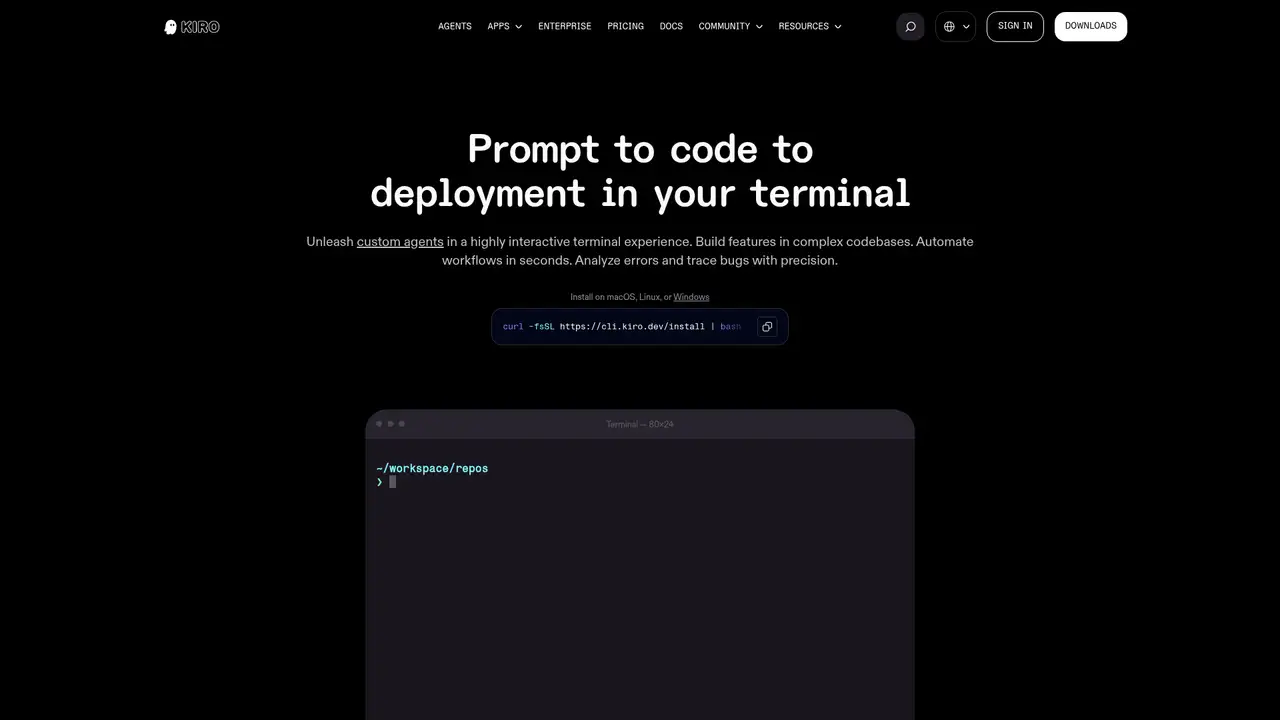
Amazon introduced Kiro CLI on November 17, 2025, as the successor to Amazon Q Developer CLI, changing the command from `q` to `kiro-cli`. It is a terminal-based coding agent within Amazon’s broader Kiro developer product, rather than a separately sold application. The tool targets developers who want a managed terminal agent with AWS-linked identity, model access, and one account shared between command-line and IDE workflows. Kiro’s official page uses a proprietary license, while the former Amazon Q Developer CLI repository remains open source. Amazon does not publish Kiro’s user count or funding figure. The product’s scope includes repository work, shell commands, specifications, MCP connections, hooks, steering files, and custom agents, placing it among managed coding assistants rather than self-hosted model servers.
A typical Kiro CLI session starts in a repository with a natural-language task. The agent can inspect files, propose and apply edits, run shell commands, and continue through an interactive loop. Agent mode supports steering files, custom agents, hooks, MCP servers, and specification workflows, with the announcement emphasizing terminal development, MCP, steering, custom agents, and the Auto agent. Authentication uses Kiro's service, with personal sign-in and organization controls documented through Kiro and AWS. The CLI is included in standard Kiro pricing rather than sold separately, and its credit allocation is shared with the Kiro IDE. That arrangement lets subscribers switch between terminal and editor workflows without purchasing a second plan, although usage remains subject to fractional, model-dependent credit consumption.
Kiro CLI supports a broad, plan- and region-dependent model matrix rather than a single fixed model. Its Auto agent selects among available options from OpenAI, Anthropic, DeepSeek, MiniMax, GLM, Kimi, and Qwen, including GPT-5.6 variants, Claude Opus, Sonnet and Haiku versions, DeepSeek 3.2, MiniMax M2.1, and Qwen3 Coder Next. Each model carries a credit multiplier, so request capacity varies with model choice. Amazon launched and rebranded the CLI on November 17, 2025, changing the command from q to kiro-cli. Kiro later added Pro Max in June 2026 and combined vibe and specification allowances into a fractional credit pool. That change makes larger specification or coding workloads draw from the same subscription balance, while model selection continues to affect consumption.
The Free plan costs $0 and includes 50 credits, selected models, and applicable rate limits, but free users cannot purchase add-on credits. Pro costs $20 per user monthly for 1,000 credits, Pro+ costs $40 for 2,000, Pro Max costs $100 for 5,000, and Power costs $200 for 10,000. Paid users can buy additional credits at $0.04 each, with packs ranging from $5 for 125 credits to $100 for 2,500 credits. Credits are fractional and request-dependent, so an allowance does not represent a fixed number of prompts. Model choice also affects consumption through credit multipliers, with access varying by plan and region. Enterprise pricing is custom and adds centralized billing, single sign-on, analytics, and security controls. Kiro CLI usage shares the same subscription and credit allocation as the Kiro IDE.
Kiro CLI is not self-hosted: it depends on Kiro's hosted identity, model access, and fractional credit accounting, and it has no separate public CLI API for arbitrary application calls. Its current proprietary license also differs from the former Amazon Q Developer CLI repository, which remains open source. Claude Code is the closest managed terminal comparison, while Aider gives users broader bring-your-own-key and local-model flexibility. OpenAI Codex CLI and Gemini CLI target the same terminal workflow, and Amazon Q Developer CLI is Kiro's predecessor rather than a current alternative. Kiro instead combines shared CLI and IDE billing with AWS-oriented administration, MCP servers, hooks, steering, custom agents, and specification workflows. Choose Kiro CLI if those controls and shared Kiro access matter more than self-hosting, independent provider keys, or an unrestricted application API.
Who is Kiro CLI best for?
- Developers wanting a managed coding agent in a terminal.
- Teams using Kiro subscriptions and AWS-oriented administration.
- Projects needing MCP, hooks, steering, or custom agents.
- Users sharing one credit allocation across CLI and IDE.
Kiro CLI Pricing (2026)
Pricing model: Freemium. All prices in USD.
| Plan | Price | What you get |
|---|---|---|
| Free | $0/month | 50 credits with selected models and rate limits. Free users cannot buy add-on credits. |
| Pro | $20/user/month | 1,000 credits. Paid users can purchase add-on credits at $0.04 each. |
| Pro+ | $40/user/month | 2,000 credits. Paid users can purchase add-on credits at $0.04 each. |
| Pro Max | $100/user/month | 5,000 credits. Paid users can purchase add-on credits at $0.04 each. |
| Power | $200/user/month | 10,000 credits. Paid users can purchase add-on credits at $0.04 each. |
| Enterprise | Custom | Centralized billing, SSO, analytics, and security controls. |
Pros and Cons
Pros
- The CLI shares Kiro subscriptions with the IDE.
- MCP, hooks, steering, and custom agents support structured workflows.
- The Free plan provides 50 credits without a subscription.
- Model access includes premium and open-weight coding options.
Cons
- The current CLI uses a proprietary Kiro license.
- Credit multipliers make request capacity model-dependent.
- There is no separate public Kiro CLI API.
Who should look elsewhere?
- Teams requiring a self-hosted coding agent.
- Users wanting unrestricted provider API keys.
- Developers avoiding monthly credits and proprietary software.
Technical Details
Frequently Asked Questions
How much does Kiro CLI cost?
Kiro CLI has a $0 Free plan with 50 credits. Pro costs $20 monthly, Pro+ costs $40, Pro Max costs $100, and Power costs $200. Those plans include 1,000, 2,000, 5,000, and 10,000 credits. Add-on credits cost $0.04 each for paid users, while Enterprise pricing is custom.
Is Kiro CLI free?
Yes. The Free plan includes 50 credits, selected model access, and applicable rate limits. Free users cannot purchase add-on credits. Larger allocations and broader premium model access require paid Kiro plans. Because credits are fractional and model-dependent, 50 credits does not represent a fixed number of terminal requests.
How does Kiro CLI compare with Claude Code?
Kiro CLI and Claude Code both provide managed terminal coding agents. Kiro adds shared billing with the Kiro IDE, AWS-oriented administration, MCP, hooks, steering, custom agents, and specification workflows. Claude Code is the closer choice for users centered on Anthropic's product. Kiro suits teams prioritizing Kiro account controls and its broader documented model matrix.
Does Kiro CLI train on user data?
The cited Kiro product pages do not provide a blanket statement that all CLI prompts are or are not used for model training. Organizations should review Kiro and AWS privacy terms before sending sensitive source code. Enterprise customers can also evaluate the documented SSO, analytics, security, and centralized administration controls.
Can companies use Kiro CLI commercially?
Commercial use is governed by Kiro's proprietary license and subscription terms. Enterprise pricing adds centralized billing, SSO, analytics, and security controls. The former Amazon Q Developer CLI repository remains open source, but that status does not make the current Kiro CLI open source. Companies should review the current license before deployment.
Best Kiro CLI Alternatives in 2026
These tools do the same job as Kiro CLI, with different pricing, limits and trade-offs.
An agentic coding assistant for terminal, IDE, desktop, and web
Open-source AI pair programming in a Git-aware terminal

Terminal coding agent with sandbox controls and OpenAI model access

An open source Gemini agent for coding and research in the terminal

AWS-integrated coding help for IDEs, terminals, and cloud operations