
Hume AI Review, Pricing & Alternatives (2026)
Former expressive voice AI maker now selling evaluation tools for voice systems
pivoted: On October 2, 2026, Hume announced it is shutting down its Octave text-to-speech and EVI speech-to-speech APIs. Access ends November 13, 2026 at 12:01 a.m. EST, and account data is permanently deleted after that date. The company now sells VoiceEQ, a platform for evaluating other voice AI systems, plus Expression Measurement APIs.
Last updated: October 19, 2026
What is Hume AI?
Hume AI built Octave text-to-speech and the EVI voice-to-voice API, both of which shut down on November 13, 2026. The company now sells VoiceEQ, a platform for testing voice AI systems, and APIs that measure tone and emotion in speech. Existing EVI and Octave users should migrate before the cutoff.
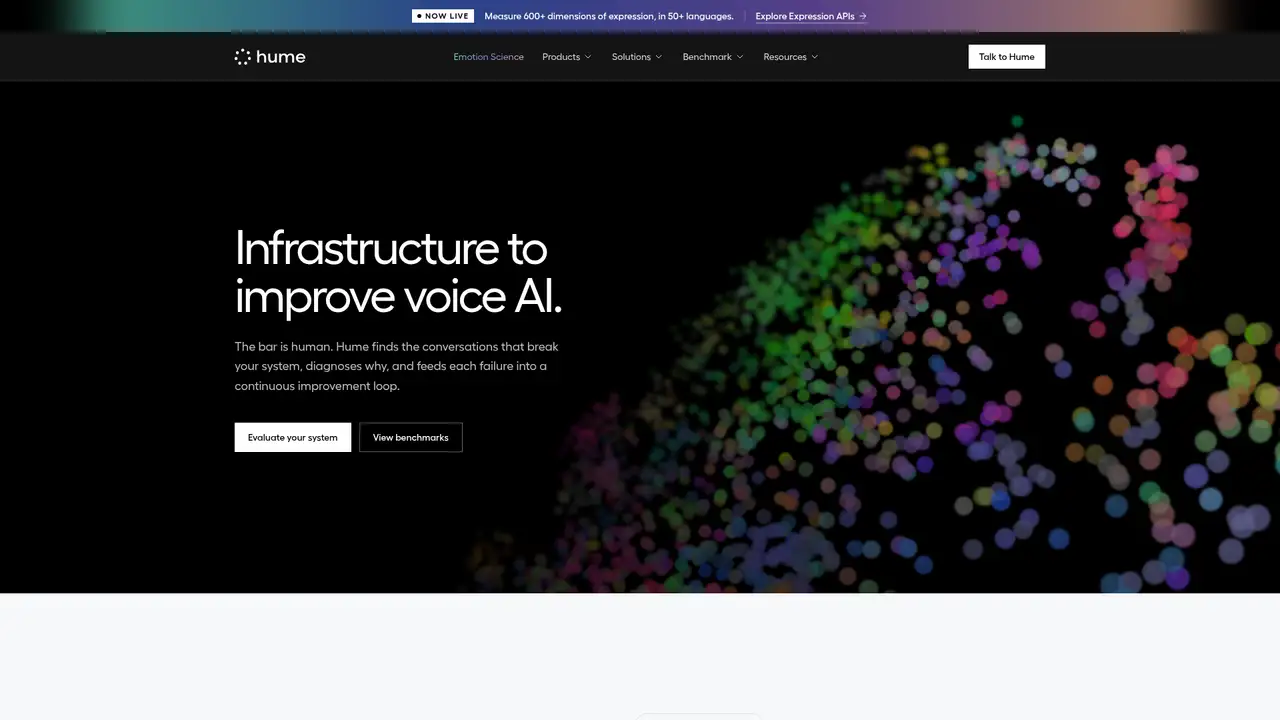
Hume AI is a New York research company founded in 2021 by Alan Cowen, a former Google researcher whose academic work mapped how people express emotion through voice and face. It raised a $50 million Series B in March 2024 led by EQT Ventures, with Union Square Ventures and Comcast Ventures participating, which Forbes reported valued it at $219 million. For most of its life Hume sold two things to developers: an Expression Measurement API that scores emotion in audio, video and text, and voice products that could speak with matching emotion. On October 2, 2026 it announced that its text-to-speech and Empathic Voice Interface APIs would end on November 13, 2026, with all account data deleted afterward. Hume now positions itself as evaluation infrastructure for voice AI, built on 10 years of emotion research and what it says are more than 100 million speech samples.
The products being retired defined Hume's reputation. EVI was a speech-to-speech API: a developer opened a WebSocket, a user talked, and EVI replied in a voice whose tone changed with the conversation. It handled turn-taking and interruptions and could call an outside language model such as Claude or GPT for reasoning, while Hume's own model shaped how the reply sounded. Octave was a text-to-speech model that read context from the script, so the same line was delivered differently in a sad scene and a happy one. Users could design a voice from a text prompt, clone one from a short sample and convert one voice into another. Pricing ran from a free tier through Creator and Pro plans to enterprise contracts with SOC 2, GDPR and HIPAA compliance.
Hume shipped quickly right up to the shutdown. Octave launched in February 2025 as one of the first TTS models built on a language model, and Octave 2 arrived on October 1, 2025 at half the price of the first version, with 11 languages and responses in under 200 milliseconds. EVI 3 came out in mid-2025, and EVI 4-mini brought the same 11 languages to conversations. Voice conversion endpoints and a control plane for live chats followed in November 2025, configurable turn detection in April 2026, and a temperature setting for speech in May 2026. Hume also partnered with SambaNova in October 2025 to run models faster. The new direction reuses that research. VoiceEQ turns a company's call data into test suites, stress-tests voice systems, and scores timing, tone, interruption handling and accent alongside transcript accuracy, combining automated metrics with human ratings.
Hume's old self-serve plans no longer matter for new projects, because the TTS and EVI APIs stop on November 13, 2026 regardless of plan. Its pricing page still lists Octave 1 and 2 plans with monthly character allowances, extra EVI 3 minutes at $0.04 each and up to 30 concurrent connections, and enterprise plans with unlimited voice cloning and HIPAA support. VoiceEQ and the Prism Pipeline audio enrichment service are sold through sales conversations without published prices. The Expression Measurement APIs continue for analysing recorded or streamed media. Hume publishes a public Real-World VoiceEQ leaderboard comparing models such as GPT-4o Realtime, Gemini Live, ElevenLabs v3 and Cartesia Sonic, which serves as a free reference when choosing a replacement voice model.
Anyone building on EVI or Octave needs a replacement now. For expressive text-to-speech, ElevenLabs v3 and Cartesia Sonic are the closest matches, with Cartesia stronger on latency and ElevenLabs on voice range and audio tags. For speech-to-speech agents, OpenAI's Realtime API and Google's Gemini Live cover similar ground, and orchestration platforms such as Vapi let you combine transcription, a language model and a voice from different vendors. Export transcripts, chat histories and custom voice configurations before the deadline, because Hume deletes them afterward. VoiceEQ is aimed at AI labs and large companies that run voice agents and want independent quality measurement. Pick Hume today if you need to benchmark voice systems or measure emotion in recorded media. Do not start a new speech generation project on it.
Who is Hume AI best for?
- AI labs comparing voice models on tone, timing and interruption handling.
- Companies running voice agents that want independent quality testing.
- Researchers measuring emotional expression in recorded speech or video.
- Teams picking a replacement voice model using the public VoiceEQ leaderboard.
Hume AI Pricing (2026)
Pricing model: Paid. All prices in USD.
| Plan | Price | What you get |
|---|---|---|
| Octave and EVI plans | Ending Nov 13, 2026 | Legacy TTS and speech-to-speech plans. Extra EVI 3 usage was $0.04 a minute. Access and data end on November 13, 2026. |
| Expression Measurement API | Usage-based | Measures emotional expression in audio, video and text. Continues after the voice API sunset. |
| VoiceEQ and Prism Pipeline | Custom | Voice AI evaluation platform and audio enrichment service, sold through Hume's sales team. |
Pros and Cons
Pros
- A decade of published emotion research underpins its measurement tools.
- VoiceEQ scores dimensions such as timing and tone that word error rate misses.
- The public leaderboard compares major voice models from several vendors.
- Expression Measurement APIs remain available after the voice shutdown.
Cons
- Octave TTS and EVI end on November 13, 2026, forcing existing users to migrate.
- Account data is permanently deleted after the shutdown date.
- VoiceEQ pricing is not published.
Who should look elsewhere?
- New text-to-speech or voice agent projects, since both APIs close in November 2026.
- Creators who need voiceover generation for videos or podcasts.
- Small teams wanting self-serve pricing for evaluation tools.
Technical Details
Frequently Asked Questions
Is Hume AI shutting down?
Hume is shutting down only its voice generation products. The Octave text-to-speech and EVI speech-to-speech APIs stop working on November 13, 2026 at 12:01 a.m. EST, and data in those accounts is permanently deleted afterward. The company continues to operate and now sells VoiceEQ, a voice AI evaluation platform, along with its Expression Measurement APIs.
Does Hume AI have a free plan?
Hume's free tier for Octave and EVI ends with those APIs on November 13, 2026, so it is not worth signing up for voice generation. The public Real-World VoiceEQ leaderboard, which compares voice models from several vendors, is free to view. VoiceEQ itself and the Prism Pipeline are sold through Hume's sales team without published prices.
What should replace Hume EVI or Octave?
For expressive text-to-speech, ElevenLabs v3 and Cartesia Sonic are the closest replacements. For real-time voice conversations, OpenAI's Realtime API and Google's Gemini Live offer speech-to-speech models, and platforms such as Vapi let you mix transcription, language model and voice vendors. Export your chat histories and voice settings before November 13, 2026, because Hume deletes them.
What happens to my data on Hume?
Hume's changelog says any data in TTS and EVI accounts is permanently deleted after November 13, 2026. That includes stored chats, configurations and custom voices, so download anything you need before then. While active, Hume's enterprise plans listed SOC 2 Type II, GDPR and HIPAA compliance. Questions about the shutdown go to Hume support or assist@hume.ai.
Can I still use Hume commercially?
Audio generated with Octave under a commercial plan before the shutdown keeps the rights granted in your plan's terms, but you cannot generate new speech after November 13, 2026. VoiceEQ and the Expression Measurement APIs are commercial products for companies evaluating voice systems or analysing media. Check Hume's terms for how emotion measurement results may be used, particularly in hiring or health settings.
Best Hume AI Alternatives in 2026
These tools do the same job as Hume AI, with different pricing, limits and trade-offs.
Expressive speech, dubbing, music and realtime voice agents

Low-latency text-to-speech, transcription and voice agents on state space models

Developer platform for building phone and web voice agents on any model stack

Speech-to-text, text-to-speech and voice agent APIs priced by the minute

Former voice-cloning startup now selling deepfake detection, watermarking and voice ID