
Hedra Review, Pricing & Alternatives (2026)
Generate characters, scenes, voices, and visual media from one studio.
Last updated: October 26, 2026
What is Hedra?
Hedra is a visual-generation studio and developer platform for creators, marketers, and teams making character videos, images, audio, and model-powered media. Its current pricing page leads with prepaid usage, with video generation from $0.0113 per second and avatar or lip-sync from $0.025 per second. Studio plans and their September pricing are separate from the newer API model.
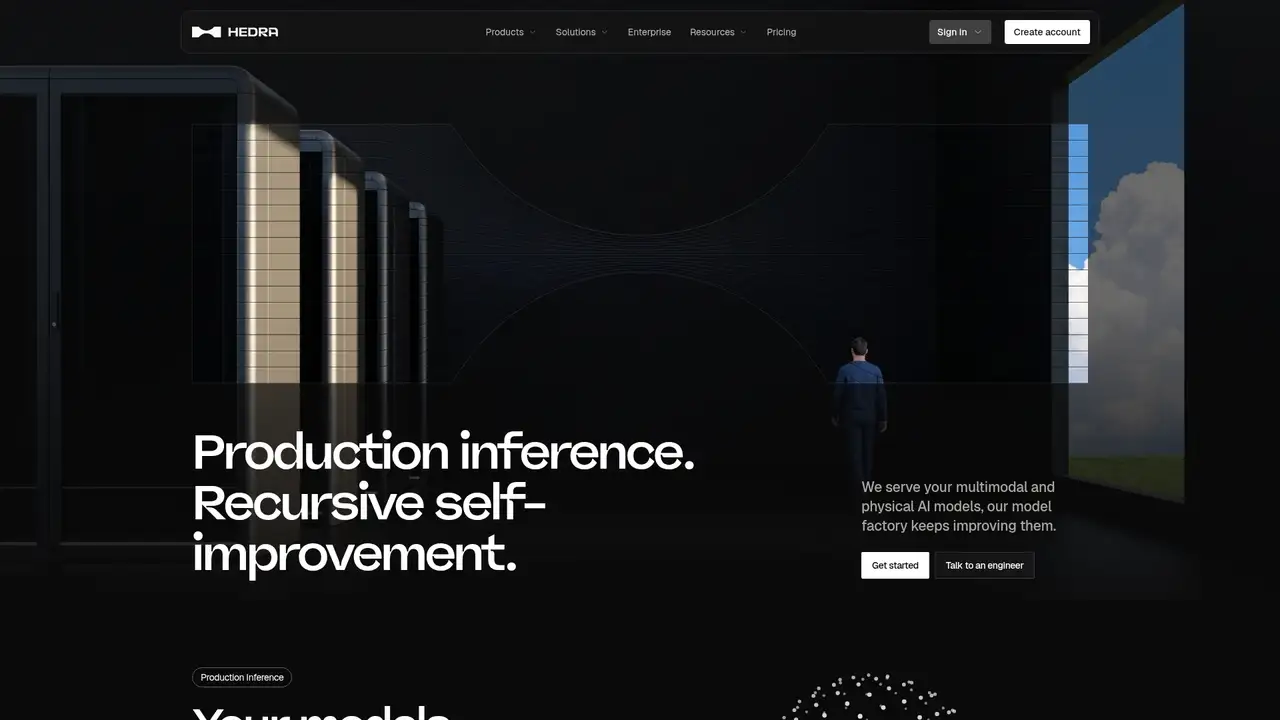
Hedra, Inc. is a San Francisco AI company that launched publicly in 2024 with Character-1 and $10 million in funding from Index Ventures, Abstract, and a16z Speedrun. Its May 2025 announcement of a $32 million Series A led by Andreessen Horowitz's Infrastructure fund brought reported total funding to $44 million. The company began with character-centric video but now describes a broader production platform. Studio addresses creator and marketing workflows, while inference and API products address developers and companies operating model workloads. Its stated coverage of visual media generation, audio, language models, and infrastructure engagements means customers can approach Hedra for both content production and technical deployment. The model also places greater importance on selecting suitable services, hardware, training arrangements, and GPU execution for each workload.
The Studio combines prompt-based creation with uploaded images, characters, voices, and other media, allowing a project to move from source assets to generated output within one workspace. Talking-avatar and lip-sync tools can turn selected characters and voices into presenter videos, while image and video generation supports additional visual material. Audio, face swaps, motion transfer, relighting, restyling, background removal, and upscaling provide ways to alter or finish assets without changing applications. The shared interface also lets users compare partner and in-house models for different tasks. For developers, asynchronous, model-specific jobs mean results arrive after submission rather than during a single request. The estimate endpoint supports cost checks first, while model schemas and limits determine which inputs each workflow accepts.
Character-1 remains relevant as the reference point for Hedra’s original focus on longer-form character video and expressive control, but the expanded catalog changes how developers evaluate the service. Image, video, speech, language, and vision-language options can support more stages of a production workflow without requiring every task to use a character model. The GLM-5.3 example in the v3 documentation also illustrates that model names alone are insufficient: developers must verify the current identifier, accepted inputs, duration constraints, and price before building an integration. Because availability can change, code and internal documentation may require periodic review. The shift toward dedicated serving, training, and GPU execution also means larger customers assess hardware and workload requirements alongside creative capabilities when requesting an engagement.
Hedra’s prepaid API balance makes usage costs visible before a team commits to recurring capacity, but it also shifts planning responsibility to the buyer. A project can estimate video, avatar, image, and speech expenses from the listed starting rates, while final charges still depend on the selected model and submitted inputs. Token billing for language and vision language models means text volume and request design affect the total separately from media duration. The absence of seats and minimums may fit occasional or variable workloads, whereas the Studio tiers package credits into fixed monthly plans with different effective rates and limits. Keeping the Studio subscription separate from the API wallet also requires teams to choose the correct purchasing route before production, rather than assuming one balance covers both forms of use.
Hedra's breadth increases the need to inspect model contracts and licensing for each job. Its privacy policy permits aggregated, de-identified, or anonymized data to improve services and train AI models. Its terms say users retain ownership of inputs and outputs while granting Hedra a broad license to operate the service, so teams should document approved inputs, outputs, and use cases before production. HeyGen is a closer avatar specialist, Runway is a broader creative video alternative, and Synthesia focuses on structured business presenters. Hedra is less suitable for teams requiring a traditional timeline editor, a single fixed subscription, or blanket exclusion from model-improvement uses. Choose Hedra when one account spanning characters, partner models, audio, and API inference matters most, and when variable model pricing and contract review fit the workflow.
Who is Hedra best for?
- Creators making talking-character and lip-sync videos.
- Teams combining video, image, audio, and partner models.
- Developers needing model discovery, estimates, jobs, and usage records.
- Businesses requiring custom infrastructure or enterprise arrangements.
Hedra Pricing (2026)
Pricing model: Usage-based. All prices in USD.
| Plan | Price | What you get |
|---|---|---|
| v3 API wallet | Prepaid USD | No subscription, seats, or minimum. Video starts at $0.0113 per second, while exact media and token charges depend on model and inputs. |
| Studio Basic | $20/month | September Studio pricing listed 2,000 credits monthly. |
| Studio Pro | $50/month | September Studio pricing listed 7,200 credits monthly. |
| Studio Ultra | $100/month | September Studio pricing listed 18,000 credits monthly. |
| Studio Teams | $75/month | September Studio pricing listed 14,400 credits monthly for the team plan. |
| Studio Enterprise | Custom | Custom pricing for enterprise requirements, with terms determined by engagement. |
Pros and Cons
Pros
- Hedra covers character video, image, audio, and broader model inference.
- The v3 API provides model schemas and cost estimates before jobs.
- The current pricing page lists rates across video, image, audio, and tokens.
- Enterprise infrastructure work can be priced around a specific workload.
Cons
- Studio subscriptions and API wallet funds are separate.
- Model availability and prices can change in the live catalog.
- The privacy policy permits anonymized data for model training.
Who should look elsewhere?
- Users wanting unlimited video minutes under one fixed subscription.
- Teams that cannot permit aggregated data for model improvement.
- Editors seeking a traditional timeline-first post-production application.
Technical Details
Frequently Asked Questions
How much does Hedra cost?
Hedra's current pricing page uses a prepaid dollar balance with no subscription, seats, or minimum. Video generation starts at $0.0113 per second, avatar and lip-sync at $0.025 per second, image generation at $0.0059 per generation, and speech at $0.05 per 1,000 characters. Earlier Studio plans were listed separately at $20, $50, $100, and $75 monthly, depending on tier.
Does Hedra have a free plan?
The current pricing page describes prepaid usage rather than a subscription or permanent free Studio plan. It lists voice cloning as free, while other media and token services have published starting rates. Studio plans from September were paid tiers. API work requires a prepaid dollar balance, and Studio subscriptions do not fund the API wallet.
Hedra or HeyGen for avatar videos?
Hedra is a better fit when avatar work sits alongside image, audio, partner video models, and developer inference. HeyGen is a more focused avatar and presenter product. Compare voice rights, avatar controls, generation speed, commercial terms, and the exact models available for the project before choosing between them.
Does Hedra train on user data?
Hedra's privacy policy says it may create aggregated, de-identified, or anonymized data and use or share it for lawful business purposes, including improving services and training AI models. Its terms say users retain ownership of inputs and outputs but grant Hedra a broad service license. Enterprise customers should rely on their customer agreement and applicable data-processing terms.
Can Hedra outputs be used commercially?
Commercial rights depend on the applicable Studio or enterprise terms, the model used, and rights in the source material. Users remain responsible for uploaded likenesses, voices, music, images, and other content. Hedra's terms say it does not claim ownership of inputs or outputs, while granting a broad license to operate the service. Review model-specific terms before client publication.
Best Hedra Alternatives in 2026
These tools do the same job as Hedra, with different pricing, limits and trade-offs.
AI avatars, translation, and prompt-based video production
AI presenters, dubbing, and training videos for business teams
Generative media tools for video, images, audio, and production workflows
AI avatar videos and interactive agents from text, images, and audio

Real-time AI humans through a multimodal video API