
Tavus Review, Pricing & Alternatives (2026)
Real-time AI humans through a multimodal video API
Last updated: October 26, 2026
What is Tavus?
Tavus provides real-time conversational video, AI faces, and developer APIs for teams building interactive agents, interviews, coaching, onboarding, and customer experiences. Its CVI developer plans start free, with paid access from $22/month and usage charges on higher tiers. A separate PALs product offers consumer AI companions with voice and video calls.
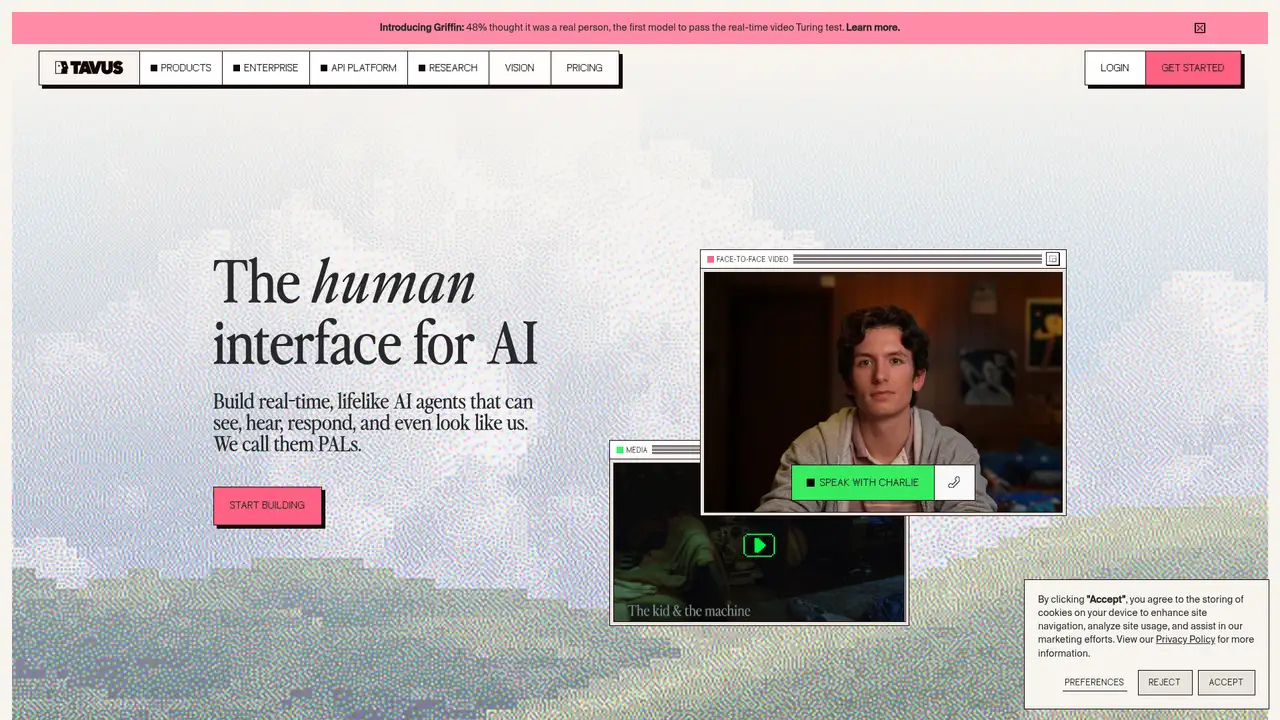
Tavus is a San Francisco AI company founded in 2020 by Hassaan Raza and Quinn Favret. After joining Y Combinator’s Summer 2021 batch, it developed its human computing category around PALs, AI humans that communicate through video, voice, and text. The company announced a $40 million Series B led by CRV in November 2025, bringing reported funding to approximately $64 million, although it does not publish annual recurring revenue. Its current developer product, the Conversational Video Interface, or CVI, gives teams API access and a no code portal for embedding live AI humans in products. This positions Tavus as infrastructure for interactive experiences, where teams can integrate video based conversations rather than produce only prerecorded avatar content.
CVI combines a face, voice, language model, knowledge base, memory, objectives, guardrails, and external tools in one conversation pipeline, allowing developers to define both how an AI human appears and how it responds. A typical build starts by selecting or creating a custom Face, configuring a PAL, adding documents or websites for retrieval, and setting the model or application logic. Developers then create a conversation through the API and connect users through WebRTC, making the system suitable for applications that need live interaction rather than prerecorded output. Tavus includes transcripts, function calling, audio-only operation, video sessions, Google Meet and Zoom configurations, and recordings on higher plans. Conversations consume live minutes, rounded to six-second increments with a 30-second minimum charge.
Tavus’s current model family divides the live interaction into three functions. Phoenix-4.5 handles human rendering, with the company reporting audio-to-video output in 134 milliseconds, a figure that supports responsive visual feedback during conversation. Raven-1 combines voice, video, and screen context, allowing perception to extend beyond spoken words and include what a participant shares on screen. Sparrow-2 focuses on conversational understanding and turn-taking, including interruptions, pauses, backchannels, and background audio, which are signals that can affect when an AI human responds. Tavus introduced earlier Phoenix, Raven, and Sparrow versions in 2025, but current product materials identify the newer models. The company reported a $40 million Series B in November 2025 and frames these models as infrastructure for AI humans.
The pricing structure makes usage planning central to implementation. Free can support testing, but 20 monthly minutes and stock faces limit sustained trials. Starter adds a custom Face and transcripts at a fixed $22, yet its single concurrent session constrains simultaneous users and its lack of overage means teams must monitor consumption. Builder increases capacity to 175 minutes and three sessions, but each additional minute costs $0.35, making extended conversations materially more expensive than the subscription alone suggests. Growth and Business reduce overage rates to $0.31 and $0.26 while raising included capacity, which suits heavier traffic but requires larger upfront commitments. Because video generation is separate, teams combining live CVI with generated video must budget for two billing categories.
Tavus’s main limitation is cost predictability. Builder, Growth, and Business permit uncapped usage, so frequent or long conversations can push monthly spending beyond the access fee. Starter has no published overage path, while concurrency and session-duration limits can constrain simultaneous or extended use. Tavus also processes uploaded audio and video, and its privacy policy permits research and development uses that may include training proprietary AI technology, making data review part of deployment planning. Synthesia, HeyGen, and D-ID are more established comparisons for generated avatar videos, whereas Tavus is designed for live, two-way conversations through API-controlled sessions. Choose Tavus when real-time AI humans and application integration matter more than predictable costs or low-cost, one-way video production.
Who is Tavus best for?
- Developers embedding live AI video agents through an API.
- Teams building interviews, coaching, onboarding, or support experiences.
- Companies needing custom AI faces with voice and video interaction.
- Products that need perception, memory, tools, and turn-taking in one pipeline.
Tavus Pricing (2026)
Pricing model: Freemium. All prices in USD.
| Plan | Price | What you get |
|---|---|---|
| Free | $0/month | Includes 20 CVI minutes monthly, stock faces, API and no-code access, one concurrent session, and no pay-as-you-go overage. |
| Starter | $22/month | Includes 60 CVI minutes, one custom Face slot, one concurrent session, transcripts, and no pay-as-you-go overage. |
| Builder | $59/month | Includes 175 CVI minutes, three custom Face slots, three concurrent sessions, and extra CVI usage at $0.35/minute. |
| Growth | $397/month | Includes 1,300 CVI minutes, seven custom Face slots, ten concurrent sessions, recordings, and extra CVI usage at $0.31/minute. |
| Business | $975/month | Includes 4,000 CVI minutes, 15 custom Face slots, 15 concurrent sessions, priority support, and extra CVI usage at $0.26/minute. |
| Enterprise | Custom | Adds custom concurrency, white labeling, enterprise security and compliance, service-level agreements, dedicated support, and scaling discounts. |
| PALs Free | $0/month | Includes unlimited messaging, 15 minutes of voice and video calls, and support for 30 or more languages. |
| PALs Plus | $20/month | Includes unlimited messaging, 150 minutes of voice and video calls, support for 30 or more languages, and MCP early access. |
| PALs Max | $50/month | Includes unlimited messaging, 500 minutes of voice and video calls, support for 30 or more languages, and MCP early access. |
Pros and Cons
Pros
- CVI combines perception, conversation flow, rendering, audio, and WebRTC in one pipeline.
- The Free plan includes 20 live conversation minutes and API access.
- Higher plans support custom Faces, knowledge bases, memory, guardrails, and tools.
- Published overage rates fall from $0.35 to $0.26 per CVI minute as plans scale.
Cons
- Uncapped usage can make monthly costs difficult to forecast.
- Starter has no published pay-as-you-go overage option.
- Tavus may use personal information for research and proprietary model training.
Who should look elsewhere?
- Teams producing only scripted, one-way marketing videos.
- Buyers requiring a self-hosted avatar platform.
- Projects with strict caps on variable media usage.
Technical Details
Frequently Asked Questions
How much does Tavus cost?
Tavus has a free developer plan, followed by Starter at $22 per month, Builder at $59, Growth at $397, Business at $975, and custom Enterprise pricing. Builder and higher plans add pay-as-you-go CVI usage. Extra conversation minutes cost $0.35 on Builder, $0.31 on Growth, and $0.26 on Business. Tavus also lists separate PALs consumer plans at $0, $20, and $50 monthly.
Does Tavus have a free plan?
Yes. The developer Free plan includes 20 minutes of Conversational Video each month, stock faces, API and no-code access, one concurrent session, developer documentation, community support, and support for 42 or more languages. It does not include a published pay-as-you-go overage rate. Tavus also lists a separate PALs Free plan with unlimited messaging and 15 minutes of voice and video calls.
How does Tavus compare with HeyGen?
Tavus is focused on live, two-way AI-human conversations through its Conversational Video Interface. HeyGen is a direct alternative for avatar video creation and also offers interactive avatar capabilities. Tavus exposes perception, turn-taking, rendering, memory, knowledge bases, and tools in one developer pipeline. Choose Tavus for real-time conversational agents, and compare HeyGen when scripted avatar production is the primary requirement.
Does Tavus train models on user data?
Tavus's privacy policy says it collects uploaded audio and video samples, generated videos, user content, and related metadata. It may use personal information for research and development, including training proprietary artificial intelligence technology. The policy also describes biometric processing for voice and facial characteristics. Customers should review applicable agreements and obtain required likeness, voice, and biometric permissions before uploading content.
Can I use Tavus videos commercially?
Tavus provides developer and Enterprise plans for building commercial applications, and customers retain ownership of their content and outputs under the enterprise terms described in the company materials. Commercial use still requires appropriate rights to likenesses, voices, biometric information, and uploaded media. Teams should review the applicable Tavus terms, privacy policy, and any plan-specific agreement before launching a customer-facing product.
Best Tavus Alternatives in 2026
These tools do the same job as Tavus, with different pricing, limits and trade-offs.
AI presenters, dubbing, and training videos for business teams
AI avatars, translation, and prompt-based video production

AI avatar videos for workplace training and internal communication

AI avatar videos and interactive agents from text, images, and audio