D-ID Review, Pricing & Alternatives (2026)
AI avatar videos and interactive agents from text, images, and audio
Last updated: October 26, 2026
What is D-ID?
D-ID is a cloud platform for creating avatar videos, translated content, and interactive visual agents. It targets marketers, trainers, educators, support teams, and developers who need browser tools or an API. A free Trial is available, while paid Studio plans start at $5.90 per month with monthly billing or $56 annually.
D-ID is an AI video company established in 2017, offering avatar video creation, translation, and interactive visual agents. Its Studio and API have powered more than 200 million avatar videos and attracted more than 280,000 developers, according to the company. TechCrunch reported $48 million raised by 2022 and $60 million by September 2025. In 2025, D-ID acquired Berlin-based Simpleshow, bringing its product and more than 1,500 enterprise clients into the planned platform expansion. These figures indicate a service designed for both individual production and developer-led deployment. Organizations can use its video tools across marketing, training, onboarding, learning, customer experience, and communication, while the acquisition adds an established enterprise audience and a broader base for workplace video use.
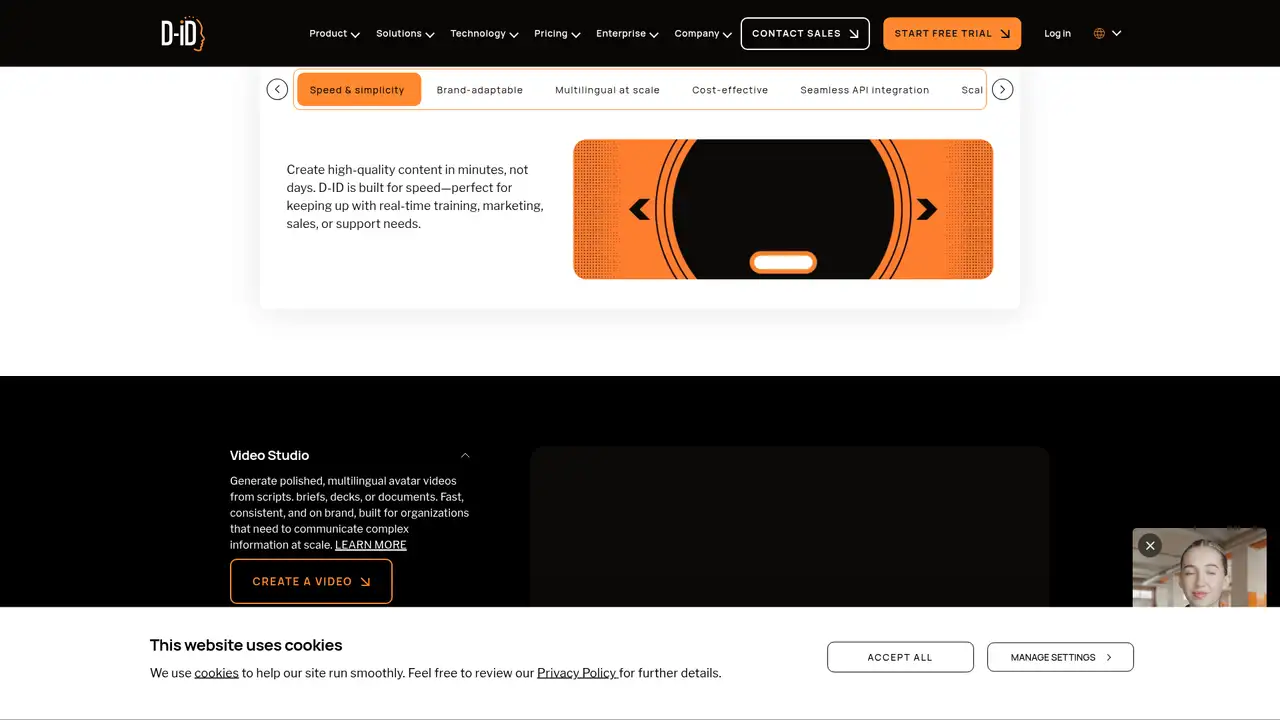
Users can begin in Studio with a stock avatar, a photo, or a personal avatar, then turn text, audio, or video into a presenter-led clip. Voice cloning and subtitles support consistent presentation, while multilingual output and video translation extend material to additional audiences. Higher plans add branding controls, which matter when exports must follow organizational guidelines. Developers can submit API jobs, retrieve finished files, or use real-time WebRTC sessions for interactive applications. Agents combine a knowledge base, an LLM configuration, and chat exports, connecting generated responses with stored information and conversation records. The documented avatar range includes V2 Photo, V3 Instant, V3 Pro, and V4 Expressive Avatars. Applicable API jobs share Studio credits, while streaming follows separate treatment.
D-ID’s lineup is built around proprietary avatar systems, including V4 Expressive Avatars and V3 Pro Avatars, rather than a separately licensed open model. Its documented agent stack can use OpenAI, Google, external OpenAI, Azure OpenAI, D-ID GPT OSS, custom, and Auto LLM configurations, allowing organizations to match agents with different model arrangements. Real-time Agents operate through WebRTC sessions and can connect responses to a knowledge base, supporting interactive exchanges grounded in selected information. D-ID reported more than 150,000 agents, 1.8 million messages, 340,000 minutes of engagement, and 99.5% uptime in a July 2025 company post, though these figures are not independent test results. The 2025 Simpleshow acquisition expanded the enterprise video offering beyond avatar production.
D-ID’s pricing makes production volume and usage conditions central to cost. The Trial can support a short evaluation, but its roughly three minutes and full screen watermark limit its suitability for presentable deliverables. Lite provides 10 minutes under the published credit rules, while Pro raises that amount to 15 minutes and adds commercial use, making it a more practical threshold for paid work. Advanced reaches 100 minutes and adds broader avatar, voice, agent, and branding options, but its annual price is substantially higher. Because durations round up to 15 second increments, brief clips can consume more credits than their exact runtime suggests. Expiring balances also require users to match subscriptions to predictable production schedules, while shared Studio and API credits can constrain simultaneous use.
D-ID’s main tradeoff is credit accounting: a short overrun rounds up, and unused minutes do not carry forward, so occasional editing or testing can consume more of an allocation than the final runtime suggests. Trial and Lite exports carry prominent D-ID branding, while commercial rights begin with Pro according to published plan details, limiting lower-cost use for client-facing work. Synthesia is a stronger alternative for structured enterprise presentation video, HeyGen is a close option for avatar-led marketing content, and Tavus focuses more heavily on conversational video interfaces. D-ID stands out when one account needs generated videos, translation, API access, and interactive agents, though that breadth may matter less for teams focused on one format. Choose D-ID for a combined workflow requiring developer access alongside Studio.
Who is D-ID best for?
- Marketing teams producing avatar-led campaign videos.
- Training teams creating multilingual instructional content.
- Developers embedding avatars or agents through an API.
- Organizations combining video generation with interactive agents.
D-ID Pricing (2026)
Pricing model: Freemium. All prices in USD.
| Plan | Price | What you get |
|---|---|---|
| Trial | $0 | About 3 total video minutes, personal use, and a full-screen watermark. Unused minutes do not carry over. |
| Lite | $5.90/month | Starts at 40 credits, equivalent to 10 minutes under D-ID’s 15-second credit rules. Annual billing is $56; personal use and D-ID branding apply. |
| Pro | $29/month | Starts at 60 credits, equivalent to 15 minutes. Annual billing is $191; commercial use, three personal avatars, and one voice clone are included. |
| Advanced | $196/month | Starts at 400 credits, equivalent to 100 minutes. Annual billing is $1,293; five personal avatars, three voice clones, and three embedded agents are included. |
| Enterprise | Custom | Custom video volume, avatars, agents, collaboration, support, and security terms. |
Pros and Cons
Pros
- The Studio and API cover both no-code creation and developer workflows.
- Video translation includes voice cloning and lip synchronization.
- Agent workflows support knowledge bases, LLM selection, and WebRTC sessions.
- The privacy policy defines automatic API data deletion windows.
Cons
- Video duration rounds up to 15-second billing intervals.
- Trial and Lite exports include prominent D-ID branding.
- Commercial use begins at the Pro tier.
Who should look elsewhere?
- Teams requiring self-hosted avatar generation.
- Users needing credits that carry into the next month.
- Creators seeking watermark-free commercial output on the cheapest plan.
Technical Details
Frequently Asked Questions
How much does D-ID cost?
D-ID has a free Trial with about three total video minutes. Paid Studio plans start at $5.90 per month for Lite, or $56 annually. Pro costs $29 monthly or $191 annually, Advanced costs $196 monthly or $1,293 annually, and Enterprise pricing is custom. API pricing is separate, although applicable API usage can draw from the same Studio credit balance.
Does D-ID have a free plan?
D-ID offers a free Trial rather than an unlimited free plan. The Trial provides about three total video minutes and places a full-screen watermark on exports. Trial minutes do not accumulate between billing periods because the Trial is not a recurring monthly allocation. D-ID also provides API access to Studio users, with API pricing and streaming treatment handled separately.
How does D-ID compare with Tavus?
D-ID combines avatar video creation, video translation, voice cloning, API access, and interactive Agents in one platform. Tavus centers its product on conversational video interfaces that pair a face and voice with a conversational system. D-ID is the broader fit for teams producing conventional avatar videos alongside agents, while Tavus is more focused on real-time conversational video sessions.
Does D-ID train models on user data?
D-ID’s privacy policy says applicative data awaiting processing is not accessed for model training. It also says API applicative data is automatically erased within 24 hours, Agent data within 72 hours, and Insight data within 14 days unless persisted. The biometric policy says biometric information is not used to improve products or train AI models.
Can I use D-ID videos commercially?
Commercial use begins with the Pro Studio plan according to published plan details. Trial and Lite are intended for personal use and include D-ID branding. Pro includes commercial use with a generic AI watermark, while Advanced adds custom logo or blank watermark-area control. Users remain responsible for obtaining required permissions for uploaded images, audio, voices, and likenesses.
Best D-ID Alternatives in 2026
These tools do the same job as D-ID, with different pricing, limits and trade-offs.