
Google Stitch Review, Pricing & Alternatives (2026)
Prompt, sketch, and voice driven UI design with Figma and code export
Last updated: October 22, 2026
What is Google Stitch?
Google Stitch is a Google Labs web tool that turns text, images, code, and voice instructions into web and mobile UI designs, prototypes, and frontend output. It targets designers, developers, founders, and small teams exploring product flows. Access currently costs $0, with changing usage limits and no published paid plan.
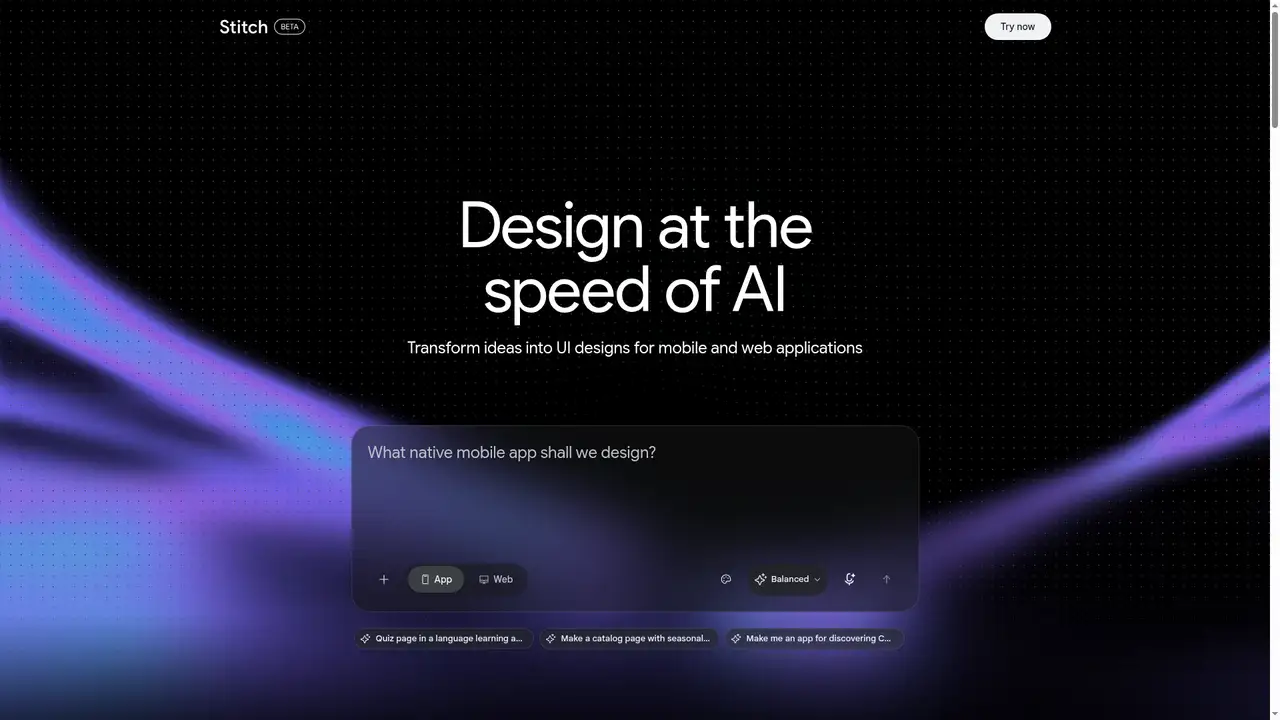
Google Stitch is a browser based UI design experiment from Google Labs, introduced on May 20, 2025 and rebuilt as an AI native infinite canvas on March 18, 2026. It turns text, images, screenshots, sketches, code fragments, and voice instructions into web and mobile interface designs, prototypes, and frontend output. A user can begin with a product description or rough reference instead of a blank design file. Stitch targets designers, developers, founders, and small teams exploring product flows. Its current scope runs from early ideas through connected prototypes and developer handoff. Google publishes no Stitch specific user, revenue, funding, or company scale figures. Because Stitch remains a Labs experiment, its long term availability is less certain than established design software used for lasting archives.
A typical Stitch workflow starts with a product description, screenshot, sketch, image, code fragment, or voice instruction. Generated screens appear on an infinite canvas, where users can request conversational edits, variants, critiques, layout changes, alternate palettes, and logical next screens. Screens can connect into clickable flows, and Play previews interactions. Stitch can extract design rules from a URL, while DESIGN.md transfers those rules between Stitch projects and coding tools. Users can paste output into Figma, export frontend code, and connect development workflows through the Stitch MCP server and SDK. Google also documents exports toward AI Studio and Antigravity. The March 2026 release added project wide canvas context, a design agent, an Agent manager for parallel directions, and voice design, extending work beyond single generated screens.
Google said the 2025 launch used Gemini 2.5 Pro multimodal capabilities. The March 2026 release added a project aware design agent, an Agent manager for parallel directions, voice design, DESIGN.md, and project wide canvas context. Google later announced real time canvas streaming, shareable links through AI Studio, Antigravity export, and Netlify publishing. Official Stitch announcements describe the product as Gemini powered, but do not provide a complete current model and quota table. The model layer matters because screen generation, revision, and project context depend on model responses. Generated designs and code still need accessibility, consistency, security, and engineering review before production use. Users should also consider Stitch’s unpaid AI terms, which permit submitted content and responses to support product improvement, with human review possible.
Stitch costs $0 per month during its current Labs availability. Google publishes no subscription, paid plan, credit purchase, team plan, enterprise contract, stable quota table, or guaranteed reset schedule. The free allowance includes the canvas, UI generation, prototypes, voice features, DESIGN.md, Figma transfer, code export, and developer integrations, subject to changing account limits. Independent reporting cites changing snapshots, including 350 Standard generations per month and 50 or 200 Experimental generations, while Google forum discussions describe daily limits. Those figures are not contractual. Users cannot buy additional Stitch capacity, so intensive work may require waiting for an account allowance to reset. A Google account is required, and unpaid service terms advise against submitting sensitive, confidential, or personal information.
Stitch suits rapid product exploration and design to code handoff, especially for designers, developers, founders, and small teams that want free multimodal generation and connected prototypes. Figma remains stronger for established collaboration, permissions, version history, review processes, design systems, and shared libraries. Framer is a stronger choice for publishing responsive websites, while Visily focuses on accessible wireframing and diagram to UI work. Stitch can transfer designs into Figma, but generated layouts and frontend code require accessibility and engineering checks. Changing quotas make budgeting difficult, and experimental status creates uncertainty for long lived archives. Pick Google Stitch if free prompt, image, and voice exploration plus Google developer integrations matter most; pick Figma for mature team controls, or Framer for responsive website publishing.
Who is Google Stitch best for?
- Designers exploring web and mobile flows from prompts, sketches, or screenshots.
- Developers wanting Figma output and a fast frontend starting point.
- Founders testing product directions before commissioning detailed design work.
- Small teams building clickable prototypes without a paid design subscription.
Google Stitch Pricing (2026)
Pricing model: Free. All prices in USD.
| Plan | Price | What you get |
|---|---|---|
| Free | $0/month | Includes current Stitch features subject to changing account limits. Google publishes no paid upgrade, stable quota table, or guaranteed reset schedule; annual billing does not apply. |
Pros and Cons
Pros
- Text, image, code, and voice inputs support varied starting points.
- Connected screens become clickable prototypes in the same canvas.
- Figma, HTML, CSS, DESIGN.md, MCP, and SDK paths support handoff.
- The free tier includes substantial design and prototyping functionality.
Cons
- Quotas and model labels change without a stable public pricing table.
- Generated layouts and frontend code require accessibility and engineering review.
- Experimental status creates uncertainty for long lived design archives.
Who should look elsewhere?
- Organizations requiring enterprise procurement terms or guaranteed capacity.
- Design teams needing mature permissions, version history, and shared libraries.
- Projects that cannot send confidential material to an unpaid hosted AI service.
Technical Details
Frequently Asked Questions
How much does Google Stitch cost?
Google Stitch currently costs $0 per month during its Labs availability. Google has not announced a subscription, paid plan, credit purchase, or public price table. Access remains quota limited, and reported allowances have changed between releases. Check the usage panel in the product before planning a large project because Google does not guarantee a fixed monthly or daily allowance.
Is Google Stitch free to use?
Yes. Stitch provides its current canvas, generation, prototype, voice, Figma, code, and developer handoff features without a monetary charge. A Google account is required, and use is limited by account allowances that Google can change. There is no published paid tier that raises those limits. The free service should not receive confidential or personal material under Google’s unpaid AI terms.
How does Google Stitch compare with Figma?
Stitch begins with prompts, images, code, and voice, then generates screens, flows, and frontend output. Figma provides the more established collaborative canvas, design systems, review processes, permissions, and version history. Stitch can transfer designs into Figma, making it useful for rapid exploration and handoff. Teams needing a central production design system should prefer Figma as the primary workspace.
Does Google Stitch train on user data?
Google’s Gemini terms say unpaid AI services may use submitted content and generated responses to provide, improve, and develop products and machine learning technologies. Human reviewers may read and process inputs and outputs for quality work. The terms advise against submitting sensitive, confidential, or personal information. Treat Stitch prompts, images, code, and generated responses accordingly unless current product terms provide different coverage.
Can I use Google Stitch designs commercially?
Google’s Gemini terms say Google does not claim ownership of generated content, while similar content may be generated for other users. Users remain responsible for lawful use, including rights in uploaded references and generated code. Commercial deployment therefore requires normal copyright, trademark, accessibility, security, and software license review. Check Stitch’s current service terms before shipping work created from third party assets.
Best Google Stitch Alternatives in 2026
These tools do the same job as Google Stitch, with different pricing, limits and trade-offs.

Design, publish, and host responsive websites from one visual workspace

AI wireframing and prototyping for product teams before its October 31 closure

AI-assisted site planning, design systems, and publishing for web teams

Turn prompts, screenshots, and sketches into editable interface prototypes