
Google Lyria Review, Pricing & Alternatives (2026)
Controllable AI music generation from Google DeepMind
Last updated: October 26, 2026
What is Google Lyria?
Google Lyria is a family of AI music models for creators, developers, and enterprises. It generates clips, full songs, image-guided tracks, and interactive music through Google products and APIs. Lyria 3.5 costs $0.08 per full song through the Gemini API, while Lyria 3 costs $0.04 for a 30-second clip.
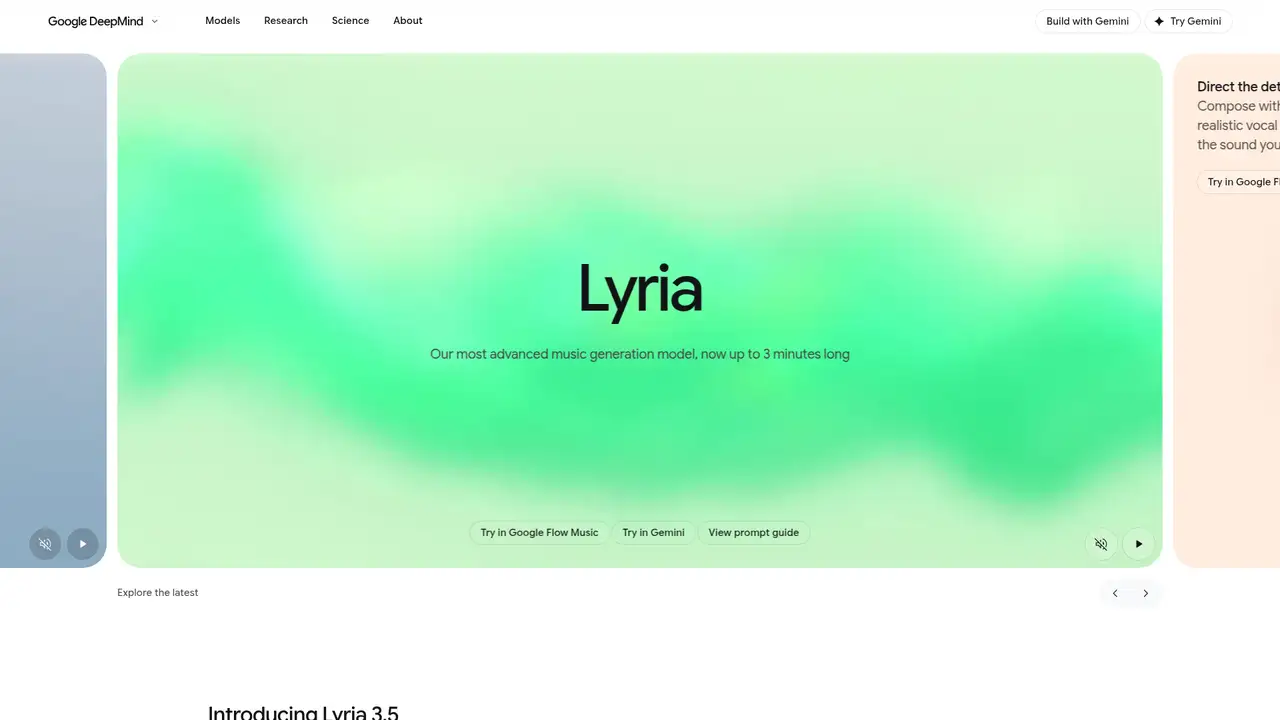
Google Lyria is a family of generative music models from Google DeepMind, not one standalone subscription application. Google introduced Lyria publicly in 2023, and its related Music AI Sandbox emerged that year through collaboration with YouTube’s Music AI Incubator. The family generates short clips, complete tracks, image-guided music, and continuous streams. Google has made Lyria available through Google AI Studio, Google Cloud, YouTube Shorts experiments, MusicFX DJ, and other products. The current DeepMind model page identifies Lyria 3.5 as the newest model, supporting variable song lengths up to three minutes. Google does not publish a separate Lyria funding figure or user count. Access therefore depends on the particular Google product, developer surface, experiment, or enterprise service being used.
Lyria workflows begin with prompts describing genre, mood, tempo, instruments, vocal style, lyrics, or other musical details. Lyria 2 provides controls for instruments, BPM, and related characteristics, allowing a prompt to specify more than a general atmosphere. The model page also describes image-to-music generation, where an uploaded image guides a custom track. Music AI Sandbox adds Create, Extend, and Edit. Create generates musical parts or samples and can use your own lyrics with tempo and key. Extend continues uploaded or generated clips, helping develop an unfinished idea. Edit changes the mood, genre, or style of an entire clip, or targets selected sections. RealTime supports interactive creation, performance, and continuous music rather than one completed song.
Lyria is a changing model family with different durations and interfaces. Lyria 2 reached general availability in Vertex AI in May 2025, following an April preview with allowlist access. Google’s May 2025 announcements also described Lyria 2 in YouTube Shorts and Lyria RealTime through an API and AI Studio. The current DeepMind page presents Lyria 3.5, with improved vocals, musicality, and variable song lengths up to three minutes. Google Cloud documentation lists Lyria 3 for 30-second song clips and Lyria 3 Pro for 184-second tracks with structure and vocals. The family also includes Lyria RealTime and Magenta RealTime. Generated Lyria audio carries SynthID, while Cloud services apply content filters, recitation checks, and artist-intent checks.
The Gemini API lists Lyria 3.5 at $0.08 per full song, with no free tier. Legacy Lyria 3 Clip Preview costs $0.04 per 30-second song, while Lyria 3 Pro Preview costs $0.08 per full song; neither has a free tier. Google does not publish one monthly Lyria subscription covering the family. Vertex AI uses service-specific, usage-based arrangements, and prices for Lyria 2 and Lyria RealTime are not published on Google’s pricing pages. The Gemini API says free-tier requests may be used to improve Google products, while paid-tier requests are not. Availability, preview status, regional access, quotas, and possible Google Cloud charges vary by surface. Music AI Sandbox and YouTube experiments have separate access rules rather than universal limits.
Lyria’s main limitation is fragmented access: model names, durations, billing, preview status, interfaces, and rights conditions differ across Google services. Safety filters can block prompts, and Google publishes no detailed parameter counts or training-corpus description. SynthID adds an inaudible watermark that aids provenance and remains detectable after common audio changes, but projects requiring unwatermarked files may need another service. Suno provides a more direct consumer songwriting workflow, while Udio is another consumer-focused music generator. Musicfy emphasizes voice-cloning workflows, and Stable Audio targets text-to-audio generation with separate licensing and API terms. Lyria is the better pick for developers, enterprises, and performers needing Google integration, API access, musical controls, interactive generation, and SynthID provenance.
Who is Google Lyria best for?
- It suits developers adding music generation to Google applications.
- It suits producers who need prompt control over instruments and BPM.
- It suits performers exploring interactive, continuously generated music.
- It suits teams that want SynthID provenance in generated audio.
Google Lyria Pricing (2026)
Pricing model: Usage-based. All prices in USD.
| Plan | Price | What you get |
|---|---|---|
| Lyria 3.5 | $0.08/song | Paid Gemini API access, billed per full-song request. No API free tier. |
| Lyria 3 Clip Preview | $0.04/song | Legacy preview model for 30-second songs. No API free tier. |
| Lyria 3 Pro Preview | $0.08/song | Legacy preview model for full songs. No API free tier. |
Pros and Cons
Pros
- Lyria offers clips, full songs, image-guided tracks, and real-time music.
- Lyria 2 supports controls for instruments, BPM, and other musical characteristics.
- SynthID adds an inaudible watermark to Lyria-generated audio.
- The Gemini API publishes per-song prices for current and legacy models.
Cons
- Access differs across Google Cloud, AI Studio, YouTube, and experiments.
- Google does not publish detailed training-corpus or parameter information.
- Safety checks can block prompts involving harmful content or artist intent.
Who should look elsewhere?
- It is not ideal for buyers seeking one consumer subscription.
- It is not suitable for projects requiring audio without SynthID watermarks.
- It is not ideal for teams avoiding product-specific access rules.
Technical Details
Frequently Asked Questions
How much does Google Lyria cost?
Lyria 3.5 costs $0.08 per full song through the Gemini API. Lyria 3 Clip Preview costs $0.04 per 30-second song, and Lyria 3 Pro Preview costs $0.08 per full song. Google lists no free tier for these models. Vertex AI, AI Studio, and other surfaces can have different availability and billing arrangements.
Does Google Lyria have a free plan?
No universal free Lyria plan is published. The Gemini API pricing page lists no free tier for Lyria 3.5, Lyria 3 Clip Preview, or Lyria 3 Pro Preview. Google has offered access through experiments and previews, but those arrangements are product-specific and do not establish ongoing free usage across the Lyria family.
Lyria or Suno: which is better?
Lyria fits developers and enterprises that need Google APIs, Google Cloud integration, model-specific controls, and SynthID watermarks. Suno offers a more direct consumer songwriting workflow. Lyria’s pricing and access vary by Google surface, while Suno presents its own subscription structure. Choose based on deployment, workflow, and rights requirements.
Does Google train on Lyria prompts or generated audio?
Google Cloud says customer data is not used to train its models under Google Cloud data-governance controls. The Gemini API pricing page separately says free-tier requests may be used to improve Google products, while paid-tier requests are not. These statements differ by service, so check the terms for the surface handling your data.
Can Google Lyria music be used commercially?
Commercial rights depend on the Google service, model terms, account type, region, and any source material used in a prompt or upload. Google describes copyright indemnity for covered generative AI services on Vertex AI, but that does not automatically settle every Lyria use case. Review the applicable terms before releasing or monetizing a track.
Best Google Lyria Alternatives in 2026
These tools do the same job as Google Lyria, with different pricing, limits and trade-offs.
Prompt-driven song creation with editing, stems, and voice tools
Generate, extend, remix, and edit songs from text prompts

Instrumental music and sound effects with open weights and commercial rights

Turn prompts and vocal samples into songs with AI voices