
Stable Audio Review, Pricing & Alternatives (2026)
Instrumental music and sound effects with open weights and commercial rights
Last updated: October 22, 2026
What is Stable Audio?
Stable Audio is Stability AI’s text to music and sound effects service for creators, developers, and production teams. The web app starts at $12 per month after 50 free signup credits, while Stable Audio 3.0 Small and Medium can also be self hosted under the Community License for qualifying users.
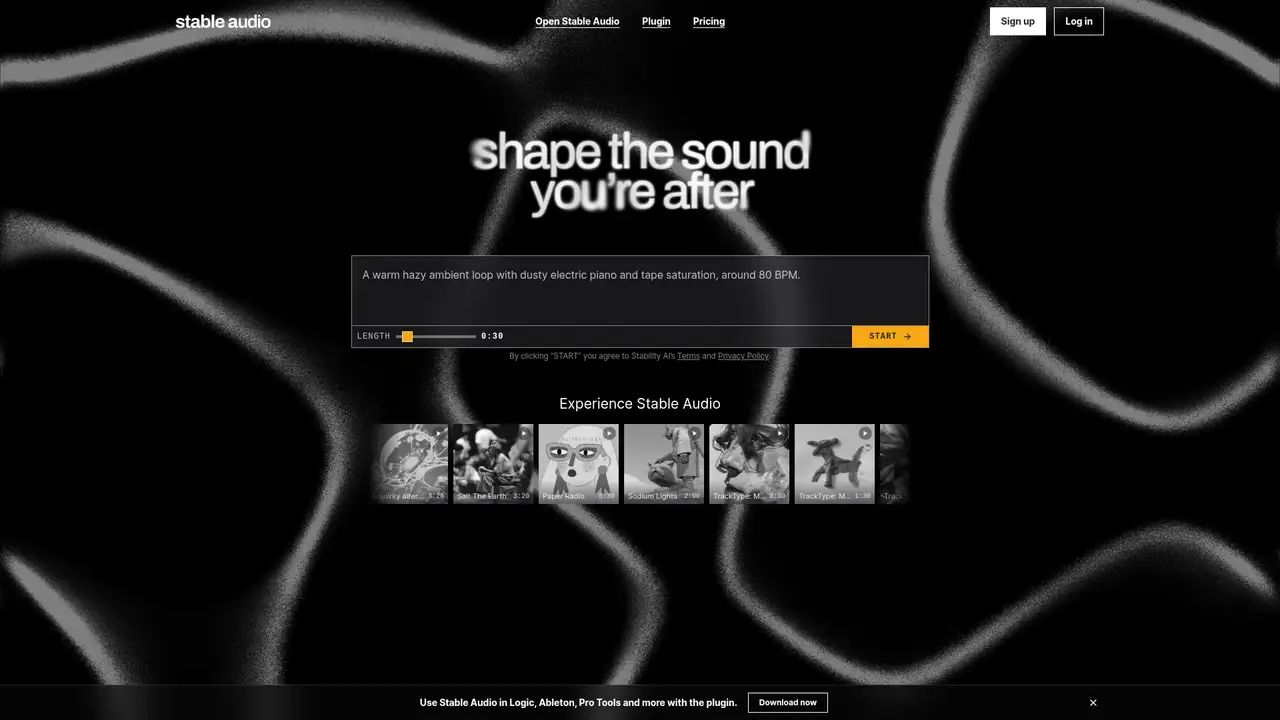
Stable Audio is Stability AI’s generative audio product, launched in September 2023 after the company’s earlier Dance Diffusion work. The first release generated stereo audio at 44.1 kHz and supported clips of up to 95 seconds, using a roughly 1.2 billion parameter latent diffusion model conditioned on text, duration, and start time. The current product centers on the Stable Audio 3.0 model family, released in May 2026. Stability AI presents it as a set of models for music composition, sound effects, on device generation, hosted API use, and enterprise deployment. The company does not publish a current Stable Audio user count or product specific funding figure. Stability AI itself raised $101 million in 2022, according to TechCrunch.
A typical web workflow starts with a text description covering genre, instruments, mood, tempo, arrangement, or sound design details. Users can select generation settings, create audio, listen to results, and download finished files. Stable Audio 3.0 adds editing functions for changing one or more sections, extending a track beyond its endpoint, and working with longer compositions. The model family supports music and sound effects, but the company says Stable Audio 3.0 does not generate singing, lyrics, or voice performances. The product is therefore better suited to instrumental beds, samples, game audio, advertising, podcasts, and production music than to complete vocal songs. Stability AI also documents LoRA training for users customizing supported open weight models on their own audio libraries.
Stable Audio 3.0 uses a semantic acoustic autoencoder designed for longer, variable length generation, together with diffusion based audio synthesis and a T5Gemma text encoder. The family contains four models: Small SFX for sound effects, Small for on device music composition, Medium for higher musical coherence and tracks up to 6 minutes 20 seconds, and Large for hosted and enterprise workloads. Stability AI released 3.0 Small SFX, Small, and Medium as downloadable weights in May 2026. Its technical report says Stable Audio 3.0 Medium can return 380 seconds of audio in 1.31 seconds on an H200 under the reported test setup. The training corpus contains 1,278,902 recordings from AudioSparx and Freesound, with published counts and partial attribution.
The hosted app gives every new account 50 free credits. Current monthly plans are Creator at $12 for 660 credits, Pro at $30 for 1,800 credits, Studio at $90 for 6,000 credits, and Max at $199 for 14,000 credits. Monthly credits reset at the start of each billing cycle and do not roll over. Users can buy additional credit packs through the web interface, and purchased credits do not expire. Credit consumption depends on the number of tracks and the process used, which makes a precise track count impossible without the generation settings. The company permits commercial use on the free and paid plans, subject to its terms and acceptable use policy. Commercial use of self hosted core models requires registration, and organizations above $1 million in annual revenue need an Enterprise license.
Stable Audio’s strongest distinction is deployment and licensing flexibility. Suno offers vocal music and a lower priced paid entry point, but its current terms include download limits and it does not provide self hostable weights. ElevenLabs Music supports vocals and describes licensed training partnerships, but it does not ship model weights and places additional restrictions on some film, television, and game uses. Mubert supports longer outputs and licensing plans, but grants a license rather than ownership. Stable Audio is a weaker choice for vocal songwriting, lyric generation, or a polished social music community. It is the better pick for instrumental production, sound design, self hosted generation, and teams that need published training data details and direct control over deployment.
Who is Stable Audio best for?
- It suits producers who need instrumental tracks, samples, and sound effects from text prompts.
- It suits developers that need downloadable weights or a hosted API for audio generation.
- It suits game teams creating background music and sound effects under commercial terms.
- It suits businesses that want published training data counts and self hosted deployment options.
Stable Audio Pricing (2026)
Pricing model: Freemium. All prices in USD.
| Plan | Price | What you get |
|---|---|---|
| Free | $0 | New accounts receive 50 free credits. Commercial use is permitted under the applicable terms, and generation consumes credits according to the selected process. |
| Creator | $12/month | Includes 660 monthly credits. Credits reset each billing cycle and unused subscription credits do not roll over. |
| Pro | $30/month | Includes 1,800 monthly credits. Credits reset each billing cycle and unused subscription credits do not roll over. |
| Studio | $90/month | Includes 6,000 monthly credits. Credits reset each billing cycle and unused subscription credits do not roll over. |
| Max | $199/month | Includes 14,000 monthly credits. Credits reset each billing cycle and unused subscription credits do not roll over. |
| Credit top ups | Custom | Additional credit packs can be purchased through the web interface. Purchased credits do not expire. |
| Enterprise | Custom | For organizations above $1 million in annual revenue and teams needing enterprise deployment, customization, support, or legal indemnification. |
Pros and Cons
Pros
- Stable Audio 3.0 Small SFX, Small, and Medium are available as downloadable weights.
- The model family supports instrumental music, sound effects, inpainting, and causal continuation.
- The company publishes counts for 1,278,902 training recordings and attribution for the Freesound subset.
- Commercial use is permitted under the applicable subscription or model license terms.
Cons
- Stable Audio 3.0 does not generate vocals, lyrics, or voice performances.
- Subscription credits expire at the billing reset and do not roll over.
- Self hosting requires attention to separate model, code, text encoder, and commercial license terms.
Who should look elsewhere?
- It is not a strong fit for vocal songs, lyrics, or synthetic voice performances.
- It is not ideal for users who want a social music platform built around sharing and remixing.
- It is not suitable for companies seeking unlimited hosted generation without credit accounting.
Technical Details
Frequently Asked Questions
How much does Stable Audio cost?
Stable Audio gives new accounts 50 free credits. Paid web plans currently start at $12 per month for 660 credits, followed by $30 for 1,800 credits, $90 for 6,000 credits, and $199 for 14,000 credits. Credits reset monthly and do not roll over. Additional credit packs are available through the web interface and do not expire.
Does Stable Audio have a free plan?
Yes. Every new account receives 50 free credits to test the service. The company says generated audio can be used commercially on the free plan, subject to its terms and acceptable use policy. Free credits are intended for hosted generation, while self hosting Stable Audio 3.0 uses the applicable model and Community License conditions.
How does Stable Audio compare with Suno?
Suno is the better choice for vocal songs, lyrics, and a consumer music creation experience. Stable Audio is stronger for instrumental audio, sound effects, downloadable weights, and self hosting. Stable Audio 3.0 supports tracks up to 6 minutes 20 seconds in Medium, while Suno supports vocals and longer generations on some plans. Their download and commercial terms also differ.
Does Stable Audio train on user uploads or generated audio?
Stability AI says uploaded audio is used during the relevant Stable Audio interaction and is not added to model training data. Generated audio may be used to improve or train Stable Audio unless the account owner turns off the training preference in StableAudio.com settings. Teams handling confidential material should review the current privacy terms and consider self hosting.
Can I use Stable Audio output commercially?
The company says commercial use is permitted for output from free, paid, and API usage, subject to its terms and acceptable use policy. Permitted examples include monetized videos, advertisements, podcasts, client projects, apps, games, streaming releases, stock music, and sample packs. Organizations above $1 million in annual revenue need an Enterprise license for covered model use.
Best Stable Audio Alternatives in 2026
These tools do the same job as Stable Audio, with different pricing, limits and trade-offs.
Prompt-driven song creation with editing, stems, and voice tools
Generate, extend, remix, and edit songs from text prompts

Prompt complete songs with vocals, structure, and commercial rights.

Royalty-free background music generated for creators and products