
Musicfy Review, Pricing & Alternatives (2026)
Turn prompts and vocal samples into songs with AI voices
Last updated: October 26, 2026
What is Musicfy?
Musicfy is a browser-based AI music service for singers, producers, and creators making generated songs, AI covers, voice conversions, and custom singing models. It advertises free access without a credit card. Paid plans start at $8 per month when billed annually, while the Professional plan at $20 per month lists a commercial license.
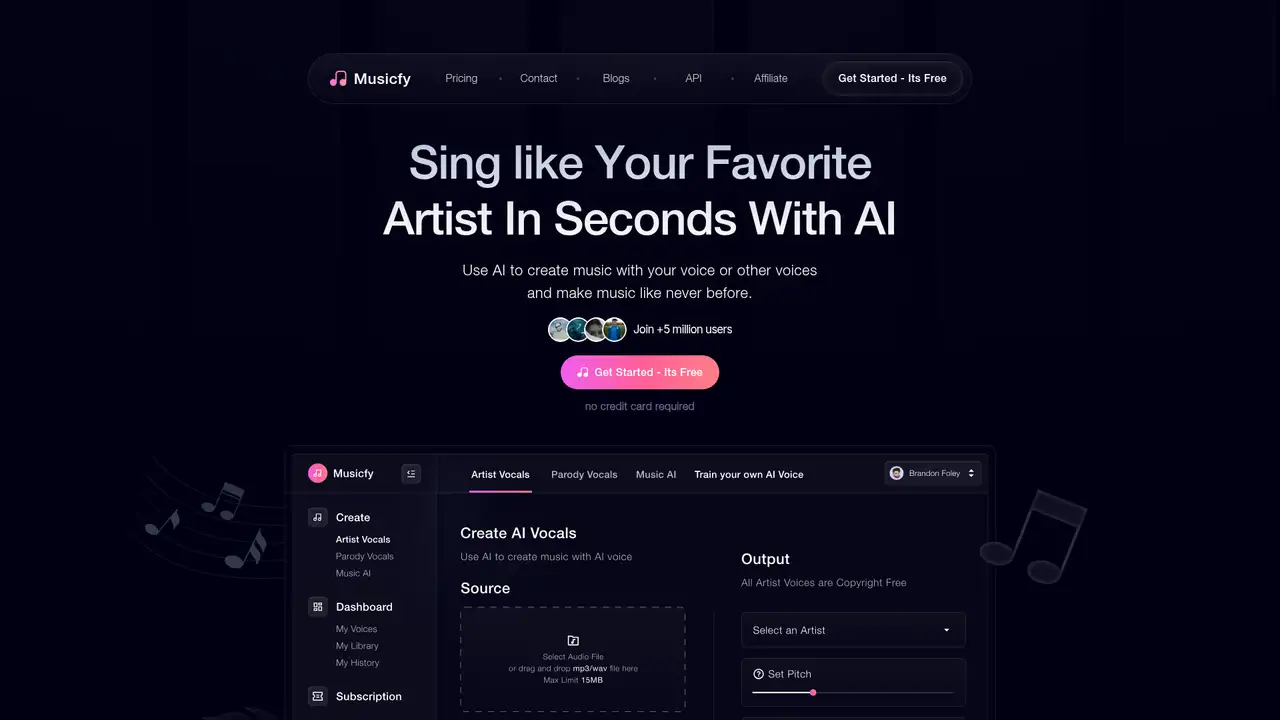
Musicfy is a browser-based AI music service with an API for singers, producers, and creators. It turns text prompts into music, applies voices to songs, converts vocals, and lets users train custom singing models from uploaded recordings. The homepage advertises free access without a credit card and reports more than five million users. Its interface is aimed at producing song ideas and vocal material without requiring a recording session or a conventional production setup. Musicfy offers AI-generated artist voices, parody voices, original-song creation, voice-to-instrument functions, and planned stem splitting. The service is hosted rather than self-hosted, so users work through its web product or API. It supports rapid drafting, but the published materials do not describe its underlying model architecture, benchmarks, or training data.
The workflow begins with either a text description of musical style and instrumentation or an uploaded vocal recording. Text-to-Music generates instrumental or song concepts, while voice conversion and voice-to-instrument tools reshape an uploaded performance. Users can select voices from Musicfy’s AI library, create a custom model using a few minutes of their voice, and generate singing with controlled notes and tempo. AI covers and parody voices provide alternate treatments of existing songs, subject to applicable rights. Multiple variations per generation support comparison before arranging a preferred result elsewhere. Professional and Studio users can target voices during generation, and Studio adds longer tracks, one-hour datasets, simultaneous training, and generation from audio. Stem splitting is listed as coming soon, so current users should not expect built-in drum, bass, and vocal isolation.
Musicfy currently presents several model categories rather than named or versioned model releases. These include text-to-music generation, AI artist voices, custom singing models, voice conversion, voice-to-instrument transformation, AI covers, and parody voices. The feature pages say a custom model can sing notes at a requested tempo after training on a short recording. Musicfy does not disclose model families, parameter counts, release dates, evaluation scores, or training datasets. For 2025 and 2026, the available product information shows expanded paid-plan capacity, including Studio’s larger uploads, longer datasets, simultaneous training, studio-grade audio, and generation from audio. The homepage still labels stem splitters as coming soon. No separate 2025 or 2026 named model launch is documented, so claims beyond these listed capabilities remain unverified.
Musicfy advertises a free tier with no credit card, but it does not publish the free quota. Starter costs $8 per month when billed annually and includes 150 songs monthly, two custom voices, 25 MB uploads, master-quality output, multiple variations, and no voice targeting. Professional costs $20 monthly annually and provides 400 songs, including 100 with voice targeting, six voices, 100 MB uploads, faster speed, and a commercial license. Studio costs $56 monthly annually and provides 1,000 songs, including 300 targeted generations, 30 voices, 150 MB uploads, one-hour datasets, simultaneous training, and a commercial license. The API charges $0.07 per minute of successful generated audio, with a default $100 billing-period quota and invoices every two weeks.
Musicfy does not replace a multitrack DAW or detailed mix editor, and it publishes no model cards, benchmark results, or training-data documentation. Its privacy policy dates from March 2023 and its terms from September 2023. The FAQ says recordings and voice models are private, while commercial licensing is explicitly listed only for Professional and Studio. Suno and Udio focus more broadly on full-song generation, Kits AI concentrates on vocal production and voice tools, and Fadr emphasizes stem separation and remixing. Musicfy therefore offers a wider combination of prompt-based songs and custom singing voices than Kits AI, but less documented model detail and less production-focused separation than Fadr. Choose Musicfy for fast voice-led drafts and custom singing models, especially when a commercial tier is required.
Who is Musicfy best for?
- It suits creators making quick AI vocal demos and social-ready song ideas.
- It suits singers creating custom voice models from their own recordings.
- It suits producers needing multiple vocal variations before arranging in a DAW.
- It suits commercial users selecting the Professional or Studio license tiers.
Musicfy Pricing (2026)
Pricing model: Freemium. All prices in USD.
| Plan | Price | What you get |
|---|---|---|
| Free | $0/month | Free access without a credit card is advertised. The exact free generation quota is not published. |
| Starter | $8/month | Billed annually. Includes 150 songs monthly, two custom voices, 25 MB uploads, no voice targeting, master-quality output, and multiple variations. |
| Professional | $20/month | Billed annually. Includes 400 songs monthly, 100 with voice targeting, six custom voices, 100 MB uploads, faster speed, and a commercial license. |
| Studio | $56/month | Billed annually. Includes 1,000 songs monthly, 300 with voice targeting, 30 custom voices, 150 MB uploads, one-hour datasets, simultaneous training, and a commercial license. |
| API | $0.07/minute | Successful generated-audio responses are billed per minute. Each account has a default $100 billing-period quota cap, with invoices issued every two weeks. |
Pros and Cons
Pros
- Musicfy combines text-to-music, voice conversion, custom voices, and AI covers.
- Professional and Studio publish concrete monthly song and upload limits.
- The FAQ says recordings and voice models are stored privately for each user.
- The API publishes a per-minute price for successful generated audio.
Cons
- Musicfy does not publish model architecture, benchmark results, or training-data details.
- Stem splitting remains labeled as coming soon on the public homepage.
- The privacy policy and terms have 2023 update dates.
Who should look elsewhere?
- It is not a replacement for a full multitrack DAW or detailed mix editor.
- It is not suitable for buyers requiring published model cards or training-data documentation.
- It is not ideal for commercial releases on Starter because its listed commercial license starts higher.
Technical Details
Frequently Asked Questions
How much does Musicfy cost?
Musicfy advertises free access, then lists Starter at $8 per month, Professional at $20 per month, and Studio at $56 per month when billed annually. The pricing page also displays annual totals of $190, $590, and $1,200. API generation is separate at $0.07 per minute for successful generated-audio responses.
Does Musicfy have a free plan?
Yes. Musicfy advertises free access without a credit card, but the current pricing page does not state an exact free quota. Published paid limits are 150 songs monthly for Starter, 400 for Professional, and 1,000 for Studio, with voice-targeting allowances on Professional and Studio.
Musicfy or Kits AI: which is better?
Musicfy is the broader song-creation service, combining prompts, AI covers, voice conversion, and custom singing models. Kits AI focuses more on vocal production and artist voice tools. Choose Musicfy for generated song ideas and choose Kits AI when vocal transformation and production workflows matter more than text-to-song features.
Does Musicfy train on uploaded recordings?
Musicfy says users can upload vocals to train custom voice models, and its FAQ says recordings and voice models are stored privately. Its public privacy page does not explain current model-training retention or whether uploads improve shared models. Upload recordings only when you control the necessary rights, and review the terms before submission.
Can Musicfy output be used commercially?
Musicfy’s FAQ says generated music belongs to the user and describes mechanical and recording rights. Its current pricing page explicitly lists a commercial license for Professional and Studio, not Starter. Commercial users should confirm the applicable plan license, voice permissions, and third-party rights before distributing a release.
Best Musicfy Alternatives in 2026
These tools do the same job as Musicfy, with different pricing, limits and trade-offs.