
Google Jules Review, Pricing & Alternatives (2026)
An asynchronous coding agent that turns GitHub tasks into pull requests
Last updated: October 26, 2026
What is Google Jules?
Google Jules is an asynchronous coding agent for developers maintaining GitHub repositories. It runs tasks in fresh cloud virtual machines, proposes plans, edits files, runs setup commands, and can publish pull requests. The free tier costs $0/month and includes 15 tasks per rolling 24 hours, while higher limits come through Google AI Pro and Ultra plans.
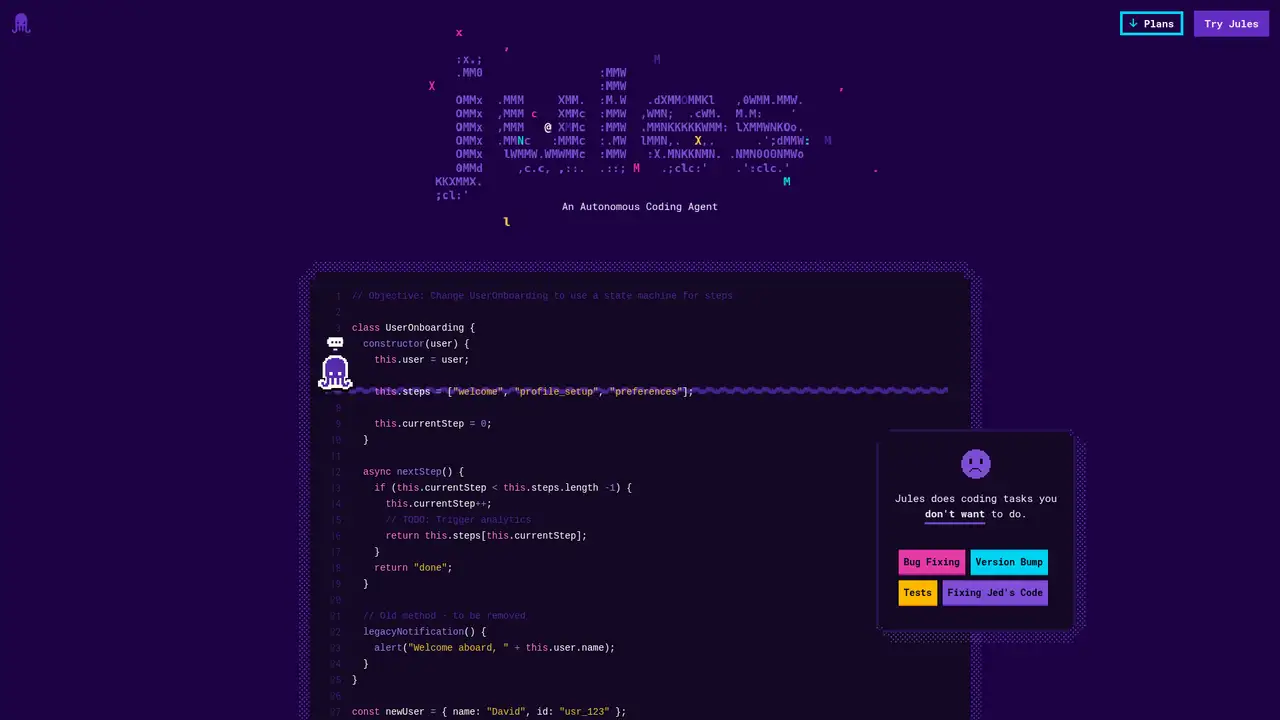
Google Jules is an asynchronous coding agent made by Google and introduced publicly in 2025. It connects to GitHub repositories, runs assigned work in fresh cloud virtual machines, and returns code changes, tests, and pull requests. The company says Jules supports bug fixes, documentation, dependency updates, tests, and feature work. Google identifies the product as experimental and currently in Public Beta. The service is active rather than acquired, renamed, pivoted, or shut down. Its free tier allows 15 tasks in a rolling 24-hour period and three concurrent tasks. Higher allowances come through Google AI Pro and Ultra subscriptions. Paid Jules access is currently available through individual Google Accounts ending in @gmail.com, which limits its immediate fit for some business teams.
Jules starts with a connected GitHub repository, a branch, and a specific prompt. It clones the repository into a fresh cloud virtual machine, installs dependencies, follows optional setup scripts, and generates a plan before changing code. Users can review the plan, approve execution, and inspect the resulting diff and test output. Jules can publish current work as a branch or pull request, allowing normal GitHub review before merging. An AGENTS.md file at the repository root can describe project conventions and tool usage. Scheduled tasks automate recurring maintenance, while Suggested Tasks can identify TODO comments on up to five repositories for Pro and Ultra subscribers. Notifications let users leave the browser while a task runs.
Jules uses Gemini models inside isolated cloud virtual machines. Gemini 3 Flash became the base model for all tiers on January 30, 2026. Gemini 3.1 Pro replaced Gemini 3 Pro as the default model for Pro users on March 9, 2026. The January 2026 releases added a Planning Critic, performance suggestions, MCP support, automatic CI failure fixing, repoless sessions, downloadable file outputs, and activity filters. Earlier releases added the public REST API, command-line tools, repository environment variables, web search, scheduled tasks, and Suggested Tasks. The company says the Planning Critic reduced task failure rates by 9.5%. Jules supports projects in JavaScript or TypeScript, Python, Go, Java, and Rust, with results depending on installed tools and setup clarity.
The free Jules tier costs $0/month and provides 15 tasks per rolling 24 hours with three concurrent tasks. Jules in Pro provides 100 rolling-window tasks and 15 concurrent tasks, while Jules in Ultra provides 300 and 60. Google bundles those paid allowances with Google AI Pro and Google AI Ultra rather than publishing a standalone Jules price. Task limits reset on a rolling 24-hour basis, not at a fixed midnight boundary. Family-plan allowances are not pooled, and reaching a cap blocks new tasks while existing work remains accessible. The free tier is enough for occasional repository maintenance. Costs rise when a developer needs higher throughput, greater concurrency, or paid model access through a Google AI subscription.
Jules remains a Public Beta service, and its cloud execution model requires code review and security discipline. Tasks run in internet-connected virtual machines, so Google advises users not to expose secrets and to inspect commands, dependencies, setup scripts, and non-code files. Long-running processes such as development servers and watch scripts are unsupported. GitHub Copilot is stronger for interactive editor assistance, while Jules is built around asynchronous plans, tests, diffs, and pull requests. OpenAI Codex and Claude Code are closer repository-agent alternatives, though their models, interfaces, and account requirements differ. Jules also has a narrower business purchasing path because paid access currently uses individual Gmail accounts. Choose Jules for background GitHub maintenance when that workflow matters more than enterprise administration or live editor help.
Who is Google Jules best for?
- Developers assigning asynchronous maintenance work to GitHub repositories.
- Teams that want generated diffs, tests, and pull requests.
- Users who need scheduled repository maintenance tasks.
- Developers comfortable reviewing code from cloud VM execution.
Google Jules Pricing (2026)
Pricing model: Freemium. All prices in USD.
| Plan | Price | What you get |
|---|---|---|
| Jules | $0/month | 15 tasks per rolling 24 hours and 3 concurrent tasks. |
| Jules in Pro | Included with Google AI Pro | 100 tasks per rolling 24 hours and 15 concurrent tasks. |
| Jules in Ultra | Included with Google AI Ultra | 300 tasks per rolling 24 hours and 60 concurrent tasks. |
Pros and Cons
Pros
- Each task runs in a fresh cloud virtual machine.
- The free tier includes 15 rolling daily tasks.
- Jules can publish branches and pull requests.
- The API supports CI, Slack, Linear, and Jira integrations.
Cons
- Paid plans currently target individual Gmail accounts.
- Long-running commands are unsupported in setup scripts.
- Rolling task and concurrency limits restrict throughput.
Who should look elsewhere?
- Teams requiring standard enterprise Workspace procurement.
- Projects that depend on long-running development servers.
- Developers wanting only interactive editor autocomplete.
Technical Details
Frequently Asked Questions
How much does Jules cost?
Jules has a free tier priced at $0/month with 15 tasks per rolling 24 hours and three concurrent tasks. Google does not publish a standalone Jules subscription price. Jules in Pro is included with Google AI Pro, while Jules in Ultra is included with Google AI Ultra. Paid access currently applies to individual Google Accounts ending in @gmail.com.
Is Jules free?
Yes. The free Jules tier provides 15 tasks per rolling 24 hours and three concurrent tasks. After reaching that allowance, new tasks cannot start until the rolling window resets. Users can still review and manage existing tasks, while task history and feedback remain available. The free plan suits occasional fixes, documentation updates, and small dependency changes.
How does Jules compare with GitHub Copilot?
Jules focuses on autonomous, asynchronous repository work. It creates a plan, edits files in a cloud VM, runs discrete commands, and can publish a branch or pull request. GitHub Copilot is primarily an interactive coding companion inside supported editors and GitHub workflows. Jules suits background maintenance, while Copilot suits continuous in-editor assistance and rapid code completion.
Does Jules train on private repositories?
Google says Jules does not train on private repository content. Jules still clones repositories and executes code in a cloud virtual machine with internet access. Google advises users to avoid committing API keys, tokens, and credentials, and to review third-party packages, shell commands, setup scripts, and other code before running tasks.
Can Jules be used commercially?
Jules can work with repositories selected through a connected GitHub account, including commercial code, subject to Google’s terms, Google AI plan terms, GitHub permissions, and dependency licenses. Paid Jules access currently targets individual Gmail accounts, which can make procurement less direct for organizations using Workspace accounts. Teams should review applicable terms before deployment.
Best Google Jules Alternatives in 2026
These tools do the same job as Google Jules, with different pricing, limits and trade-offs.
An agentic coding assistant for terminal, IDE, desktop, and web
AI coding assistance across editors, terminals, and GitHub
AI coding workspace with repository context and software agents

AWS-integrated coding help for IDEs, terminals, and cloud operations
A cloud and terminal agent for writing, testing, and reviewing code